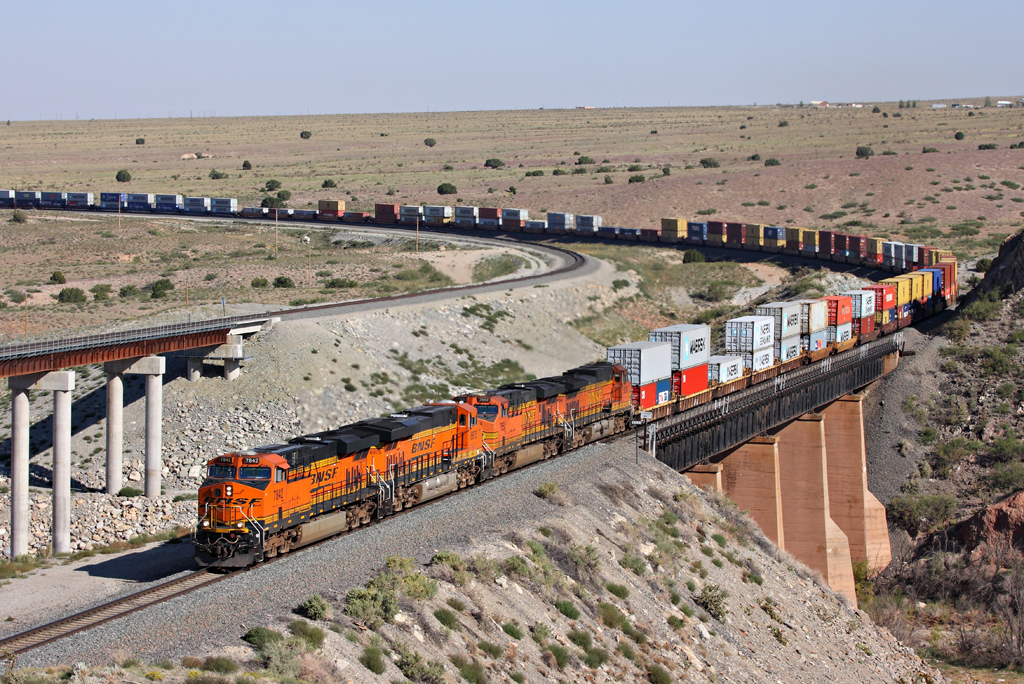
Abo Canyon (BNSF)
Abo Canyon, located in New Mexico, is a renowned train observation spot along the BNSF Railway. This scenic area features a series of bridges and tunnels that navigate through rugged terrain, offering train enthusiasts a unique vantage point to witness the impressive engineering and frequent train traffic.
Photos
 chief_huddleston
4
Trainspotting Experience
Expect fast, frequent, heavy freight. Trains charge upgrade at a visible crawl in the eastbound direction and roar downgrade westbound, amplifying wheel squeal against the canyon walls. The recently completed double track means meets and overtakings are common, often within direct line-of-sight of the viewer. From the pull-outs along U.S. Route 60, railfans can watch dynamics unfold in real time—distributed-power units shoving hard on the rear, head-end locomotives in run 8, and mid-train helpers working in concert. The ruling grade through the pass does not exceed 1.25%, though operational dynamics still produce dramatic audio-visual effects as tonnage navigates the tight curves and canyon acoustics. The rumble reverberates through the narrow gorge, making even routine intermodal consists feel larger than life. Nights bring piercing headlights that illuminate the cliff faces and create dramatic time-exposure opportunities, while daytime visits reward patience with a parade of colorful motive power sets.
Landscape, Setting & Local Atmosphere
Abo Canyon slices through the eastern flank of the Manzano range at roughly 5,700 ft elevation. The surroundings feature weather-sculpted sandstone, dotted piñon and juniper, and broad vistas toward the high desert plains. Spring and fall offer mild temperatures and crystal-clear air; summer afternoons can spike above 90 °F but often conclude with thunderheads that add drama to skyline compositions. Winters are generally dry, yet a rare snow dusting paints the red cliffs white, giving photographers a striking seasonal contrast. Wind is a constant companion, funneling through the cut and carrying the distant horn blasts long before each train appears.
Type & Frequency of Train Activity
Abo Canyon anchors BNSF’s busy Clovis-Gallup segment, a core artery between the West Coast and the Midwest. Reliable railfan counts place daily movements in the 70–80 range, with peaks exceeding 90 during holiday surges. Intermodal and priority merchandise dominate, typically stretching 7,000–8,500 ft. Grain, ethanol, crude oil, and mixed manifest trains add variety, while unit coal and auto racks appear less frequently. Motive power is overwhelmingly BNSF orange, yet foreign-line leaders—Union Pacific, Norfolk Southern, CSX, Kansas City Southern, and Canadian carriers—are regular catches on run-through agreements. No scheduled Amtrak or commuter service traverses the pass.
Best Angles for Photos & What Railfans Enjoy Most
- West Portal Cut: From the public pull-off near MP 895, photographers can frame eastbounds exiting the canyon with layered sandstone walls as a backdrop; late afternoon light side-illuminates locomotives perfectly.
- East End Overlook at Scholle: A short hike up the hillside north of the highway grade crossing provides an elevated perch where both mains curve under the photographer—ideal for wide-angle shots showcasing double-track meets. Morning light favors this angle.
- High Desert Panoramas: West of the canyon mouth, open plains allow long-lens captures of entire trains snaking into the gorge, with the Manzano crest in background. Golden-hour side light makes railcars glow against desert grasses.
- Nighttime Light Trails: The confined rock walls concentrate locomotive light, enabling dramatic long exposures from safe highway shoulders without trespassing on railroad property.
Railfans prize Abo for its audio signature; the canyon’s echo chamber magnifies prime-mover notches, making recordings as compelling as photographs.
Historical or Cultural Relevance
The rail line through Abo Pass opened in 1908 as part of the Atchison, Topeka & Santa Fe's shortcut to the southeast, known as the Belen Cutoff. For a century it remained single-track, creating the notorious "Abo bottleneck." BNSF's ambitious double-tracking project began in October 2008 and was completed ahead of schedule on June 3, 2011. The project required blasting approximately 3.6 million tons of rock and constructing nine new bridges totaling about 3,000 feet in length, an engineering feat that eliminated the last major single-track gap on the 2,200-mile Southern Transcon. Just east of the canyon lie the 17th-century ruins of the Abo Pueblo mission, now preserved within Salinas Pueblo Missions National Monument, tying centuries of human movement through the same natural corridor.
What Makes This Spot Different
Unlike open-desert locations farther west, Abo compresses six miles of railroad into a canyon barely a quarter mile wide, producing intimate views of Class I mainline operations usually seen only from cab videos. The topography forces trains to work visibly and audibly harder, allowing enthusiasts to study distributed-power physics in action. Add the blood-red cliffs and high-country vegetation, and the result is a setting that feels simultaneously Southwestern and mountainous—an uncommon combination on BNSF’s predominantly flat Transcon.
Frequently Asked Questions
QHow many trains pass through Abo Canyon daily?
Approximately 90-100+ trains traverse Abo Canyon each day, making it one of the busiest rail corridors in the western United States. Peak traffic can exceed 100 trains daily during holiday surges.
QWhat is the best time of day to photograph trains here?
Late afternoon light (2-5 PM) works beautifully at the west portal cut near MP 895, side-illuminating locomotives against the sandstone walls. Morning light (7-10 AM) favors the east end overlook at Scholle for elevated shots of double-track meets. Golden hour provides excellent side lighting for long-lens captures of entire trains entering the gorge.
QIs Abo Canyon accessible year-round?
Yes, U.S. Route 60 through the canyon remains open year-round. However, winter weather can occasionally create challenging driving conditions. The high-altitude location (~5,771 ft) means snow is possible from November through March, though the area is generally dry.
QCan I access the railroad tracks for photography?
No. All railroad property is strictly off-limits and trespassing is both illegal and extremely dangerous. Excellent viewing and photography opportunities are available from public pull-offs along U.S. Route 60 without trespassing.
QWhat types of trains will I see?
The vast majority of traffic consists of BNSF intermodal and priority merchandise trains, typically 7,000-8,500 feet long. You'll also see grain, ethanol, crude oil, and mixed manifest trains. Motive power is predominantly BNSF orange, though foreign-line leaders (UP, NS, CSX, KCS, Canadian carriers) appear regularly on run-through agreements. No scheduled passenger service operates through the canyon.
QAre there facilities or amenities at the viewing locations?
No. The canyon viewing areas are remote with no restrooms, shelters, or services. Bring water, sun protection, and snacks. The nearest town with amenities is Mountainair, approximately 10-15 miles east.
Safety Tips
Observe trains from designated public pull-offs along U.S. Route 60 only. Never trespass on BNSF railway property. The canyon experiences strong winds that can create hazardous conditions; BNSF installed a 1,300-foot wind fence at MP 874.2 to help mitigate wind impacts on trains. Stay clear of active tracks and obey all signage. Canyon acoustics can make approaching trains difficult to gauge; always assume a train is closer than it sounds.
Seasonal Information
Abo Canyon in New Mexico offers stunning train views year-round. Spring and fall provide mild weather and vibrant scenery. Summer has longer daylight but can be hot. Winter offers picturesque snow scenes but check for delays. The rugged terrain and engineering marvels make it a prime spot for train enthusiasts.
Nearby Lodging
- Rock Motel
Local motel in Mountainair offering basic, affordable accommodations. Convenient for rail photography trips to Abo Canyon.
- Turner Inn & RV Park
Combination motel and RV park in Mountainair with camping facilities and basic lodging options.
- Manzano Mountains State Park Campground
23 developed campsites (9 with electric hookups) nestled in wooded foothills at 7,250 ft. Peaceful retreat for railfans who enjoy camping. Located about 16 miles north of Mountainair.
- Albuquerque Hotels
Wide range of lodging options in Albuquerque (approximately 70 miles west via I-40). Suitable for those who prefer more amenities and don't mind the drive.
Nearby Attractions
5 miles / 8 km
Three 17th-century Spanish mission ruins (Abó, Quarai, and Gran Quivira) preserving the intersection of Puebloan and Spanish colonial history. The monument headquarters is in Mountainair with the Abó site being closest to the canyon.
16 miles / 26 km
Wooded state park at 7,250 ft elevation offering camping, hiking trails (3.5 miles), bird-watching, and photography opportunities. Popular base camp for exploring the region.
8 miles / 13 km
One of three sites within Salinas Pueblo Missions National Monument, featuring the best-preserved mission church ruins with impressive sandstone walls. Located about 8 miles north of Mountainair.
25 miles / 40 km
The largest and most remote of the three Salinas mission sites, located on a mesa at 6,500 ft with expansive views. Features partially excavated pueblo ruins and an uncompleted mission church.
External Links
Looking for more spots? Browse the complete list of train spotting locations.
Quick Information
Country
USA
Region
New Mexico
City
Mountainair
Spot Type
Scenic Overlook
Best Times
The best hours to observe trains in Abo Canyon are during daylight, especially morning and late afternoon, to capture frequent BNSF traffic and optimal lighting.
Train Activity
Frequency
Approximately 90-100+ trains daily
Access & Amenities
Parking
Not available
Shelter
Not available
Restrooms
Not available