Railfan field guide
Railfan Gear: What to Carry, by Budget
Cameras that recognise trains, telephoto zooms, railroad scanners and the kit that keeps you safe and dry — chosen by criteria, not by ranking.
Specifications and list prices read on the makers’ own pages in September 2026. We have not tested this equipment, and nothing here is sponsored.
As an Amazon Associate I earn from qualifying purchases. How we pick our gear
- camera makers whose product pages name trains in their autofocus detection
- 4
- the VHF band coordinated for railroads in the US and Canada
- 160–161 MHz
- to start: the phone in your pocket already shoots bursts
- $0
The Short Version
Trainspotting gear has one job that studio reviews never test: a subject that arrives once, fast, in whatever light and weather the day hands you, with no second take. So buy for autofocus that tracks a train, reach — you are standing back, on public ground — and weather sealing, in that order. Megapixels come last.
Our buying philosophy has not changed: buy fewer things, but buy the things that survive the trip. What is new is that camera makers now say, on their own product pages, whether their autofocus recognises trains. That is a fact we can read and link — so this guide is built on it, rather than on opinions we are not qualified to give.
Three Kits, by Budget
Kit 1 · The phone you own
Start here
- Burst: on an iPhone, swipe the shutter button to the left. A Pixel takes its own burst with Top Shot.
- Lock focus and exposure where the train will be: touch and hold until AE/AF Lock appears (iPhone), or tap the subject, then Lock (Pixel).
- A power bank, a notebook and a high-visibility layer.
Kit 2 · First camera
Body + one telephoto zoom
- A body whose autofocus recognises trains (section 02).
- One stabilised telephoto zoom, 70–300 or 100–400 mm (section 03).
- A spare battery, a fast memory card, a rain cover.
- At list prices, the Canon EOS R8 with the RF 100–400 mm comes to about $2,049.
Kit 3 · All weather, all day
Sealed body, scanner, binoculars
- A weather-sealed body and a sealed lens — check both, not just one.
- A scanner that covers the railroad band (section 05).
- 8x42 binoculars to pick up a headlight early (section 06).
- A bag you can work out of without putting it on the ground.
Cameras Whose Autofocus Recognises Trains
Subject detection is the biggest change in cameras for this hobby: the autofocus finds the front of the train and stays on it while you frame. But makers are precise about what each model detects, and the word matters. Every body below has the word trains on its official product page. Several cheaper models detect “vehicles” without naming trains — Nikon's Z50II and Z5II, for instance — and some entry-level bodies have no vehicle detection at all.
| Camera | Sensor | What the maker writes | Burst | Weather sealing | List price |
|---|---|---|---|---|---|
| Canon EOS R8 | Full frame | Vehicle detection covers “cars, motorcycles, trains, and airplanes” | Not stated on the page we read | No claim on the page we read | $1,349 |
| Canon EOS R5 Mark II | Full frame | “Trains and aircraft can all be detected” | Up to 30 fps (electronic shutter) | “Dust and water-resistant design” | $3,999 |
| Nikon Z6III | Full frame | Detects “airplanes, cars, motorcycles, bicycles and trains” | 20 fps RAW, 60 fps JPEG at full resolution | Same dust- and drip-resistance as the Z8, per Nikon | $2,000 |
| Nikon Z8 | Full frame | Detects “vehicles, bicycles and trains” | Up to 120 fps (11 MP JPEG) | “Premium Weather Sealing” | $3,400 |
| Fujifilm X-M5 | APS-C | Detects “cars, motorcycles, bicycles, airplanes, trains” | About 30 fps (electronic shutter, cropped) | No claim on the page we read | Not displayed |
| Fujifilm X-H2S | APS-C | Detects “airplanes, and trains” | 40 fps with autofocus | “79 weather-sealed points”, rated to −10 °C | Not displayed |
| OM System OM-3 | Micro Four Thirds | Lists “Bullet trains”, “Standard trains” and “Steam locomotives” | 50 fps with continuous autofocus | IP53, splashproof, dustproof, freezeproof to −10 °C | $1,700 |
| OM System OM-1 Mark II | Micro Four Thirds | Lists “Bullet trains”, “Standard trains” and “Steam locomotives” | 50 fps with continuous autofocus | IP53 | $2,000 |
Sony is missing from this table for one reason only: we could not open Sony's official pages on the day we checked, and we do not write what we have not read. List prices are those displayed on each maker's US site in September 2026, promotions included.
Telephoto Zooms: One Lens Does Most of the Work
From a sidewalk, an overpass or a viewing platform, the train is rarely close. A zoom that reaches 300 or 400 mm covers the distant approach, the three-quarter shot and the scenic view without changing lenses in the dust. One per system, the most affordable each maker offers in that range:
| Lens | Reach | Stabilisation | Weather sealing | Weight | List price |
|---|---|---|---|---|---|
| Canon RF100-400mm F5.6-8 IS USM | 100–400 mm | Optical IS, 5.5 stops | None — Canon says so in the spec table | 635 g | $700 |
| NIKKOR Z DX 50-250mm f/4.5-6.3 VR | 50–250 mm (DX lens: about 75–375 mm equivalent) | VR | No claim on the page we read | 405 g | $410 |
| FUJINON XF70-300mmF4-5.6 R LM OIS WR | 70–300 mm (107–457 mm equivalent) | OIS, up to 5.5 stops | Dust- and moisture-resistant, rated to −10 °C | 580 g | $750 |
| M.Zuiko Digital ED 100-400mm F5.0-6.3 IS | 100–400 mm (200–800 mm equivalent) | Built-in IS, up to 3 stops | “Hermetically sealed” barrel | 1,120 g | $1,200 |
- Canon RF. The least expensive full-frame body whose autofocus names trains. Canon states that its budget 100–400 mm has no dust or weather resistance.
- Nikon Z. Train detection starts at the Z6III: the Z50II and Z5II pages name “vehicles” but not trains. Nikon sells no budget full-frame telephoto zoom — the affordable one is a DX (APS-C) lens.
- Fujifilm X. The only maker here whose cheapest body names trains. APS-C sensors: the 70–300 mm frames like a 107–457 mm on full frame.
- OM System. The most specific detection list of all — standard trains, bullet trains and steam locomotives — and IP53-rated sealing. Micro Four Thirds: the 100–400 mm frames like a 200–800 mm.
Which shutter speed to use with them is in the train photography guide, with a simulator that shows what motion blur looks like.
Build a Kit
Pick a system and a body; the page pairs it with that system's telephoto zoom and adds up the list prices when the maker publishes both.
Try it — build a kit
Your kit
- Canon EOS R8 — Vehicle detection covers “cars, motorcycles, trains, and airplanes”. The maker’s page makes no weather-sealing claim.
- Canon RF100-400mm F5.6-8 IS USM — 100–400 mm, Optical IS, 5.5 stops, 635 g. None — Canon says so in the spec table.
List price, body and lens: about $2,049.
Manufacturer list prices in US dollars, as displayed on their US sites in September 2026. Add a spare battery and a memory card.
Railroad Scanners
Railroad radio in North America is unencrypted, and a scanner is the classic early warning: hear a defect detector up the line and you know a train is coming. The one specification that matters is the band. The frequency coordinator owned by the Association of American Railroads describes itself as the only designated coordinator for 160.215–161.565 MHz — the VHF railroad band. Any scanner that covers it will do, and the analog BC125AT below comes with a preset Railroad search. Laws on carrying and using a scanner differ from place to place: check yours before you buy.
| Scanner | Type | Railroad coverage | Power | List price |
|---|---|---|---|---|
| Uniden BC125AT | 500-channel analog handheld | Preset “Railroad” service bank; covers 137–174 MHz | 2 AA batteries (Ni-MH or alkaline), or USB | $170 |
| Uniden SDS100 | Digital handheld | “Railroad” service type in the owner’s manual | Lithium-ion battery pack | $700 |
Every scanner in our catalogue, with the hands-on test behind it, is in the radio scanner comparison.
No scanner yet? Free live feeds carry many of the same channels — the tracking guide lists them, and explains what a defect detector tells you.
Binoculars: Read the Two Numbers
A pair of binoculars earns its place on a long, straight line: you see the headlight minutes before you hear the train. Nikon's explainer gives the rule for reading the label — the number before the “x” is the magnification, and the second is the diameter, in millimetres, of the two front lenses. An 8x42 magnifies eight times through 42 mm lenses; a 10x42 brings the train closer but shakes more in the hand and shows a narrower slice of the line. For watching trains, steadiness and a wide view usually win.
Safety and Comfort: The Cheap Gear That Matters Most
A high-visibility layer is not a permit
Wear one so that drivers and train crews see you on the public roadside — never as a way to look official on railroad property. High-visibility garments are graded in performance classes under ANSI/ISEA 107; OSHA asks for class 2 or 3 for people working beside traffic, and the ISEA describes three classes scaled to the hazard. Where you may stand is in the safety guide.
Pro tips for your next trainspotting session
- Carry backup batteries and memory cards at all times — cold drains lithium faster than you expect.
- Invest in a rugged, weatherproof bag; the first time a squall rolls through a yard, it pays for itself.
- A lightweight travel tripod that you actually carry beats a heavy one that lives in the trunk.
- Keep a paper or offline copy of train schedules — cell coverage in good spotting locations is famously unreliable.
- Clean your front element before every session; sensor dust is fixable in post, but a smudged lens often is not.
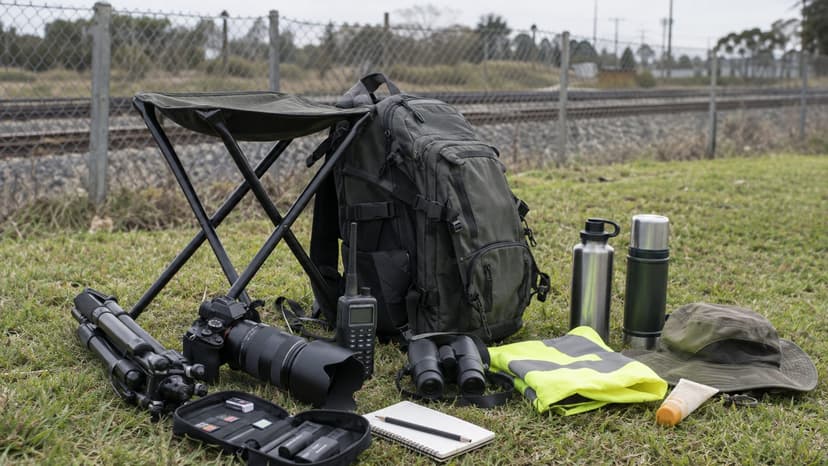
- Water, sun protection and a folding stool: most of trainspotting is waiting.
What Not to Buy (Yet)
- More megapixels. Every camera in this guide has more resolution than a screen or a print will show. Autofocus and reach make the difference between a sharp train and a soft one.
- A top-of-the-range scanner, to begin with. The analog models above already list a Railroad search. Upgrade when you know what you are missing.
- A heavy tripod. Trains are shot at fast shutter speeds; you need support at night and for video, and several station operators ask you to avoid tripods anyway.
- A drone, until you have read the rules that apply near a railway — they are in the safety guide.
Think a product is missing, or no longer deserves its place? The contact form takes thirty seconds — we read everything.
Browse the Gear Catalogue
Product pages written for railfans, and comparisons sorted by use rather than ranked. Every product passed the same checks, and where a category needs a hands-on test, a named source has tested it.
As an Amazon Associate I earn from qualifying purchases. How we pick our gear
Photo & video
Listening & tracking
In the field
Frequently Asked Questions
What is the best camera for trainspotting?
There is no single best one, and we have not tested any: what matters is an autofocus that tracks a moving train, a fast burst and, if you shoot in bad weather, a sealed body. Several makers now write on their own product pages that their subject detection recognises trains — Canon (EOS R8, EOS R5 Mark II), Nikon (Z6III, Z8), Fujifilm (X-M5, X-H2S) and OM System (OM-3, OM-1 Mark II). Any of them, with a telephoto zoom, will do the job.
Do I need an expensive camera to start trainspotting?
No. A phone is enough to start: use burst mode and lock focus and exposure on the spot where the train will be. Spend on a camera when you know what the phone cannot do for you — usually reach, for trains that are far away, and autofocus at dusk.
What lens do I need to photograph trains?
A telephoto zoom covering roughly 70–300 mm or 100–400 mm handles most trackside situations, because you are usually standing well back from the line on public ground. Look for image stabilisation, and for weather sealing if you shoot in rain or snow: Canon states its budget RF 100–400 mm has none, while Fujifilm and OM System describe their equivalents as sealed.
What scanner do railfans use?
Any scanner that covers the VHF railroad band. In the United States and Canada the band coordinated for railroads is 160.215–161.565 MHz. Uniden’s BC125AT is an analog handheld with a preset Railroad search, and its manual lists coverage of 137–174 MHz. Check the law on scanner use where you live before you buy one.
What do the numbers on binoculars mean?
The first number is the magnification and the second is the diameter of the front lenses in millimetres: an 8x42 magnifies eight times through 42 mm lenses. Lower magnification is easier to hold steady and gives a wider view, which helps when you are picking up a headlight far down the line.
Official Sources
Every rule and figure in this guide comes from a page we opened and read in September 2026. Laws change: follow the link before you rely on one.
- Canon — Canon EOS R8
- Canon — Canon EOS R5 Mark II
- Nikon — Nikon Z6III
- Nikon — Nikon Z8
- Fujifilm — Fujifilm X-M5
- Fujifilm — Fujifilm X-H2S
- OM System — OM System OM-3
- OM System — OM System OM-1 Mark II
- Canon — Canon RF100-400mm F5.6-8 IS USM
- Nikon — NIKKOR Z DX 50-250mm f/4.5-6.3 VR
- Fujifilm — FUJINON XF70-300mmF4-5.6 R LM OIS WR
- OM System — M.Zuiko Digital ED 100-400mm F5.0-6.3 IS
- Uniden — Uniden BC125AT
- Uniden — Uniden SDS100
- AAR frequency coordinator (MxV Rail) — Railroad band 160.215–161.565 MHz
- Nikon — How to read the numbers on a binocular
- OSHA — Work zone traffic safety (high-visibility garments)
- International Safety Equipment Association — High-visibility products
- Apple — Take Burst mode shots with your iPhone camera
- Apple — Set up your shot: AE/AF Lock
- Google — Pixel Camera: focus and exposure lock
- Google — Pixel Camera: Top Shot