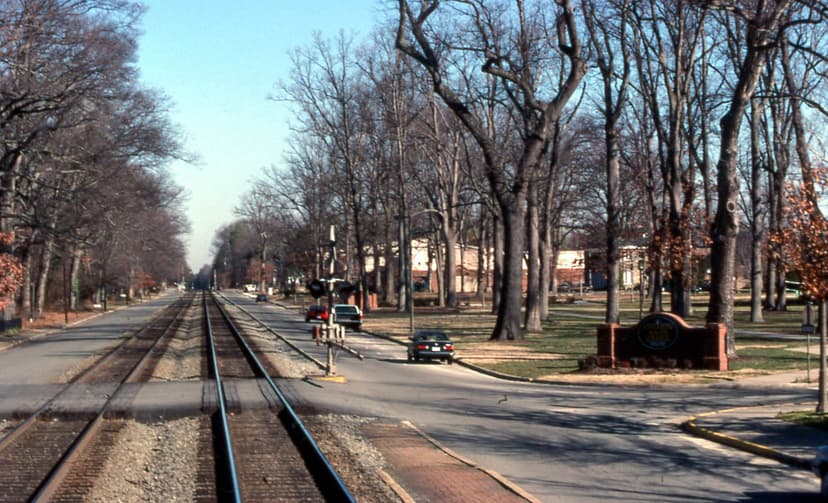
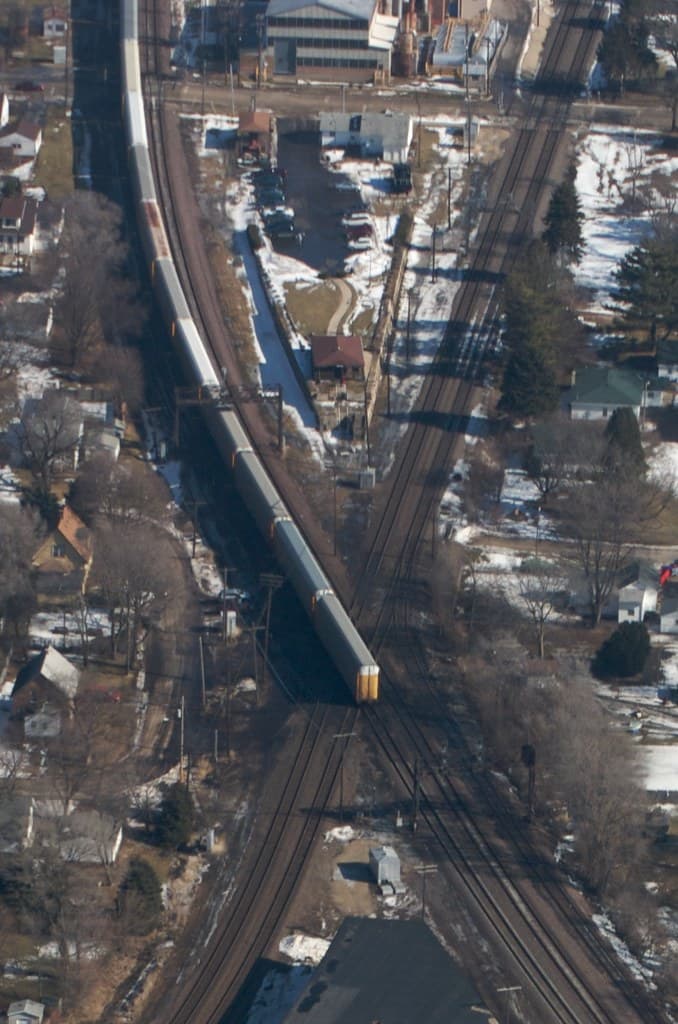
Rochelle Railroad Park
Illinois, United States
Photo: H. Michael Miley · Attribution-ShareAlike License
Railfan field guide
What the hobby involves, the gear that matters, how to find a spot without breaking the law, and your first outing step by step.
Almost everyone who takes up trainspotting starts the same way: they see a photograph they love, or they grow up near a line, or a single dramatic locomotive catches them off guard — and then they have no idea what to do next. There is a lot of unwritten knowledge in this hobby, passed down in clubs and forums over decades, and it can be genuinely hard to find in one place. This guide is our attempt to write it all down for a complete beginner: what the hobby actually involves, the gear that matters (and the gear that doesn't), how to find a good spot without breaking the law, how to stay safe, how to know when a train will actually appear, how to take a photograph you're proud of, and how to fit into the community that has grown up around all of it.
You do not need to read it end to end. Use the contents below to jump to whatever you need right now — but if you read only one section before your first outing, make it Staying safe and legal.
At its simplest, trainspotting is the hobby of observing trains. That plain definition hides an enormous range of ways to actually do it, and one of the first useful things a beginner can do is work out which version appeals to them — because it shapes everything else, from the gear you buy to the places you go.
For some people the heart of the hobby is photography: capturing locomotives and trains in good light, in interesting landscapes, or in dramatic weather. For others it is logging — recording the individual locomotives and units they have seen, often chasing rare or soon-to-be-retired classes, a tradition especially strong in Britain where “gricers” have kept meticulous records for generations. Others are drawn to heritage and tourism: riding preserved steam railways and scenic lines, which shades into rail travel as a holiday in its own right. And a growing number are fascinated by the infrastructure itself — the signalling, the civil engineering, the megaprojects that reshape whole regions.
None of these is more legitimate than another, and most railfans end up doing a bit of each. But naming what draws you helps you start well. If you love photography, the train photography guide matters more to you than a locomotive-numbers database. If you love the machines and their history, our six content pillars — spotting locations, experiences, epic journeys, mega projects, live cams, and events — are a map of the things worth seeking out. And whichever way you lean, the vocabulary can be baffling at first, which is why we keep a plain-language railfan glossary you can consult whenever a word stops you.
One myth worth dispelling immediately: trainspotting is not childish, and it is not rare. It is one of the oldest continuous hobbies in the world, with millions of participants across every continent that has railways, an enormous online community, and a surprising overlap with photography, travel, history, and engineering. You are joining something large and welcoming.
It's also a hobby that scales to whatever time and budget you have. You can do it for an hour at your local station with a phone in your pocket, or you can build entire holidays around it. There are no fees, no membership requirements, and no barrier to entry beyond curiosity and a respect for safety. That flexibility is a large part of why people stay with it for a lifetime: it grows and shrinks to fit whatever else is going on in your life, and it's always there when you want to come back to it.
One of the quiet pleasures of the hobby is that, over time, a passing train stops being an anonymous blur and becomes something you can read — its type, its job, often its individual identity. You don't need any of this to enjoy your first outing, but a little orientation makes everything you see more interesting, and it's the knowledge that turns a casual watcher into a railfan.
Start with the biggest distinction: how the train is powered and formed. A locomotive-hauled train has a separate engine at the front (or rear) pulling or pushing unpowered carriages or wagons — the classic image most people picture. A multiple unit is a train where the passenger carriages have their own motors built in and no separate locomotive; most modern commuter and metro trains are multiple units, either electric (an EMU) or diesel (a DMU). Learning to tell these apart at a glance is the first real skill, and the glossary defines every term you'll meet along the way.
Then there's the train's job. Passenger trains carry people to a timetable. Freight trains carry goods — containers, bulk minerals, cars, fuel — and each freight type has its own distinctive wagons that you'll soon recognise. There are also engineering and maintenance trains (often nicknamed by railfans), charter and heritage specials, and light-engine moves where a locomotive travels on its own. Spotting the difference between a scheduled passenger service and a rare freight working is a large part of what makes an outing exciting.
Finally, most locomotives and units carry a class designation and an individual running number, usually painted on the side or ends. For many railfans, especially in Britain, recording these numbers — and noticing when a rare class or a soon-to-be-withdrawn machine turns up — is the core of the hobby. You can treat the numbers as trivia or as a lifelong collection; both are valid. Either way, once you know a locomotive has a name and a history, watching it pass is never quite the same.
The single most common beginner mistake is spending too much money too soon. You do not need an expensive camera, a long lens, or specialist equipment to start trainspotting well. You need far less than the hobby's gear-obsessed corners might suggest. Here is what actually matters, roughly in order of importance.
A camera you already own. A modern smartphone is a completely legitimate starting camera. Its autofocus is fast, its automatic exposure is reliable, and in good light it produces images that would have amazed photographers a generation ago. Learn its Pro or manual mode — the ability to set a faster shutter speed is the single most useful thing you can unlock — and you can go a very long way before a dedicated camera becomes the limiting factor. If you do move up later, an entry-level mirrorless camera with a modest zoom is plenty; the exotic telephoto lenses can wait until you know you want them.
Comfortable, weather-appropriate clothing. Trainspotting is an outdoor hobby that involves a lot of waiting, often in exposed places. Layers, a waterproof jacket, sturdy footwear, and — in summer — sun protection and water will affect your enjoyment far more than any camera upgrade. A cold, wet, miserable spotter packs up and goes home before the good train arrives.
A way to know where trains are. A tracking app or a printed timetable turns aimless waiting into informed anticipation. We cover the specific tools in Schedules & Tracking, but even a free real-time map or a downloaded passenger timetable transforms a first outing.
Optional extras, later. A notebook or logging app if you enjoy recording what you see; a radio scanner where it is legal and you want advance warning of movements; a small folding stool for long waits; a lens cloth. None of these are needed on day one. Buy them when a specific, felt need appears — not because a checklist told you to. For a fuller treatment of what to carry and why, our tips section and the community's gear guide go deeper without pushing you to overspend.
When should you actually upgrade? The honest answer is: when you can clearly name what your current camera is stopping you from doing. Maybe subjects at a distance are too small in the frame, so a longer lens genuinely helps. Maybe you keep shooting in low light and your phone struggles, so a camera with a larger sensor earns its place. Let the limitation come from real, repeated experience rather than from a spec sheet or a forum thread. Railfans who buy to solve a felt problem are almost always happy; those who buy to keep up with others often aren't — and the best picture at any given spot is far more often about position and light than about the price of the camera taking it.
A “spot” is simply a good place to watch and photograph trains: a station platform with a clear view, an overbridge that looks down the line, a public path beside the tracks, a scenic curve where trains lean into the frame. Finding your first one is where many beginners stall, because the good locations are exactly the kind of local knowledge that isn't obvious from a map.
This is the problem Spotatrain was built to solve. Our database of spotting locations is a community-maintained collection of vetted places to watch trains, each with coordinates, notes on what you'll see, guidance on the best times and light, and — crucially — information about access. You can browse them on the interactive map, filter by what interests you, and find something near you or near where you're travelling. Start there rather than guessing.
When you evaluate any spot — one of ours or one you find yourself — ask three questions. Is the view good? You want an unobstructed sightline down the track, with the sun behind you or to the side for most of your visit. Is it legal and safe to stand there? This is non-negotiable and gets its own section below. Is it comfortable enough to wait? Somewhere you can stand or sit for an hour without being in anyone's way.
Two more ideas help enormously. First, the best beginner spots are often busy passenger stations: they are legal to stand on with a ticket or platform pass, they are safe by design, trains come frequently and predictably, and you can practise your camera work with low stakes. Second, once you find a spot you like, return to it. Pattern knowledge — learning which trains pass, when, and in what light — is worth more than a dozen one-off visits to new places, and it's the foundation of every good railway photograph you'll ever take.
It's also worth thinking about the seasons. The same spot transforms across the year: low winter sun that stays flattering all day, lush summer greenery, autumn colour, or snow that turns an ordinary location into a special one. Deciduous trees that frame a shot beautifully in winter may hide the whole train in July. None of this is a reason to wait — go now, with what today offers — but noticing how a favourite location changes through the year is one of the things that keeps the hobby fresh over the long run.
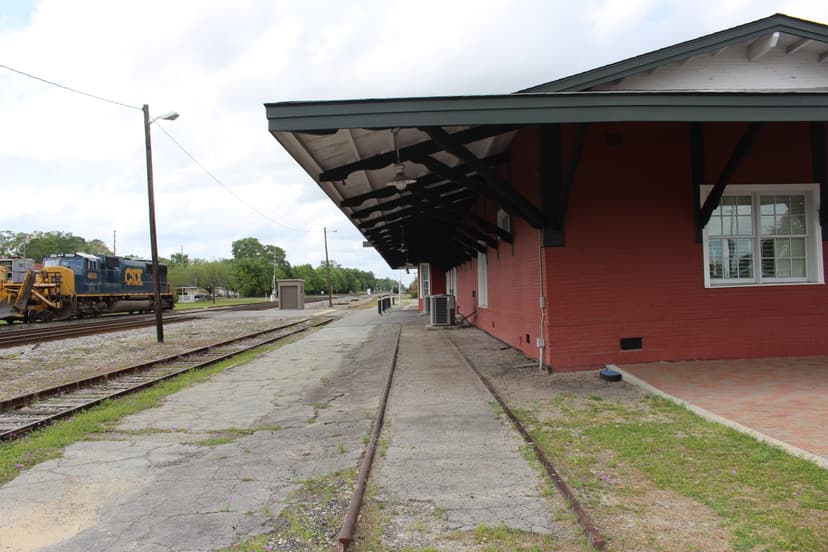
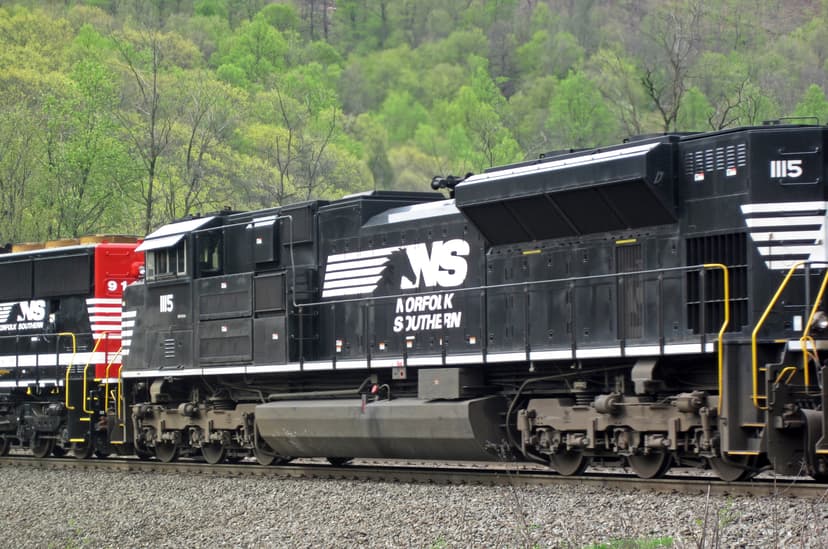
Four easy places to start
Illinois, United States
Photo: H. Michael Miley · Attribution-ShareAlike License
If you take one thing from this entire guide, take this: railways are dangerous, and the tracks are private property. Every year people are killed or seriously injured trackside, very often while doing exactly what a careless spotter might do — stepping onto or too near the rails for a better shot. No photograph is worth it, and there is never a good reason to be on the track.
The physics are unforgiving. Modern trains are quiet, they travel faster than they appear to, and they cannot stop quickly — a heavy freight can take well over a kilometre to halt. Electrified lines carry lethal voltages in the overhead wires or third rail, and you do not need to touch them to be hurt; electricity can arc across a gap. Trains also create powerful slipstreams that can pull you off balance even from the platform edge.
The rules that keep you safe are simple. Stay in places the public is allowed to be: station platforms behind the yellow line, public roads and footpaths, overbridges, and marked viewing areas. Never trespass onto tracks, into yards, depots, or anywhere fenced or signed against entry — it is illegal, it is deadly, and it gives the whole hobby a bad name. Assume a train can come from either direction on any line at any time, including lines that look disused. Keep well back from the platform edge, keep children and equipment under control, and never let a viewfinder become the only thing you're paying attention to.
Because this is so important, we treat it at length in a dedicated safety guide, covering access rights, the specific hazards to know, and how to build the situational-awareness habit that keeps experienced railfans safe for decades. Please read it before your first trip. The rest of the hobby is only fun if you come home from it.
The difference between a thrilling first outing and a frustrating one is usually timing. Stand at a random spot at a random hour and you may wait a long time for anything interesting. A little planning changes everything.
Passenger trains are the easy case. They run to published timetables, so a station or a scenic line with regular passenger service guarantees you subjects at known times — perfect for beginners. Look up the timetable for your chosen line before you go, and you can plan an outing around a cluster of movements rather than hoping.
Freight is the hard, rewarding case. Most freight does not follow a public timetable, which is exactly why catching a particular train feels like a genuine accomplishment. You anticipate freight three ways: with real-time tracking tools that show trains moving on a live map; with pattern knowledge built by watching the same location repeatedly and noticing what tends to run when; and, where it's legal and you're so inclined, with a radio scanner for advance warning. Our schedules & tracking guide names the specific apps and services worth using.
Light and weather are their own kind of timing. The most flattering light of the day is the “golden hour” shortly after sunrise and before sunset, and many railfans plan whole outings around it. Overcast days are surprisingly good for even, shadow-free detail; dramatic weather makes dramatic pictures if you're prepared for it. Our light and weather guide covers how each kind of weather changes your plan. And if the weather defeats you entirely, our live railway cameras let you watch busy lines from a warm room and learn their rhythms before you ever visit.
A final word on timing: some of it is simply patience, and that's a feature, not a bug. Even with the best planning, freight schedules slip, services get cancelled, and the train you came for sometimes just doesn't run. Experienced railfans treat the waiting as part of the pleasure — time outdoors, a chance to watch the ordinary workings go by, and the small thrill of not quite knowing what will appear next. Bring something to enjoy the gaps with, keep your expectations loose, and let a good catch be a bonus rather than the only measure of a day well spent.
You do not need to master photography to enjoy trainspotting — but a handful of simple habits will lift your pictures immediately, and they're easy to learn. Here are the essentials for a beginner.
Use a fast shutter speed. A moving train needs a shutter speed of around 1/500 of a second or faster to come out sharp; slower and it blurs. On a phone, this means using Pro mode or making sure you're in bright light where the camera chooses a fast speed automatically. This one setting fixes more beginner photos than anything else. (Later, you can deliberately break this rule for a pan shot, tracking the train at a slow speed to blur the background — but walk before you run.)
Arrive early and compose before the train. Decide where the train will be in your frame, focus on that spot, and be ready — trains do not wait for you to fiddle. Leave a little space in front of the locomotive for it to “move into,” keep the horizon level, and watch for distracting clutter like signs and poles growing out of the train.
Put the sun behind you. For classic, evenly-lit shots, the light should come over your shoulder onto the front and side of the train — which is why knowing your spot's orientation and the time of day matters so much. The glossary will help with the vocabulary you'll meet — a wedge shot (the classic three-quarter angle), going-away shots, and so on.
Review, cull, and edit gently at home. A big part of getting better happens after the outing. Look back through your shots, be honest about which ones work, and try to name why the good ones succeeded — the light, the angle, the timing. Keep the best and don't be sentimental about the rest; you took them for free. A little editing goes a long way, too: straightening the horizon, a modest crop to tighten the composition, and small exposure and contrast tweaks will lift most images without making them look artificial. Resist the urge to over-process — the goal is a clean, believable photograph of a real train.
For the full treatment — exact settings for daylight, golden hour, and night, plus autofocus and burst-mode advice — see the train photography guide. But honestly, “fast shutter, sun behind you, composed early” will carry your first dozen outings.
Trainspotting has a strong, mostly unwritten code of conduct, and following it is how you go from nervous newcomer to welcome regular. The good news is that it's all common courtesy, and railfans are — with rare exceptions — a friendly and helpful bunch who remember being beginners themselves.
Share the space. At a popular spot, don't block others' shots, don't sprawl your gear across the best position, and don't crowd someone who was there first. A quiet “mind if I stand here?” goes a long way. Be discreet and professional in public. You are, to passers-by and residents, a stranger with a camera near infrastructure; behave in a way that keeps them comfortable and keeps the hobby's reputation intact. Be especially considerate near homes, schools, and quiet residential areas.
Respect railway staff and the rules. Station staff and train crews are at work; a friendly wave is welcome, getting in their way is not. If someone in authority asks you to move, move. Think before you post. Be careful about photographing identifiable members of the public, and consider whether sharing the precise location of a sensitive or fragile spot might get it ruined or closed.
Don't be afraid to ask. The single fastest way to improve is to talk to the people around you. Most railfans are delighted to explain what's coming, why a particular working is special, or where the best light falls at a given spot — they remember being new, and enthusiasm is the whole point of the hobby. Local clubs and online communities are just as welcoming; a well-asked question in the right group will often get you decades of accumulated knowledge in a single afternoon.
Our full etiquette guide expands on all of this. Internalise it early and you'll find the community opens up to you quickly — the person standing next to you at a spot is often the best source of local knowledge you'll ever find.
Trainspotting looks a little different depending on where you do it, and part of the fun of the hobby's global side is discovering those differences. If you travel, or if you simply want to understand the wider culture you're joining, it helps to know that the customs, the language, and even the legality of certain vantage points vary from country to country.
Britain is arguably the spiritual home of the numbers-collecting tradition, with a deep vocabulary all its own — “gricing,” “bashing,” “haulage” — and a dense network of stations that are easy to reach by public transport. North America tilts toward long, heavy freight, dramatic landscapes, and photography; the sheer scale of the trains and the country shapes a road-trip-and-lineside culture, with famous locations like Cajon Pass and Tehachapi on many railfans' lists. Continental Europe offers a spectacular mix of high-speed lines, cross-border services, and Alpine scenery, while much of Asia combines cutting-edge high-speed rail with heritage operations that draw enthusiasts from around the world.
The rules change with the borders, too. What counts as an acceptable public vantage point in one country may be treated very differently in another, and photography that is entirely normal in one place can attract suspicion elsewhere. When you spot in an unfamiliar country, take a little time to learn the local norms and laws before you go — and when in doubt, err toward caution and courtesy.
This global spread is exactly why Spotatrain is organised as a worldwide hub rather than a single-country site. Our six pillars — from local spotting locations to the world's great epic journeys, landmark mega projects, railway live cams and the calendar of rail events — are meant to help you find worthwhile railways wherever you are or wherever you're headed. Wherever you spot, you're part of the same global community.
Almost every experienced railfan made the same handful of mistakes when they started. Knowing them in advance won't make you an expert, but it will save you some wasted trips and a few moments of regret. Here are the ones worth heading off.
Chasing gear instead of experience. As covered above, the urge to buy an expensive camera and a big lens before your first real outing is strong and almost always premature. Skill, patience, and knowing your spot matter far more than equipment. Spend your first season learning with what you have.
Ignoring the light. Beginners often photograph a train the instant it appears, regardless of whether they're shooting into the sun. A perfectly timed shot with the light in the wrong place is still a silhouette. Learning to think about sun direction — and to sometimes let a badly-lit train pass — is a rite of passage, and our light and weather guide shortcuts a lot of that learning.
Turning up with no plan. Standing at a random location hoping something interesting rolls by is the slowest possible way to learn. Ten minutes with a timetable or a tracking tool, and a spot chosen from our database, will teach you more in one focused afternoon than a month of aimless visits.
Getting complacent about safety. The most dangerous moment is not your first cautious visit — it's the tenth, when familiarity has bred a little carelessness and a viewfinder is pulling your attention off the tracks. The rules in the safety guide are not a beginner phase you graduate from; they are permanent.
Forgetting to just watch. Finally, don't let the camera become the whole point. Some of the best moments in this hobby happen when you put the equipment down and simply watch a great machine go by. The photographs are a way of remembering the experience — not a replacement for it.
Let's put it all together into a simple plan for your very first trip. Follow this and you'll come home with photos and confidence.
That's the whole loop, and it never really changes — even veteran railfans are doing a more refined version of exactly these steps. The hobby grows with you: today it's a phone at a local station, and in a few years it might be a planned trip to ride one of the world's great railway journeys or to witness a landmark mega project take shape. Welcome aboard.
Scout your first location from home, then find a vetted place to watch trains near you.