
Ashcroft (Black Canyon)
A dramatic canyon on the Thompson River where CN and CPKC mainlines run on opposite sides, offering views of both railways' directional-running freight traffic through BC's desert interior.
Photos
 miroslav.volek
Attribution License

miroslav.volek
Attribution License
miroslav.volek
4
miroslav.volek
4
Trainspotting Experience
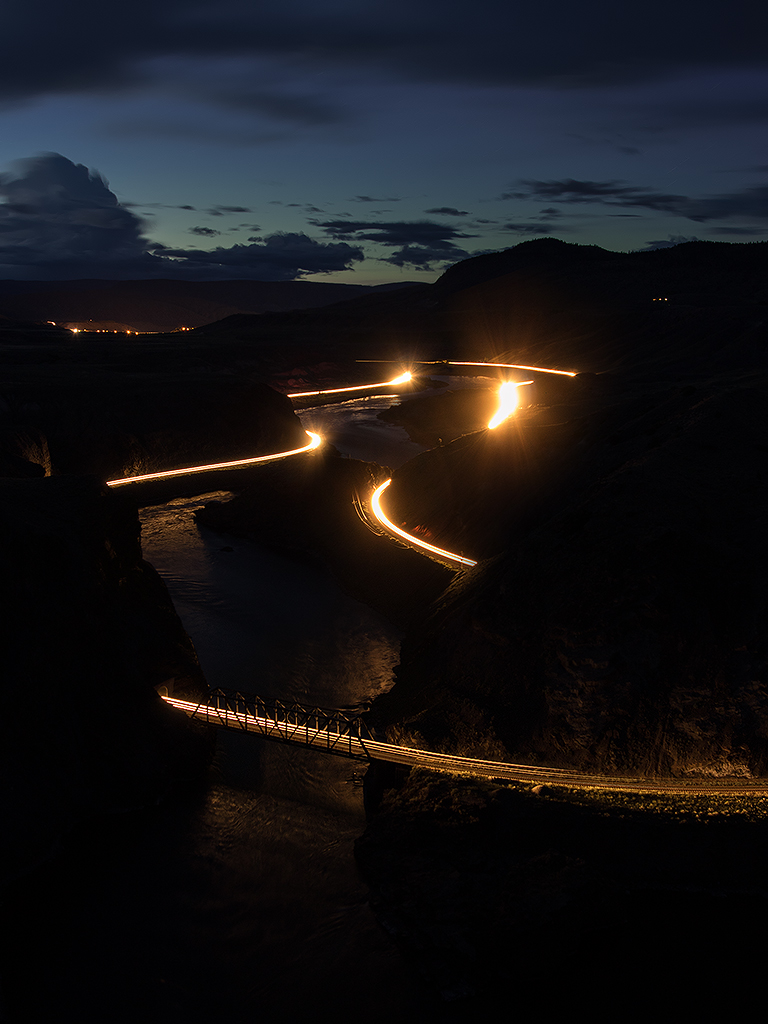
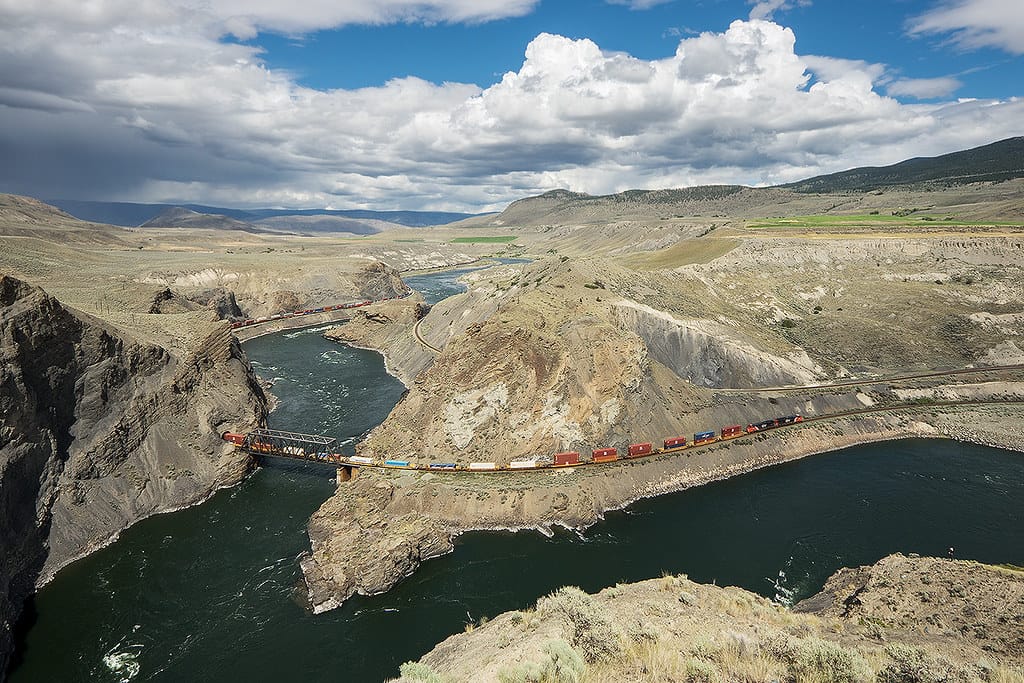
Black Canyon sits roughly 5 km southwest of Ashcroft on the Thompson River, where the CN Ashcroft Subdivision (mile 48.7 at Ashcroft) occupies the west bank and the CPKC Thompson Subdivision holds the east bank. Under the directional-running agreement in effect since 1999, all westbound CN and CPKC traffic uses the CN tracks through this stretch, while all eastbound traffic runs on the CPKC side. That means you can watch two Class I railroads' entire westbound or eastbound fleets from a single vantage point, depending on which bank you observe from.
Trains move at moderate speeds through the canyon—the CN Ashcroft Sub has a maximum authorized speed of 50 mph—and the rocky walls amplify locomotive exhaust and flange squeal into an immersive soundtrack. Both railways have tunnels at Black Canyon: the CPKC tunnel on the east bank measures 584 feet, while the CN tunnel (originally built by the Canadian Northern Railway in 1912) runs 800 feet through the dark sedimentary rock that gives the canyon its name. The canyon's acoustics mean you can often hear an approaching train a full minute or more before it appears around the curve.
Landscape, Setting & Local Atmosphere
Black Canyon takes its name from the 150-million-year-old dark sedimentary rock wall that rises vertically from the west side of the Thompson River. The landscape here is BC's Interior Plateau at its most arid—Ashcroft has a dry semi-arid climate (Köppen BSk) and frequently ranks among the hottest places in British Columbia. Parts of the Thompson River gorge near Ashcroft are sufficiently arid to be classified as Canada's only true desert.
Sagebrush and bunchgrass dominate the sandy benchlands above the river, with scattered ponderosa pines at higher elevations. Summer temperatures regularly exceed 30°C, and the surrounding hills were scarred by the 2017 Elephant Hill wildfire, adding stark contrast between charred slopes and the green ribbon of river valley below. In winter, conditions are mild by Canadian standards, with light snowfall and crisp air that provides exceptional visibility for photography.
Type & Frequency of Train Activity
The CN Ashcroft Subdivision carries westbound traffic from both CN and CPKC under the directional-running agreement that has been in place since 1999 between Nepa (CP mile 54.8) / Coho (CN mile 57.2) and Mission Junction. The CPKC Thompson Subdivision carries the corresponding eastbound flow. This means Black Canyon sees the combined westbound output of Canada's two major freight railways heading toward the Port of Vancouver.
Traffic consists of stacked intermodal, unit grain trains, coal, potash, sulfur, and mixed manifest freight. CN recently reported average intermodal train volumes of 4-5 trains per day from Vancouver alone, with train lengths averaging nearly 8,000 feet. CPKC runs similarly heavy eastbound loads. VIA Rail's "The Canadian" (train 1 westbound) passes through Ashcroft roughly three times per week as a flag stop requiring 48-hour advance notice; its stainless steel Budd cars make a distinctive sight against the desert backdrop.
Best Angles for Photos & What Railfans Enjoy Most
The canyon's dual-railway layout creates layered compositions unavailable at most locations. From elevated positions on the west side of the river, you can frame a westbound CN train in the foreground with an eastbound CPKC movement on the far bank—both against dark canyon walls. Morning light coming from the east illuminates the nose of westbound power on CN; afternoon sun lights the vertical rock face on the west side of the canyon.
A 70-200mm lens isolates locomotives emerging from the CN or CPKC tunnels, while a wider 24-70mm captures the sweeping river bends and layered desert terrain. The dark rock of the canyon wall provides a dramatic contrasting backdrop for colorful CN orange and CPKC maroon/grey consists. Clear winter air produces sharp results, and the mostly snow-free conditions in Ashcroft's semi-arid climate mean year-round shooting is feasible. Golden hour is particularly effective when the low sun paints the sedimentary cliffs in warm tones.
Historical or Cultural Relevance
The Canadian Pacific Railway was first through Black Canyon in December 1884 as the rail head advanced eastward from Port Moody. The Canadian Northern Railway (CNoR) followed on the opposite bank, completing its 244-metre (800-foot) tunnel at Black Canyon by February 1912. When the CNoR was nationalized into Canadian National Railways in 1919, the two parallel routes through the Thompson and Fraser Canyons became one of Canada's great railway rivalries—eventually resolved by the 1999 directional-running agreement.
The canyon itself was shaped by a catastrophic landslide on October 14, 1880, when thousands of tons of glacial clay crashed into the Thompson River. The landslide completely blocked the river, creating a temporary lake 14 km long with depths up to 18 metres. The backed-up water flooded what would become the Ashcroft townsite. Ashcroft later became Mile 0 on the Cariboo Wagon Road when the BC Express Company relocated its headquarters there in 1886, making the village a critical gateway connecting rail transport to the northern gold fields.
The area is Nlaka'pamux First Nation traditional territory, with Indigenous communities having lived along the Thompson River for thousands of years before European settlement.
What Makes This Spot Different
Black Canyon is one of the few locations in North America where you can watch two Class I railroads' combined freight traffic through a single, desert-walled river canyon with no fences, catenary, or urban clutter in the frame. The 1999 directional-running agreement means CN and CPKC literally share the corridor—westbound on CN tracks, eastbound on CPKC—creating an operational arrangement that rewards patient observers with both railways' motive power rosters.
The semi-arid desert setting is unique among Canadian rail viewing spots: dark volcanic rock walls, sagebrush-covered benches, and the turquoise Thompson River create a palette more reminiscent of the American Southwest than of British Columbia. The canyon's natural acoustics amplify every locomotive note, and the dual tunnels (584 ft CPKC, 800 ft CN) frame dramatic portal shots on both sides of the river.
Frequently Asked Questions
QHow do I access Black Canyon for train watching?
Black Canyon is located roughly 5 km southwest of the village of Ashcroft along the Thompson River. Highway 97C descending from Logan Lake offers views of the canyon to the west. Local roads from Ashcroft lead toward the river. The Legacy Park Campground in Ashcroft sits between the two rail lines.
QWhat is the directional-running agreement?
Since 1999, CN and CPKC have shared their parallel tracks through the Thompson and Fraser Canyons. All westbound trains (both CN and CPKC) use the CN tracks, while all eastbound trains use the CPKC tracks. This arrangement runs between Nepa/Coho near Ashcroft and Mission Junction near Vancouver.
QCan I ride VIA Rail to Ashcroft?
Yes. VIA Rail's The Canadian serves Ashcroft as a flag stop, but requires 48-hour advance notice. The station is a signpost on the north side of the Thompson River—there is no actual building or shelter. The train runs approximately three times per week.
QWhat is the climate like at Black Canyon?
Ashcroft has a dry semi-arid climate (Köppen BSk) and is frequently one of the hottest places in British Columbia. Summer temperatures regularly exceed 30°C. Parts of the Thompson River gorge are arid enough to be classified as Canada's only true desert. Winters are mild with light snowfall.
Safety Tips
Stay on public land and away from active railway tracks at all times—both CN and CPKC mainlines are heavily trafficked. The semi-arid climate means extreme heat in summer (regularly 30°C+); bring ample water, sunscreen, and a hat. Watch for rattlesnakes in the sagebrush, especially in warm months. The canyon terrain can be steep and unstable near the rim; glacial clay and loose gravel are common. Cell service may be limited in the canyon itself.
Seasonal Information
Summer (June-September) offers the longest daylight and heaviest freight traffic as port volumes peak, but temperatures frequently exceed 30°C. Spring (April-May) and fall (September-October) provide more comfortable conditions with good light and decent traffic volumes. Winter is mild by Canadian standards with light snowfall, excellent visibility, and crisp air—ideal for sharp photography. The 2017 Elephant Hill wildfire left visible scars on surrounding hillsides that remain part of the landscape.
Nearby Lodging
- Legacy Park Campground
Municipal campground on the banks of the Thompson River, right between the CN and CPKC lines. 19 sites with water, power, WiFi, showers. Open May-September. Train noise is guaranteed—bring earplugs or embrace it.
- Ashcroft River Inn
Motel at 715 Railway Ave in Ashcroft, close to the rail lines and river. Basic accommodation for the railfan on a budget.
- Blue Sage Bed & Breakfast
B&B at 405 Brink Street in Ashcroft village. A more comfortable option within walking distance of the tracks and Heritage Place Park.
- Sandman Inn Cache Creek
Chain hotel in Cache Creek, 11 km north of Ashcroft. More amenities and reliable booking. Good base for visiting both Ashcroft and Hat Creek Ranch.
Nearby Attractions
3.1 miles / 5 km
Located in the 1916 Dominion Building, this museum chronicles the Gold Rush era, railway history, Indigenous peoples, and the Chinese community. Considered one of the best small-town museums in BC.
3.1 miles / 5 km
A mini open-air museum in Ashcroft featuring a red caboose on railway tracks, mosaic murals, a functioning waterwheel, heritage cabin, and the Harmony Bell Tower. Right across from the active rail lines.
15.5 miles / 25 km
National Historic Site with over 20 original buildings from the 1860s Cariboo Wagon Road era. Features stagecoach rides, gold panning, a Shuswap Indigenous village, and a heritage roadhouse. Located 14 km north of Cache Creek.
9.3 miles / 15 km
A Thompson River park with camping, swimming, and hiking. Located between Ashcroft and Savona along the CN/CPKC corridor—excellent for combining train watching with camping.
28 miles / 45 km
Whitewater rafting on the Thompson River through the canyon downstream from Ashcroft to Spences Bridge. Offers a unique river-level perspective of the railway lines threading through the canyon walls.
External Links
informative
informative
informative
official
Looking for more spots? Browse the complete list of train spotting locations.
Quick Information
Country
Canada
Region
British Columbia
City
Ashcroft
Spot Type
Scenic Overlook
Best Times
Daylight hours year-round. Morning light illuminates westbound trains on the CN side. Late afternoon sun lights the canyon walls dramatically. Summer days are long, but temperatures frequently exceed 30°C—bring water and sun protection.
Visit Duration
2-4 hours
Cost
Free (public viewing areas)
Train Activity
Train Types
Frequency
Combined CN and CPKC traffic through the directional-running corridor is substantial, with westbounds on CN and eastbounds on CPKC. Historically 22 trains/day on the CP line alone (1947 data); modern volumes are higher due to port growth.
Access & Amenities
Parking
Available (Free (informal pullouts and village parking))