Blue Island (Junction)
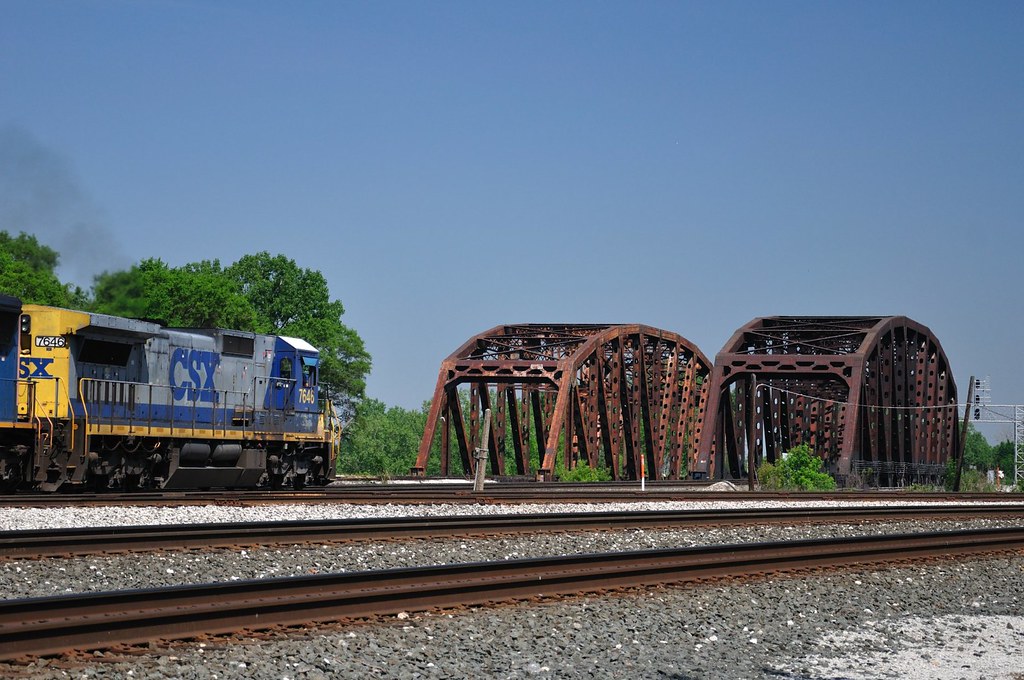
A double diamond interchange in Chicago's south suburbs where CSX, Indiana Harbor Belt, Canadian National, Iowa Interstate, and Metra converge. About 90 trains daily cross eight tracks at Broadway Street, with five iconic steel bridges spanning the Cal-Sag Channel.
Photos
 vxla
vxla
Attribution License
vxla
Attribution License
Trainspotting Experience
Blue Island Junction is one of the most complex and fascinating rail crossings in the Midwest. Eight tracks cross Broadway Street at grade, forming a double diamond interchange where CSX, Indiana Harbor Belt (IHB), Canadian National (ex-Grand Trunk Western), and Iowa Interstate (IAIS) all converge. About 250 yards south of Broadway, the Metra Rock Island District commuter line crosses over the entire junction on elevated tracks, adding a vertical dimension to the action.
The primary viewing area is the public sidewalks along Broadway Street, which run directly through the middle of the junction. From here, you stand at ground level with clear sightlines to approaching trains from multiple directions. The junction is laid out roughly north-south, so southbound trains are generally the most photogenic. Trains rarely exceed moderate speeds through the interlocking, giving ample time to observe locomotive details and consist composition.
The CSX main line enters from the southeast out of nearby Barr Yard, while the IHB double-track main comes from the south out of Blue Island Yard. These two lines share a crossover just south of Broadway, creating a joint IHB/CSX route heading northwest. CN's double-track main enters from the south heading north into Chicago, crossing the joint line just north of Broadway. IAIS enters from the southwest on a single track. All of these tracks then cross the Cal-Sag Channel on five formidable steel truss bridges that are visible from Broadway and have become iconic images in railroad photography.
Landscape, Setting & Local Atmosphere
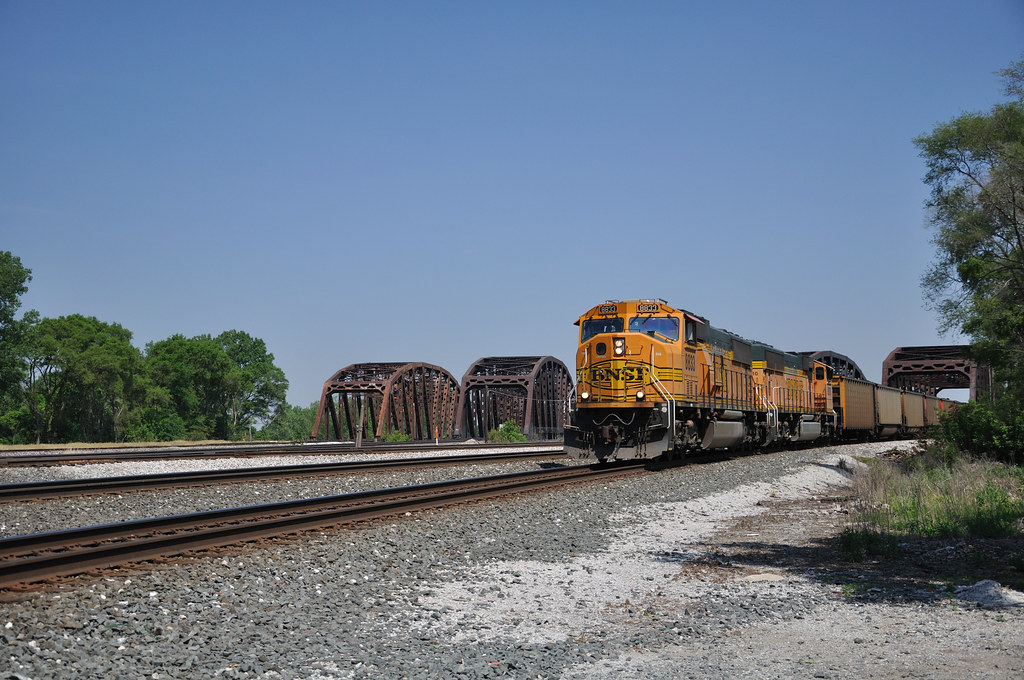
Blue Island sits in a flat, working-class suburb about 20 miles south-southwest of downtown Chicago. The terrain around the junction is level, with the tracks at grade and the Cal-Sag Channel cutting through just north of Broadway. The five steel truss bridges spanning the channel are the dominant visual feature — heavy, industrial structures that have appeared in countless train magazines and railfan photographs over the decades.
The surrounding neighborhood is residential with brick homes and small commercial buildings typical of Chicago's older south suburbs. The area has a gritty, industrial character that has improved in recent years but still warrants basic caution. At the south end of the junction, the elevated Metra Rock Island tracks on their embankment frame the scene from above. Toward the north, the former interlocking tower stands beyond the bridges across the channel — shut down in June 2013 but still visible as a local landmark. The junction sits on Broadway, which carries steady vehicle traffic alongside the rail crossings, adding to the busy atmosphere.
Type & Frequency of Train Activity
The junction hosts traffic from at least six railroads. The joint IHB/CSX line (technically owned by CSX subsidiary B&OCT but dispatched by IHB) sees the most action, carrying a mix of road trains, yard transfers, and interchange moves between Barr Yard, Blue Island Yard, and points northwest toward Franklin Park. BNSF and CP trains regularly use this joint line via trackage rights — BNSF heading to/from connections and CP accessing Bensenville Yard.
The CSX main line (Blue Island Subdivision, CTC controlled by CSX 'RB' Dispatcher in Calumet City) carries heavy freight in both directions between Barr Yard and Chicago. Since June 2013, CSX also dispatches the former CN/GTW tracks between Chicago and Munster, Indiana, adding CSX movements on what was once exclusively CN territory.
CN traffic has diminished significantly since CN acquired the Elgin, Joliet & Eastern in 2009, rerouting many trains onto the former EJ&E. Only two to four CN trains per day now pass through Blue Island. Iowa Interstate moves freight — sometimes impressively long consists of ethanol and grain — and uses the Metra Rock Island tracks via trackage rights for part of its routing. Belt Railway of Chicago and Chicago Rail Link also make occasional appearances.
Metra Rock Island District operates approximately 80 weekday trains on the full district, with 16 round trips terminating at Blue Island/Vermont Street. Weekend service runs every two hours.
Best Angles for Photos & What Railfans Enjoy Most
The junction is oriented north-south, which can make lighting tricky at certain times. Southbound trains generally photograph best, especially with the five Cal-Sag Channel bridges as a backdrop. From the Broadway sidewalks, you can capture trains at the grade crossing from multiple angles without moving far.
The Western Avenue overpass, a short walk from the junction, provides an elevated perspective looking down at the tracks and can frame trains with the bridges in the background. At the south end of the plant, the elevated Metra Rock Island tracks about 250 yards from Broadway create opportunities to photograph a freight train at grade level with a commuter train passing overhead — a dramatic layered composition.
A telephoto lens (200mm+) is useful for compressing the bridges and capturing approaching trains from a distance. The best overall lighting is on southbound trains in the morning to midday, when the sun illuminates locomotive faces without harsh shadows. Afternoon light works well for the bridge structures. Be mindful that this is an active street crossing — stay on the sidewalks and watch for traffic from all directions, both rail and road.
Historical or Cultural Relevance
Blue Island's railroad history dates to the very beginning of railroading in Illinois. The Chicago and Rock Island Railroad completed its line through Blue Island to Joliet in October 1852, making it among the first railroads built west from Chicago. The first train ran on October 10, 1852, with Blue Island as one of the earliest stops, just 15 miles from Chicago. The railroad quickly transformed Blue Island from a stop along the old Vincennes Trail into a hub of commerce and industry.
The junction grew as additional railroads threaded their lines through the area. The Baltimore & Ohio Chicago Terminal (now CSX) and Indiana Harbor Belt stitched their networks into what became a shared corridor. Blue Island played a role in the 1894 Pullman Strike, a watershed moment in American labor history — on June 30, 1894, local resident James Murwin threw a switch on locomotive No. 19, shutting down Rock Island service for three days.
By the 20th century, Blue Island had become synonymous with railroading and heavy industry, with clay from an ancient glacial bed making it the 'brick-making capital of the world.' The interlocking tower that once controlled the crossing was shut down in June 2013 when operations shifted to remote CSX dispatchers, but the structure remains visible across the Cal-Sag Channel as a local landmark.
What Makes This Spot Different
What makes Blue Island exceptional among Midwestern rail junctions is the combination of multi-railroad diversity, the iconic Cal-Sag Channel bridges, and the vertical element of the Metra Rock Island overpass. Few locations allow you to watch trains from six or more different railroads without changing position.
Blue Island and nearby Dolton Junction (five miles east) form a matched pair of mega-junctions. Dolton is the eastern gateway to CSX's Barr Yard and IHB's Blue Island Yard, while Blue Island is the western gateway. Together, they offer a full day of railfanning with enormous variety. The junction is also notable for its public transit accessibility — you can reach it by Metra commuter train from downtown Chicago, a rarity among major railroad photography destinations.
Frequently Asked Questions
QHow do I get to Blue Island Junction without a car?
Take a Metra Rock Island District train from LaSalle Street Station in downtown Chicago to Vermont Street station, or take a Metra Electric train to the end of the line at Blue Island. From either station, walk west along Vermont to Western Avenue, then south on Western to Broadway. Use the stairway from the Western overpass down to Broadway, then continue west to the junction. The walk is about one mile.
QHow many trains pass through Blue Island Junction daily?
Visit Chicago Southland reports approximately 90 trains daily across all railroads. This includes Metra commuter trains, CSX and IHB freight, CN road trains (2-4 per day), Iowa Interstate moves, and occasional BNSF, CP, Belt Railway, and Chicago Rail Link trains.
QWhere should I park at Blue Island Junction?
Park on Vine Street, the first side street on the left after crossing all the tracks on Broadway. Do NOT use the parking area on the right just before the tracks — it is CSX property and railroad police may ask you to leave.
QIs Blue Island Junction safe to visit?
The area has improved from earlier decades. Stay on the public sidewalks along Broadway, bring a companion if possible, and exercise normal urban caution. The viewing location is a public street with regular vehicle traffic. Be especially alert for trains from multiple directions simultaneously.
QWhat scanner frequencies should I use at Blue Island?
Key frequencies: CN 160.530 and 160.590; CSX 160.230, 160.320, and 160.290; IHB 160.980, 160.070, and 161.565; IAIS 160.305; Metra 161.340. A scanner greatly enhances the experience by letting you anticipate approaching trains.
Safety Tips
Stay on the public sidewalks along Broadway Street at all times — CN and CSX have posted No Trespassing signs on their property. The tempting parking area just before the tracks on the right side of Broadway is CSX property, and CSX police have been known to ask visitors to leave. Do not stray onto the Metra elevated tracks, which are posted off-limits. Be extremely careful when photographing — it is easy to get absorbed in one set of tracks while another train approaches from a different direction. The neighborhood has improved from past decades but the railfanguides.us recommends bringing a 'buddy' for company. This is a working-class area; exercise normal urban caution.
Seasonal Information
Blue Island is an all-season railfanning destination. Summer offers the longest daylight hours but can be hot and humid with limited shade along the sidewalks — bring water and sunscreen. Winter may bring dramatic snow-covered bridge scenes, but Chicago-area cold can be brutal and ice on the sidewalks adds hazard near the tracks. Spring and fall generally provide the most comfortable conditions for extended sessions. There is no weather shelter at the viewing area.
Nearby Lodging
- DoubleTree by Hilton Chicago/Alsip
Full-service hotel in nearby Alsip, about 5 miles west. Indoor pool, restaurant, and reliable amenities. Good base for exploring both Blue Island and Dolton junctions.
- Hilton Chicago/Oak Lawn
Full-service 12-story tower hotel about 7 miles northwest, near Midway Airport. Restaurant, indoor pool, and conference facilities.
- Holiday Inn Express & Suites Chicago - Oak Forest
Modern budget-friendly option in Oak Forest, about 8 miles southwest off I-57. Free breakfast and easy highway access.
- Best Western Plus South Holland/Chicago Southland
Budget-friendly option in South Holland, about 8 miles east. Convenient for visiting both Blue Island and Dolton junctions.
Nearby Attractions
5 miles / 8 km
The busiest rail intersection in the Chicago Southland with approximately 120 trains daily on CSX, IHB, and Union Pacific. A natural companion visit to Blue Island — both junctions are the matched eastern and western gateways to Barr and Blue Island yards.
6.2 miles / 10 km
Former Pullman Palace Car Company factory and planned company town, now a National Historical Park. Tells the story of railroad innovation, urban planning, and the landmark 1894 Pullman Strike and 1925 Brotherhood of Sleeping Car Porters.
0.9 miles / 1.5 km
Local history museum in the landmark 1871 Albee House at 13018 Maple Avenue. Features artifacts, photographs, and memorabilia from Blue Island's rich railroad and industrial heritage. Open Fridays and Saturdays 10am–2pm.
8 miles / 13 km
Handicap-accessible elevated railroad viewing platform offering views of Metra commuter, Amtrak intercity, and freight trains. Features a live audio feed from the switchyard.
10 miles / 16 km
Award-winning brewpub housed in a restored 1906 Illinois Central Railroad station. Named Best Small Brewpub in America at the 2006 Great American Beer Festival. Watch Metra trains stop at the adjacent station while enjoying craft beer.
15 miles / 24 km
Features a 35-foot elevated handicap-accessible viewing platform overlooking a rare double wye 'highway cloverleaf interchange for trains.' Includes interpretive signs and a restored EJ&E Caboose #531.
External Links
informative
informative
Looking for more spots? Browse the complete list of train spotting locations.
Quick Information
Country
USA
Region
Illinois
City
Blue Island
Spot Type
Urban Crossing
Best Times
The junction sees traffic throughout the day. Metra Rock Island District commuter trains run hourly on weekdays (more frequently at rush hours) and every two hours on weekends. Freight movements on the CSX main and joint IHB/CSX line are less predictable but occur steadily throughout daylight hours.
Visit Duration
2-4 hours
Cost
Free access. Free street parking on Vine Street.
Train Activity
Train Types
Frequency
Approximately 90 trains per day across all railroads (source: Visit Chicago Southland). Railfanguides.us estimates 25+ freight/road trains per 24 hours excluding Metra commuters.
Access & Amenities
Parking
Available (Free street parking on Vine Street (first side street on the left after crossing all tracks). Do NOT park in the lot on the right before the tracks — it is CSX property.)
Shelter
Not available
Restrooms
Not available