Buffalo (CP Draw Bridge)
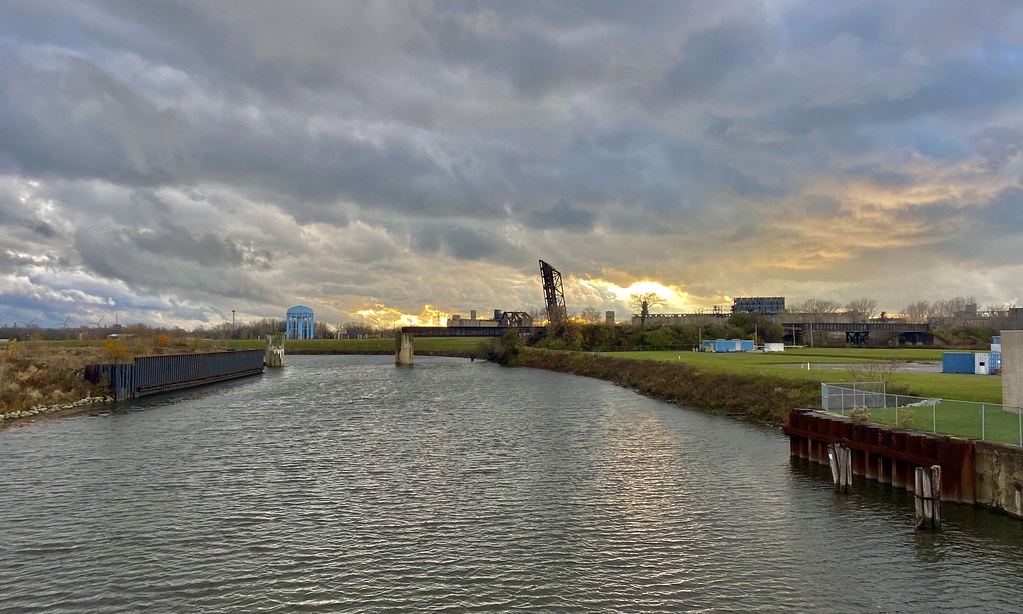
CP Draw is a key CSX control point where trains cross the Buffalo River on a 1912 Strauss bascule bridge, surrounded by historic grain elevators in Buffalo's industrial waterfront district.
Photos
 Carrotflower Productions International
5
Trainspotting Experience
CP Draw sits at milepost 1.7 on CSX's Buffalo Terminal Subdivision, where the railroad crosses the Buffalo River on a Strauss heel trunnion bascule bridge (CSX Bridge QDC 1.71). The best public viewing area is Red Jacket Riverfront Natural Habitat Park, accessible from the end of Smith Street off South Park Avenue. This small pocket park on the river's south bank offers direct sightlines to the bridge and includes a paved trail, benches, and a kayak launch. From the park entrance, you can see both the active CSX bascule bridge and the adjacent permanently-raised former Nickel Plate Road (NKP) bridge standing alongside it — a striking visual contrast between active and abandoned infrastructure.
Trains cross the bridge at restricted speed, giving ample time to observe locomotive numbers and consist details. CSX currently operates a single track over the double-track structure. The South Park Avenue lift bridge, a short walk north, provides an elevated vantage point looking downriver toward CP Draw with the Concrete Central grain elevator in the background. Scanner traffic on 161.340 MHz (AAR Channel 82) covers the CSX dispatcher for this territory.
The area sees a mix of CSX mainline freights, Norfolk Southern run-through traffic with trackage rights, and Amtrak passenger service. Local switching from the nearby Ohio Street Yard, the former Buffalo Creek Railroad yard where CSX maintains a switcher for the remaining grain mills, adds to the variety.
Landscape, Setting & Local Atmosphere
The setting at CP Draw is defined by Buffalo's industrial waterfront heritage. The Buffalo River winds through a broad bend here, flanked by towering concrete grain elevators that once made this the world's largest grain port. The Concrete Central elevator, visible from the park, stands about 120 feet tall. To the south, the Silo City complex — the American Grain Elevator (built 1906), Perot Malthouse (1907), and Lake and Rail Elevator (1927-1930) — looms over the landscape along Ohio Street.
The terrain is flat river bottomland at approximately 575 feet elevation. Red Jacket Riverfront Park offers a surprisingly natural setting along the river with mature trees, marsh habitat, and wooded areas, despite being in an urban-industrial zone. The park's kayak launch and fishing spots attract non-railfan visitors as well. Lake Erie's influence is felt year-round: summer temperatures average around 75°F with lake breezes, while winter brings lake-effect snow and temperatures well below freezing. In winter months, the bascule bridge is occasionally raised to allow ice-breaking operations on the Buffalo River — a federal navigation channel managed by the Coast Guard and Army Corps of Engineers.
Type & Frequency of Train Activity
CP Draw is located on the CSX Buffalo Terminal Subdivision (formerly the Buffalo Creek Railroad mainline, between CP 437 and CP 2). According to 2024 timetable data, the subdivision sees approximately 16 daily freight movements and 2 scheduled Amtrak passenger trains. Norfolk Southern operates over this corridor under trackage rights agreements, adding additional freight traffic.
CSX's Frontier Yard, the former New York Central main classification facility in Buffalo, lies to the east. Trains arriving from the west via the Erie West Subdivision — which carries about 38 daily freight movements between Erie and Sheridan — converge in this area. Amtrak's Empire Service, Lake Shore Limited, and Maple Leaf all route through Buffalo on CSX trackage, connecting to Depew and Exchange Street stations. The Maple Leaf provides daily New York–Toronto service via Niagara Falls.
Local switching from the Ohio Street Yard serves the remaining grain mills and elevators along the Buffalo River and City Ship Canal. This yard, the former Buffalo Creek Railroad facility, typically sees a CSX switcher working during business hours. The Buffalo Creek Railroad was a historic terminal railroad established in 1869 that handled waterfront switching for all twelve railroads serving Buffalo until it merged into Conrail in 1976.
Best Angles for Photos & What Railfans Enjoy Most
The South Park Avenue bridge provides an elevated downriver view encompassing the two side-by-side bascule bridges (one active, one permanently raised) with grain elevators in the background. Morning light from the east illuminates westbound trains on the active bridge. A 70-200mm zoom captures the full bridge span and river reflections from this position.
From Red Jacket Riverfront Park on Smith Street, the angle is lower and closer, at near track level. This vantage puts the massive concrete elevator structures behind the bridge for a dramatic industrial composition. Late afternoon golden light works well here for trains heading toward the bridge from the east. The park is on the river's south bank, so summer evening light catches the bridge steelwork and counterweight mechanism.
The Ohio Street area, north of the river near Silo City, offers a completely different perspective with trains approaching or departing CP Draw with the 120-foot grain silos as a foreground element. The Silo City campus at 120 Silo City Row can be explored on guided tours through the Buffalo Architecture Foundation (Explore Buffalo), though photography from within the silos requires booking their tours.
Historical or Cultural Relevance
CSX Bridge QDC 1.71 at CP Draw was completed in 1912 as a double-track Strauss heel trunnion bascule bridge, a design patented by Joseph Strauss who later engineered San Francisco's Golden Gate Bridge (1937). The bridge was built for the Buffalo Creek Railroad (BCK), established in 1869 as America's first terminal switching railroad. The BCK held exclusive rights from the City of Buffalo to perform all waterfront switching for the dozen railroads entering the city, charging a uniform switching fee and bridge-crossing toll.
The adjacent Nickel Plate Road (NKP) bridge, now permanently raised and inoperable, stands as a visible reminder of the era when multiple railroads competed for routes through Buffalo's industrial waterfront. The NKP bridge's raised span pointing skyward has become a local landmark, described by photographers as a "permanent railroad to heaven."
Buffalo's grain elevator district, concentrated along the Buffalo River near CP Draw, was once the world's largest. The American Grain Elevator at Silo City (1906) was the first monolithic concrete pour in the United States. At their peak, the elevators stored tens of millions of bushels of grain transferred from Great Lakes freighters to railroad cars heading east via the Erie Canal corridor. The opening of the St. Lawrence Seaway in the 1950s shifted shipping patterns and led to the industry's decline. Today, Silo City is listed on the National Register of Historic Places and hosts cultural events, tours, and adaptive reuse projects.
What Makes This Spot Different
CP Draw is one of the few places where you can observe an operating Strauss bascule bridge — the same design family as several historic movable bridges across the United States — from unobstructed public parkland at river level. The presence of the permanently-raised NKP bridge standing right beside the active CSX span creates a compelling visual juxtaposition unique to this location: one bridge carrying freight across the river, the other frozen in its open position as industrial archaeology.
The proximity to Silo City and Elevator Alley, the densest collection of concrete grain elevators on the planet, provides backgrounds unavailable at any other trainspotting location. The Buffalo Creek Railroad historical marker on Ohio Street commemorates the pioneering terminal railroad that built this crossing. Winter visits offer the rare possibility of seeing the bascule raised for U.S. Coast Guard ice-breaking operations on the Buffalo River, a working demonstration of 1912 bridge machinery still performing its intended function over a century later.
Frequently Asked Questions
QWhere is the best spot to watch trains at CP Draw?
Red Jacket Riverfront Natural Habitat Park, accessible from the end of Smith Street off South Park Avenue. The park offers benches, a paved trail, and direct sightlines to the bascule bridge. The South Park Avenue bridge also provides an elevated view looking downriver toward CP Draw.
QHow many trains pass through CP Draw daily?
The CSX Buffalo Terminal Subdivision sees approximately 16 freight trains and 2 Amtrak passenger trains daily (2024 data). Norfolk Southern also operates through trains under trackage rights, adding to the total.
QWhat radio frequency covers CP Draw?
The CSX dispatcher frequency for this territory is 161.340 MHz (AAR Channel 82), covering CP 97 to Buffalo. The road frequency is 160.860 MHz (AAR Channel 50).
QIs there parking near CP Draw?
Red Jacket Riverfront Park has a small parking lot at the end of Smith Street with designated accessible spaces. Street parking is also available along Smith Street and South Park Avenue.
QCan you visit Silo City near CP Draw?
Yes, Silo City at 120 Silo City Row is about 0.5 miles north along Ohio Street. The Buffalo Architecture Foundation (Explore Buffalo) offers guided Ground Tours and Vertical Tours of the historic grain elevators. Reservations are required.
Safety Tips
Red Jacket Riverfront Park and the South Park Avenue bridge are both public areas with legal access. Do not venture onto railroad property, the bridge structure, or the permanently-raised NKP bridge. The NS yard area north of CP Draw is private railroad property — railfans have received trespassing citations there. The riverwalk terrain is uneven with railroad tracks embedded in some areas; wear sturdy footwear.
Seasonal Information
Summer (June-August) provides the longest daylight and warmest conditions, averaging around 75°F. Late afternoon golden light is excellent for photography from Red Jacket Park. Winter visits are cold (often below freezing with lake-effect snow) but offer the possibility of seeing the bascule bridge raised for ice-breaking operations by the U.S. Coast Guard. Spring and fall provide comfortable temperatures and dramatic skies typical of the Lake Erie microclimate.
Nearby Lodging
- Buffalo Marriott at LECOM HARBORCENTER
Downtown waterfront hotel connected to KeyBank Center, about 2 miles from CP Draw. Rooftop restaurant with city views.
- Hyatt Regency Buffalo
Full-service downtown hotel, approximately 2.5 miles from CP Draw. Pet-friendly.
- Hampton Inn & Suites Buffalo Downtown
Downtown Buffalo hotel about 2 miles from CP Draw. Complimentary breakfast included.
- Country Inn & Suites by Radisson, Buffalo South I-90
Budget-friendly option about 6 miles south on I-90. Pet-friendly with free breakfast.
Nearby Attractions
0.5 miles / 0.8 km
Historic grain elevator complex (1906-1930) now hosting cultural events, tours, and a restaurant. The American Grain Elevator was the first monolithic concrete pour in the US. Guided tours available through Explore Buffalo.
3.1 miles / 5 km
Magnificent 1929 Art Deco former New York Central Railroad station with 17-story tower. Now operated by a preservation nonprofit offering tours and hosting events.
0.06 miles / 0.1 km
Urban nature park on Smith Street with trails, marsh habitat, kayak launch, and wildlife viewing along the Buffalo River. The park entrance features a community mural on former railroad bridge abutments.
1.9 miles / 3 km
Largest inland naval park in the US, featuring the destroyer USS The Sullivans, submarine USS Croaker, and cruiser USS Little Rock on the Buffalo waterfront.
2 miles / 3.2 km
Revitalized waterfront district at the terminus of the historic Erie Canal. Year-round events, ice skating in winter, kayaking in summer, and proximity to KeyBank Center.
External Links
informative
Looking for more spots? Browse the complete list of train spotting locations.
Quick Information
Country
USA
Region
New York
City
Buffalo
Spot Type
Bridge/Overpass
Best Times
Freight activity is spread throughout the day. Amtrak Empire Service and Lake Shore Limited arrivals/departures at Buffalo occur morning and late evening. Morning visits offer the best front-lighting on westbound trains from the South Park Avenue bridge.
Visit Duration
1-3 hours
Cost
Free
Train Activity
Train Types
Frequency
Approximately 16 freight trains plus 2 Amtrak passenger trains daily on the Buffalo Terminal Subdivision (2024 data). Additional NS movements via trackage rights increase total activity.
Access & Amenities
Parking
Available (Free parking at Red Jacket Riverfront Park (Smith Street lot))
Shelter
Not available
Restrooms
Not available