Cajon Pass (Summit)
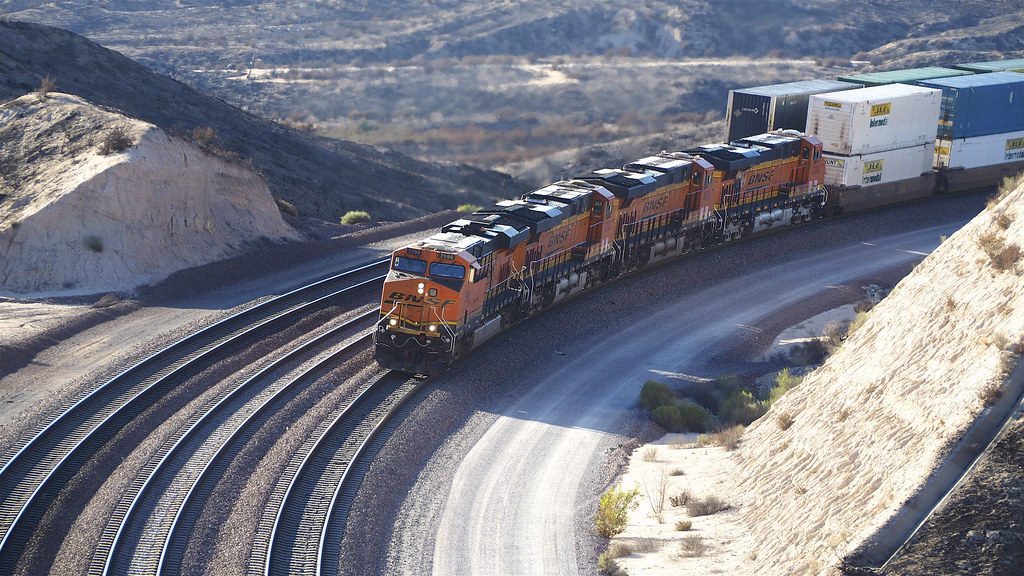
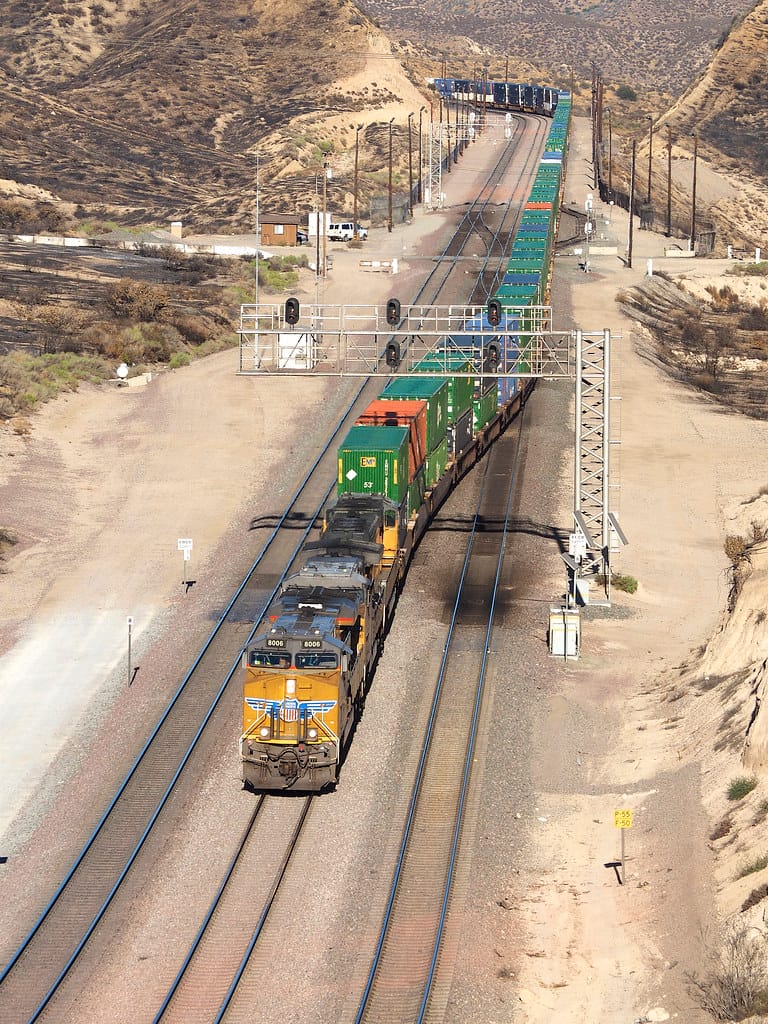
The busiest mountain railroad crossing in the United States, where BNSF's triple-track Cajon Subdivision and Union Pacific's Palmdale Cutoff funnel roughly 90 trains per day through a dramatic desert canyon between the San Bernardino and San Gabriel Mountains.
Photos
 Clay Gilliland
Attribution-ShareAlike License
Clay Gilliland
5
Trainspotting Experience
Cajon Pass Summit is a pilgrimage for serious railfans — one of the few places in North America where you can watch two Class I railroads operate four main tracks through a steep mountain corridor, all from public viewpoints within yards of the ballast. Access is via Forest Service roads that parallel the right-of-way off California Highway 138 and Summit Valley Road. From various pullouts, you can stand close enough to feel the ground shake as trains grind upgrade at 14 to 22 mph or descend using dynamic brakes at 20 to 30 mph.
The iconic viewing spot is Hill 582, an unofficial railfan overlook named for its USGS elevation contour. Maintained by volunteers who planted shade trees and installed benches, Hill 582 provides commanding views of all three BNSF main tracks and UP's Palmdale Cutoff simultaneously. On a good day, you can spot approaching headlights miles away, giving ample setup time. Expect mostly GE ES44C4s and EMD SD70ACes leading trains that routinely stretch beyond 10,000 feet. BNSF ended regular manned helper service in October 2009, switching to distributed power, though UP still maintains one helper pool.
Note that Summit itself is fenced, lit, and guarded by security. BNSF's Citizens for Rail Security program means private security patrols the area regularly. Stay on public Forest Service roads and respect railroad property boundaries. A high-clearance vehicle is recommended for reaching Hill 582 via the dirt access roads.
Landscape, Setting & Local Atmosphere
Summit sits at 3,777 feet elevation (reduced from 3,829 feet after AT&SF's 1972 realignment project that also eased curves from 10 to 4 degrees) at the transition between chaparral-covered slopes and high-desert scrub. The pass was carved by the San Andreas Fault, which runs directly through the area — Mormon Rocks, a striking white sandstone formation visible from Highway 138, marks the fault zone.
Joshua trees and scattered pinyon pine frame rail shots against tawny ridges. In winter, the peaks of the San Gabriel Mountains carry snow, adding contrast to the desert foreground. Visibility often exceeds 50 miles on clear days, though summer afternoons bring heat haze that distorts telephoto shots. The pass is notorious for wind — Santa Ana season (October through November) can bring gusts exceeding 60 mph, strong enough to topple trucks on nearby I-15. The area sits within the San Bernardino National Forest, a 676,000-acre preserve established in 1907. Spring and autumn offer the most comfortable shooting conditions with crisp light and moderate temperatures.
Type & Frequency of Train Activity
Both BNSF Railway and Union Pacific use Cajon Pass as a primary gateway between Southern California ports and the rest of the nation. BNSF’s Cajon Subdivision—three main tracks—handles an average of 65–75 trains per 24 hr, heavily weighted toward double-stack intermodal, manifest freight, autoracks, and ethanol or crude oil unit trains. Union Pacific’s Mojave Subdivision adds roughly 20–25 trains daily, including northbound stack trains bound for the Central Valley and Nevada, as well as rock and military movements from the nearby Marine Corps Logistics Base. Passenger action is limited but notable: Amtrak’s Southwest Chief glides over the pass once each direction in the early morning and late evening, its Superliner cars providing a welcome splash of color amid the freight parade.
Best Angles for Photos & What Railfans Enjoy Most
Hill 582 (GPS: N 34.33343, W 117.45536) is the premier location, offering elevated views of all four tracks. In winter, it provides all-day light on trains; in summer, morning and afternoon work best. A wide-angle lens captures the dramatic convergence of multiple tracks, while a 200-300mm telephoto compresses the S-curves stretching toward the High Desert. From the hilltop, you can shoot both uphill and downhill trains on BNSF mains 1, 2, and 3 plus the UP Palmdale Cutoff.
The Highway 138 overlook (USFS Summit Scenic Overlook) has a small unpaved parking area on the north side and offers head-on views of trains cresting the grade. Best lit mid-morning to early afternoon. The viewpoint is at the edge of a cliff — exercise caution.
Sullivan's Curve (GPS: N 34.29914, W 117.47364), lower in the pass, provides classic sweeping curve shots with Mormon Rocks as a backdrop. Accessible via Cajon Boulevard (old Route 66) from the Kenwood Avenue or Cleghorn Road exits off I-15.
Morning light favors eastbound trains climbing from San Bernardino. Golden hour produces dramatic silhouettes of westbound stacks. Night photography is productive here due to minimal light pollution — long exposures capture trains streaking beneath desert stars.
Historical or Cultural Relevance
The original single-track Santa Fe line opened through Cajon Pass in 1885, effectively linking Los Angeles with the rest of the United States. A second track followed in 1913 to handle booming citrus and oil traffic. Southern Pacific (now UP) completed its Palmdale Cutoff in 1967, giving SP a lower-grade route to the ports and introducing competitive drama still felt today. BNSF’s 2008 third mainline project at Summit eliminated a decades-old bottleneck and stands as one of the largest recent capacity upgrades in U.S. mountain railroading. Artifacts of earlier eras—abandoned telegraph poles, concrete mileposts, and foundation remnants of helper-station cabins—dot the hillsides, silently narrating 140 years of rail history.
What Makes This Spot Different
Cajon Pass is widely regarded as the busiest railroad mountain crossing in the United States. With BNSF's $90-million third main track (completed November 3, 2008, adding nearly 16 miles of track and increasing theoretical capacity from 100 to 150 trains per day), the pass handles an extraordinary volume and variety of traffic. Few locations offer simultaneous views of four main tracks operated by two competing Class I railroads.
The accessibility sets Cajon apart — public Forest Service roads and Highway 138 viewpoints bring you within arm's reach of mainline action, unlike many remote mountain passes that require long hikes. The constant flow (a train roughly every 10-15 minutes during peak periods) means minimal downtime. The mix includes double-stack intermodal, manifest freight, autoracks, unit grain and oil trains, and Amtrak's Southwest Chief — providing variety that keeps every hour interesting.
The pass is also evolving: Brightline West high-speed rail is under construction through Cajon Pass as part of the Las Vegas to Rancho Cucamonga route following the I-15 corridor, adding another chapter to over 140 years of railroading history through this gap in the mountains.
Frequently Asked Questions
QHow many trains per day pass through Cajon Pass?
Approximately 90 or more trains per day. BNSF averages about 70 trains daily on its three main tracks, Union Pacific averages about 20 on the Palmdale Cutoff, and Amtrak Southwest Chief runs once in each direction daily.
QHow do I get to Hill 582?
From Highway 138, take the dirt Forest Service roads south toward the BNSF tracks. A high-clearance vehicle is strongly recommended. Use GPS coordinates N 34.33343, W 117.45536. Access is via Powerline Road, approximately 2.3 miles east of the I-15/Highway 138 interchange.
QIs it safe to visit Cajon Pass for trainspotting?
Yes, as long as you stay on public Forest Service roads and never walk on railroad property. Summit itself is fenced, guarded, and off-limits. BNSF security patrols regularly. Bring water, sun protection, and be aware of rattlesnakes in warm months.
QWhat radio frequencies should I monitor at Cajon Pass?
BNSF: 161.190 MHz (AAR 72) San Bernardino to Hodge, 160.085 MHz (AAR 4) Hodge to Barstow. UP: 160.740 MHz (AAR 42) Colton to Hiland, 160.320 MHz (AAR 14) Hiland to Bakersfield. BNSF and UP dispatchers work from a joint facility in San Bernardino.
QWhen does Amtrak pass through?
The Southwest Chief runs daily between Chicago and Los Angeles, passing through Cajon Pass in the early morning (westbound to LA) and late evening (eastbound to Chicago). Check Amtrak schedule for current times.
Safety Tips
Stay on public USFS roads and respect railroad property boundaries — Summit is fenced and guarded, and BNSF security actively patrols. Never walk on or cross the tracks. Hill 582 requires a high-clearance vehicle on dirt roads; conditions deteriorate after rain. The Highway 138 overlook is at a cliff edge. Bring plenty of water, sunscreen, and wind protection year-round. Rattlesnakes are present in warm months. Cell service is spotty in some areas. Report suspicious activity to BNSF: 1-800-832-5452.
Seasonal Information
Year-round destination. Spring (March-May) and fall (September-November) offer the most comfortable temperatures and clearest skies. Summer brings intense heat (often exceeding 100F) and afternoon heat haze that distorts telephoto shots, but longer daylight hours compensate. Winter can bring occasional snow dustings above the pass creating dramatic backdrops, though dirt road access to Hill 582 may be muddy after rain. Santa Ana wind events (October-November) can be uncomfortable but produce exceptionally clear air once winds subside.
Nearby Lodging
- Cajon Pass Inn (Best Western)
The closest hotel to the pass, located at the junction of Highway 138 and I-15. Basic but convenient. Pool, hot tub, free Wi-Fi. Mixed reviews — book for proximity, not luxury.
- Holiday Inn Express & Suites Hesperia
Modern hotel in Hesperia, about 15 minutes from the Summit area. Indoor pool, free breakfast. Good mid-range option for a multi-day railfanning trip.
- SpringHill Suites by Marriott Victorville Hesperia
Suite-style rooms near Hesperia, about 15-20 minutes from the pass. Free breakfast, pool. Good for extended stays.
- Motel 6 Hesperia
Budget option in Hesperia, about 15 minutes from the pass. Basic accommodations — good for railfans who plan to spend all day trackside.
Nearby Attractions
3.1 miles / 5 km
Striking white sandstone formations along the San Andreas Fault, visible from Highway 138. Short interpretive trail with views of trains winding through the pass below.
18.6 miles / 30 km
Located in the restored 1918 Santa Fe Depot, this museum houses the Santa Fe Western Archives and railroad memorabilia. Over 100 freight trains pass the depot daily. Open Saturdays.
15.5 miles / 25 km
Free museum in Old Town Victorville celebrating Route 66 history, housed in the 1930s-era Red Rooster Cafe. Exhibits include railroad history alongside highway heritage.
6.2 miles / 10 km
Scenic reservoir located just northeast of the pass, offering fishing, boating, hiking, and camping with mountain views. Good for a half-day break from railfanning.
46.6 miles / 75 km
The West's largest railway museum with 200+ historic vehicles including Pacific Electric Red Cars. Ride vintage trains and trolleys on weekends. About 1 hour south via I-215.
External Links
informative
informative
informative
informative
Looking for more spots? Browse the complete list of train spotting locations.
Quick Information
Country
USA
Region
California
City
Hesperia
Spot Type
Mountain Pass
Best Times
Trains run 24/7, but daylight hours offer the best viewing. Early morning (sunrise to 10 AM) provides excellent warm light on eastbound trains climbing the grade. Late afternoon golden hour backlights westbound stacks against the Mojave sky. Traffic tends to be heavier later in the week. The Amtrak Southwest Chief passes in early morning and late evening.
Visit Duration
2-6 hours (minimum 2 hours to appreciate the traffic volume; many railfans spend a full day)
Cost
Free access. No entrance fees or Adventure Pass required.
Train Activity
Train Types
Frequency
Approximately 90+ trains per day: BNSF averages 70 trains/day on three main tracks, UP averages 20 trains/day on the Palmdale Cutoff, plus Amtrak's Southwest Chief twice daily (one each direction).
Access & Amenities
Parking
Available (Free — informal dirt pullouts at Hill 582 and along Forest Service roads. The USFS Summit Scenic Overlook on Highway 138 has a small unpaved parking area.)
Shelter
Not available
Restrooms
Not available