Colton (Colton Crossing)
Historic junction where Union Pacific's Sunset Route crosses BNSF's Southern Transcon in Colton, California. Built in 1883, the crossing saw over 110 trains daily before a $93-million flyover was completed in August 2013, lifting UP tracks 35 feet above BNSF.
Photos
 Clay Gilliland
Attribution-ShareAlike License
Trainspotting Experience
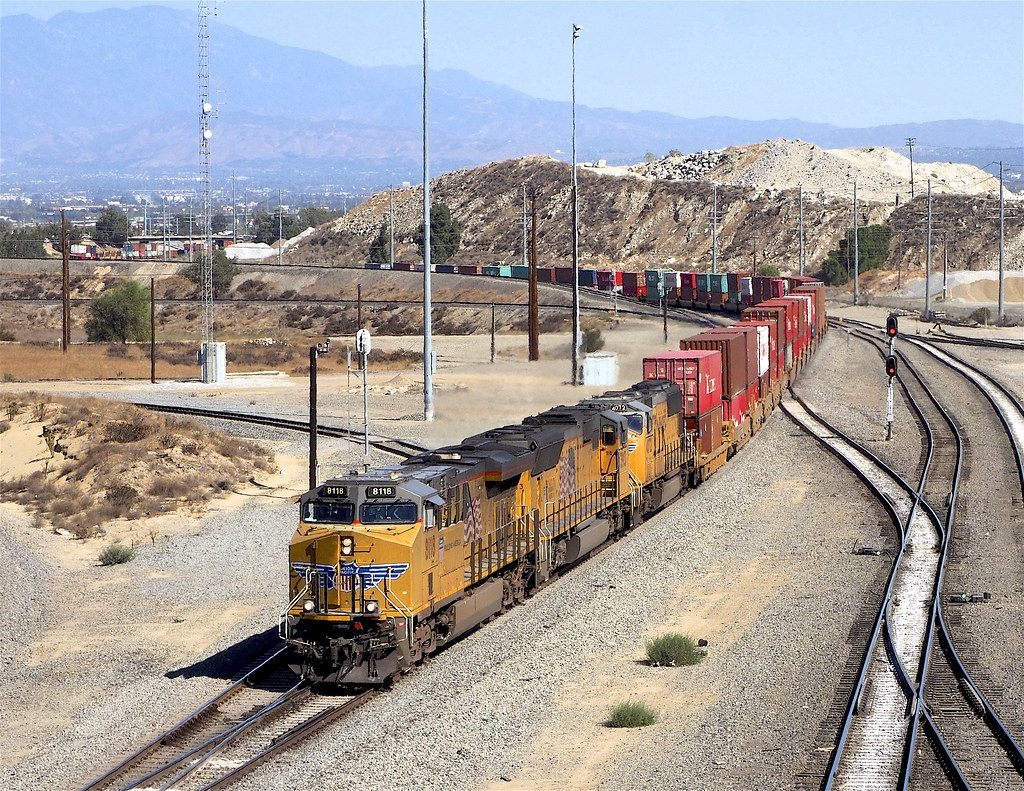
Colton Crossing sits directly south of Interstate 10 where Union Pacific's east-west Sunset Route (Yuma Subdivision) crosses BNSF's north-south Southern Transcon (San Bernardino Subdivision). Since 2013, UP trains ride a 2.2-kilometer (1.4-mile) concrete flyover 35 feet above the BNSF tracks below, creating a layered railfanning experience unlike any flat diamond.
The volume is relentless — over 100 trains per day funnel through this junction, carrying intermodal containers from the Ports of Los Angeles and Long Beach, manifest freight, unit trains of autos and bulk commodities, and occasional passenger consists. Westbound UP trains descend from the flyover toward West Colton Yard, while BNSF stacks and manifests roll north toward San Bernardino Yard and onward to Cajon Pass and Barstow. A single at-grade UP emergency track was retained beneath the flyover, preserving the last fragment of the original Colton Diamond.
Railfans typically set up along South Rancho Avenue, which runs parallel to the BNSF main on the east side of the crossing, offering clear sightlines of both railroads simultaneously. The west side along Agua Mansa Road provides a lower angle under the flyover structure. Bring a scanner for UP and BNSF road frequencies — expect near-constant radio chatter given the train density. Ear protection is advisable close to the flyover, and ground vibration from passing consists is noticeable.
Landscape, Setting & Local Atmosphere
Colton lies in the broad San Bernardino Valley at roughly 1,000 feet elevation, surrounded by the San Gabriel Mountains to the west and the taller San Bernardino Mountains to the northeast — both occasionally snow-capped in winter. The terrain around the crossing is flat and industrial, with warehouses and logistics facilities flanking the rights-of-way on both sides. The constant hum of Interstate 10, running parallel to the UP flyover just to the north, provides a backdrop of ambient noise.
The flyover itself dominates the visual landscape: a massive concrete embankment stretching 8,150 feet (per HDR Engineering) with decorative retaining walls that incorporate community-themed designs. Below, the BNSF main runs at grade through what was once the original diamond. Despite the industrial setting, clear post-frontal days — common in fall and winter — deliver startling visibility toward the San Bernardino peaks, placing dramatic mountain backdrops behind passing trains. Summer afternoons are hot and hazy in the Inland Empire, with temperatures frequently exceeding 100°F, while winter and spring mornings are crisp with clean air.
Type & Frequency of Train Activity
Two Class I carriers converge here. BNSF's Southern Transcon runs north-south through the crossing, carrying high-priority intermodal, domestic stack trains, and manifest freight between the LA Basin and Cajon Pass en route to Barstow and ultimately Chicago. Union Pacific's Sunset Route runs east-west on the flyover, handling intermodal, manifest freight, and traffic from the Coachella Valley heading to West Colton Yard and onward to Los Angeles.
Amtrak's Sunset Limited (tri-weekly, New Orleans–Los Angeles) uses the UP tracks, while Amtrak's Southwest Chief (daily, Chicago–Los Angeles) and Metrolink commuter trains on the San Bernardino Line use the BNSF tracks through the crossing. Note that passenger trains pass through Colton but do not stop — the nearest Metrolink station is San Bernardino to the north.
Pre-flyover, the crossing handled over 110 trains daily with average delays of 50 minutes and waits of up to four hours. The 2013 grade separation eliminated these conflicts entirely, and with traffic projected to grow, daily train counts have likely increased further since the flyover opened.
Best Angles for Photos & What Railfans Enjoy Most
The flyover structure creates a unique two-level composition. From the east along South Rancho Avenue, you can capture UP trains riding the elevated concrete embankment while BNSF trains pass underneath at grade — a dual-railroad shot that few other locations in North America can offer. Morning light illuminates eastbound BNSF movements nose-on, and the San Bernardino Mountains provide a dramatic backdrop on clear days.
From the west near Agua Mansa Road, a lower vantage frames BNSF power beneath the curving flyover superstructure — ideal for illustrating the scale of the grade separation. Late afternoon light works best here, backlighting dust and exhaust for atmospheric shots.
Bring lenses ranging from 24mm wide-angle (to capture the full sweep of the flyover with a train on top and below simultaneously) to 200-300mm telephoto for tight roster shots of individual locomotives. A polarizing filter helps cut midday glare off locomotive paint. Best light for photography runs October through March when the sun stays lower and winter storms occasionally cap the nearby mountains with snow.
Historical or Cultural Relevance
Colton Crossing dates to 1883, when the California Southern Railroad (a subsidiary of the Atchison, Topeka and Santa Fe Railway) needed to cross the rival Southern Pacific Railroad's east-west tracks. The installation triggered one of the most dramatic "frog wars" in American railroad history. SP hired lawman Virgil Earp — later Colton's first city marshal — to guard its tracks, and an SP locomotive drove back and forth at the crossing point to physically block construction. On September 13, 1883, the confrontation known as the "Battle of the Crossing" reached its peak: armed citizens from Colton and San Bernardino gathered on opposite sides of the tracks, revolvers drawn. California Governor Robert Waterman personally intervened, ordering San Bernardino County Sheriff J.B. Burkhart to enforce a court order. The crossing was installed that day, and the first train to San Bernardino arrived.
The town of Colton itself was founded by the Southern Pacific Railroad in 1875, named for David Douty Colton, an SP Vice President. For 130 years, the at-grade diamond was one of the busiest rail-to-rail crossings in the United States. In November 2011, construction began on a $93-million flyover (originally budgeted at $202 million), elevating UP's east-west tracks over BNSF's north-south tracks. Led by contractor Skanska and designed by HDR Engineering, the project was completed in August 2013, eight months ahead of schedule and over $100 million under budget. The innovative use of cellular concrete embankments was key to the cost savings. The flyover reduced horn blasts by 50%, cut mobile source air toxins by 76.7%, and eliminated an estimated $241 million in annual travel-time losses.
What Makes This Spot Different
Colton Crossing is one of the only locations in North America where you can simultaneously watch trains from both major western Class I railroads — Union Pacific and BNSF — operating on their own separate routes without repositioning. The flyover structure adds a vertical dimension: UP trains ride 35 feet above BNSF trains at grade, creating layered compositions that flat-diamond crossings like Rochelle, Illinois or Dalhart, Texas cannot match.
The historical significance is unparalleled among American railroad crossings. The 1883 "Battle of the Crossing" involving Virgil Earp, an armed standoff, and a governor's personal intervention is the stuff of Wild West legend. The connection to Santa Fe locomotive No. 3751 — the oldest surviving 4-8-4 in the world, built in 1927 and restored by the San Bernardino Railroad Historical Society — adds another layer of heritage. ATSF 3751 has made multiple excursion trips to San Bernardino for Railroad Days festivals, passing through the very junction where the Santa Fe first crossed the Southern Pacific over 140 years ago.
Frequently Asked Questions
QHow many trains pass through Colton Crossing daily?
Over 100 trains per day use the combined UP and BNSF lines at Colton. Before the 2013 flyover was built, the crossing handled over 110 trains daily on the at-grade diamond, frequently causing delays of up to four hours.
QWhen was the Colton Crossing flyover completed?
The flyover was completed in August 2013, eight months ahead of schedule. The $93-million project (originally budgeted at $202 million) lifted Union Pacific's east-west Sunset Route tracks 35 feet above BNSF's north-south Southern Transcon tracks.
QCan I watch trains at Colton Crossing from public areas?
Yes. South Rancho Avenue on the east side and Agua Mansa Road on the west side both offer public vantage points near the crossing. Always stay on public property and observe railroad safety rules — never trespass on the tracks or railroad right-of-way.
QWhat is the Battle of the Crossing?
On September 13, 1883, an armed confrontation erupted when the California Southern Railroad attempted to install a crossing over Southern Pacific's tracks. SP hired lawman Virgil Earp to block the construction. California Governor Robert Waterman personally intervened, ordering the sheriff to enforce a court order allowing the crossing to be built.
QDoes Amtrak stop at Colton?
No. Amtrak's Sunset Limited (UP tracks) and Southwest Chief (BNSF tracks) pass through Colton but do not stop. Metrolink commuter trains also pass through without stopping. The nearest Metrolink station is San Bernardino, a few miles to the north.
Safety Tips
Stay on public roads and sidewalks — never trespass on railroad property or climb the flyover embankment. The crossing sees constant train traffic in both directions, so maintain situational awareness at all times. Ground vibration and noise from passing trains are significant near the flyover. Bring ear protection if spending extended time close to the tracks. Summer heat in the Inland Empire can be extreme; carry water and wear sun protection.
Seasonal Information
Clear winter days (November–February) provide the sharpest visibility and snow-capped mountain backdrops. Summer (June–September) brings extreme heat exceeding 100°F and frequent haze reducing visibility. Spring and fall offer moderate temperatures with occasional clear days. Train traffic is consistent year-round with no significant seasonal variation.
Nearby Lodging
- Best Western Plus Arrowhead Hotel
Located off I-10 in Colton. Free hot breakfast, heated pool, free parking. Close to the crossing.
- Comfort Inn & Suites Colton
Off I-10 in Colton with BBQ facilities, free parking, and proximity to the crossing area.
- Holiday Inn Express Colton-Riverside North
Business-friendly hotel off I-10 with workspace amenities and complimentary breakfast.
- DoubleTree by Hilton San Bernardino
Full-service hotel in San Bernardino with pool, on-site restaurant, and easy I-10 access to Colton.
Nearby Attractions
4 miles / 6.4 km
Free museum housed in the restored 1918 Santa Fe Depot. Exhibits on railroad history, vintage locomotives, model trains, and Route 66. ATSF 3751 has visited for Railroad Days festivals.
1.5 miles / 2.4 km
Local history museum covering Colton's railroad heritage, the Battle of the Crossing, and the city's founding by the Southern Pacific Railroad in 1875.
20 miles / 32 km
One of the most famous railfanning locations in the western US, where BNSF and UP trains climb through the San Bernardino Mountains. Accessible via I-15 north from Colton.
2 miles / 3.2 km
Major Union Pacific classification yard located just west of the crossing. Visible from public roads, with trains constantly arriving and departing along the Sunset Route.
10 miles / 16 km
Regional museum in Redlands with exhibits on natural history, anthropology, and a Route 66 exhibition. Good complement to a railfanning day trip.
3.5 miles / 5.6 km
The site of the original 1940 McDonald's restaurant on Route 66 in San Bernardino, now an unofficial museum with memorabilia.
External Links
informative
informative
informative
Looking for more spots? Browse the complete list of train spotting locations.
Quick Information
Country
USA
Region
California
City
Colton
Spot Type
Junction
Best Times
Daylight hours year-round. Trains run 24/7 but photography requires natural light. Morning light is best for east-facing shots of BNSF trains; afternoon favors westbound UP movements on the flyover.
Visit Duration
1-3 hours
Cost
Free — public road access, no admission fee
Train Activity
Train Types
Frequency
Over 100 trains per day combined on both railroads (UP and BNSF). Pre-flyover counts exceeded 110 daily; some sources cite up to 120-125.
Access & Amenities
Parking
Available
Shelter
Not available
Restrooms
Not available