
Dallas Union Station
Historic 1916 Beaux-Arts station where DART light rail, TRE commuter trains, Amtrak's Texas Eagle, and UP/BNSF freight share tracks in downtown Dallas.
Photos
 davidwilson1949
Attribution License
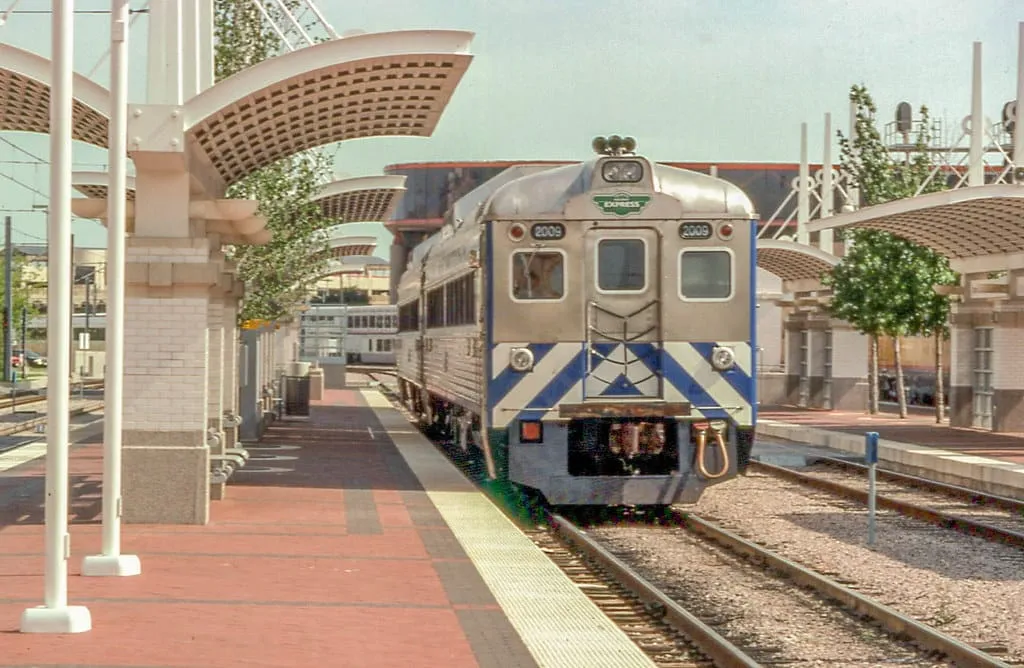
davidwilson1949
Attribution License
Trainspotting Experience
Dallas Union Station — officially Eddie Bernice Johnson Union Station since 2019 — puts you at the nerve center of North Texas railroading. The station platforms are tiered by service: DART light-rail occupies the two tracks closest to the headhouse, TRE commuter trains use the next track over, Amtrak's Texas Eagle loads on the outermost passenger platform, and beyond that Union Pacific and BNSF freight roll on the double-track former Texas & Pacific main line (UP's Dallas Subdivision). The shortline Dallas, Garland & Northeastern (DGNO) also passes through, switching industrial spurs north and west of downtown.
From the platforms you have a clear field of view in both directions. DART Red and Blue line trains appear roughly every five minutes during rush hours and every ten minutes off-peak, running seven days a week. TRE commuter trains operate Monday through Saturday, approximately hourly outside rush periods. Amtrak's Texas Eagle calls once northbound (toward Chicago) and once southbound (toward San Antonio or Los Angeles) each day.
A short walk south — about eight to ten minutes — brings you to the Houston Street Viaduct, which offers an elevated overhead perspective of the entire corridor. From the viaduct you can frame DART, TRE, Amtrak, UP, BNSF, and DGNO movements against the downtown skyline. The station itself is fully accessible by transit: you can literally ride in on DART or TRE and step off onto the viewing platforms — no car needed.
Landscape, Setting & Local Atmosphere
Union Station sits at the western edge of downtown Dallas in the Reunion district, at an elevation of roughly 430 feet. The 1916 Beaux-Arts headhouse, designed by architect Jarvis Hunt, features Neoclassical columns, arched windows soaring beneath 48-foot ceilings, and exterior walls clad in locally quarried red Texas granite with terracotta trim. Reunion Tower — the iconic 561-foot geodesic-sphere observation tower — rises just 520 feet to the southwest, providing a dramatic backdrop for platform-level shots of departing trains.
To the north, Dealey Plaza and Ferris Plaza sit within a five-minute walk. The tracks run roughly north-south through a corridor flanked by downtown office towers to the east and the Trinity River levee system to the west, creating an urban canyon that funnels sound and gives photographs a strong sense of scale. Summers in Dallas bring intense heat (average highs above 95 °F from June through August) and harsh midday light; winter mornings can produce crisp golden light ideal for photography. Spring and fall offer the most comfortable conditions for extended trackside sessions.
Type & Frequency of Train Activity
The station hosts four distinct rail services plus freight traffic, making it one of the most diverse railfan locations in Texas.
DART Light Rail: The Red Line (Westmoreland to Parker Road) and Blue Line (UNT Dallas to Downtown Rowlett) both stop here. Combined, they produce roughly 12 trains per hour per direction during peak periods and 6 per hour off-peak. DART uses custom-built Kinki Sharyo SLRV vehicles powered by overhead catenary at 750V DC.
Trinity Railway Express (TRE): This commuter rail service connects Dallas Union Station with Fort Worth's T&P Station, serving 10 intermediate stops over 34 miles. TRE runs Monday through Saturday with approximately hourly service off-peak and increased frequency during rush hours. No Sunday service except during special events like the State Fair of Texas.
Amtrak Texas Eagle: One northbound and one southbound train daily, connecting Chicago with San Antonio (and three-times-weekly through service to Los Angeles). The train typically uses Superliner equipment.
Freight: Union Pacific is the dominant freight carrier on the Dallas Subdivision, the double-track former Texas & Pacific mainline between Fort Worth and Dallas. Expect manifest freights, intermodal trains, and unit rock trains. BNSF holds trackage rights and occasionally runs trains through the station corridor, typically during off-peak commuter hours. The shortline Dallas, Garland & Northeastern (DGNO) makes transfer runs and switches industrial spurs in the area.
Dallas Streetcar: A 2.45-mile modern streetcar line connects Union Station southward across the Houston Street Viaduct to the Bishop Arts District in Oak Cliff, using Brookville Liberty articulated cars that can run on battery power across the viaduct.
Best Angles for Photos & What Railfans Enjoy Most
Houston Street Viaduct (south of station): The viaduct provides an elevated three-quarter overhead angle of the entire track corridor. From here you can capture full trainsets against the downtown skyline. Best light in the afternoon when the sun illuminates westbound movements. Walk time from platforms: 8–10 minutes. Look for the stairway from the parking area east of the tracks.
Station platforms: Eye-level shots of DART, TRE, and Amtrak arrivals and departures. The tiered track arrangement means you can frame different services side by side. The platform canopies provide shade for long sessions and even overhead lighting for blue-hour exposures.
CP T219 / Trinity River Levee (west of downtown): Take Commerce Street west, exit at Beckley, go north one block to the tracks, then park along the levee and climb up. From here you get clear views of UP intermodal, manifest, and rock trains crossing the Trinity River bridge. Sunsets behind outbound westbound trains can be dramatic.
Over Elm & Main Street bridge (north of station, GPS ~32.7785, -96.8095): This bridge carries two light-rail tracks and three mainline tracks. Good vantage for trains entering or leaving the station throat area. Towers 106 and 107 — historic interlocking towers now owned by DART — are visible from this area.
Tripods are permitted on public sidewalks. The DART police office is located inside Union Station; it may be advisable to check in before extended photography sessions on the platforms.
Historical or Cultural Relevance
Dallas Union Station opened on October 14, 1916, built by the Dallas Union Terminal Company at a cost of $1.3 million. Architect Jarvis Hunt designed the Beaux-Arts Neoclassical building to consolidate five scattered passenger depots serving seven railroads: the Atchison, Topeka & Santa Fe, St. Louis Southwestern (Cotton Belt), Fort Worth & Denver, Chicago Rock Island & Pacific, Burlington-Rock Island, St. Louis & San Francisco (Frisco), Missouri-Kansas-Texas (Katy), Southern Pacific, and Texas & Pacific.
The station was the product of the 1911 Kessler Plan, a comprehensive civic development blueprint for Dallas that also called for a belt rail line around the city and the removal of tracks from downtown streets. At its peak in the 1920s, Union Station handled up to 80 trains daily. Notable trains serving the station included the Texas Zephyr, Texas Chief, Texas Eagle, Texas Rocket, and Texas Special.
The station hosted notable visitors including President Harry Truman during his 1948 campaign, First Lady Eleanor Roosevelt, and presidential candidate Dwight Eisenhower in 1952. Elvis Presley was famously mobbed by fans passing through in 1960. Tower 106, the interlocking tower just north of the station, gained unexpected notoriety when operator Lee Bowers witnessed events surrounding the JFK assassination from its elevated vantage point on November 22, 1963.
The last privately operated passenger train — the Missouri Pacific's Texas Eagle — departed on May 31, 1969, making Dallas the first major U.S. city to lose passenger rail. Amtrak restored service on March 14, 1974, with the Inter-American (St. Louis–Laredo), which evolved into today's Texas Eagle. The station was renovated in 1978 as part of the Reunion development that added the Hyatt Regency Hotel and Reunion Tower, and again in 2008 in a $23 million modernization. DART light rail arrived on June 14, 1996, and the Dallas Streetcar began service in April 2015. In 2019, the station was renamed in honor of U.S. Congresswoman Eddie Bernice Johnson. The building is listed on the National Register of Historic Places and designated a Dallas Landmark.
What Makes This Spot Different
Dallas Union Station is one of very few locations in the United States where Class I freight (UP, BNSF), intercity passenger (Amtrak), commuter rail (TRE), light rail (DART), a modern streetcar, and a shortline railroad (DGNO) all share contiguous trackage within a downtown core. The variety of motive power is exceptional — diesel locomotives on freight, electric catenary-powered DART trains, diesel-powered TRE consists, Amtrak Superliners, and battery-capable streetcars all pass within minutes of each other.
The station is fully transit-accessible: visitors can arrive by DART light rail from DFW Airport, by TRE from Fort Worth, or by Amtrak from across the country, and step directly onto the viewing platforms. No car is required. The urban canyon setting, with Reunion Tower and downtown skyscrapers as backdrop, creates photographic compositions unavailable at rural trainspotting locations.
Scanner enthusiasts can monitor four frequencies for comprehensive coverage: 160.410 MHz (UP Dallas West Dispatcher), 161.280 MHz (UP Terminal Dispatcher), 161.340 MHz (BNSF DFW Sub Dispatcher), and 161.355 MHz (TRE).
Frequently Asked Questions
QIs there parking at Dallas Union Station?
There is no public parking at the station itself. Several pay parking lots and metered street parking are available within a few blocks. The easiest option is to arrive by DART light rail (Red or Blue line) or TRE, avoiding downtown parking entirely.
QWhat Amtrak trains serve Dallas Union Station?
Amtrak's Texas Eagle serves the station with one northbound train (toward Chicago) and one southbound train (toward San Antonio, with thrice-weekly through service to Los Angeles) each day.
QDoes freight traffic pass through the station?
Yes. Union Pacific runs manifest, intermodal, and unit rock trains on the double-track Dallas Subdivision (former Texas & Pacific mainline). BNSF has trackage rights and occasionally routes trains through the corridor. The shortline Dallas, Garland & Northeastern (DGNO) also makes runs through the area.
QWhat are the best scanner frequencies for Dallas Union Station?
Monitor 160.410 MHz for UP Dallas West Dispatcher, 161.280 MHz for UP Terminal Dispatcher, 161.340 MHz for BNSF DFW Sub Dispatcher, and 161.355 MHz for TRE communications.
QIs the station safe for trainspotting?
The station is a public transit facility with DART police on site. Platform access is open to transit passengers. For extended photography sessions, it may be advisable to check in with DART police inside the station. Stay behind safety lines and be aware of your surroundings, particularly after dark.
Safety Tips
DART police maintain a presence inside the station. Platform photography is generally tolerated but checking in with DART police before extended sessions is recommended. The Houston Street Viaduct has public sidewalks. Freight tracks are Union Pacific property — stay on public platforms and sidewalks. Be aware of your surroundings, especially after dark in the parking areas south of the station.
Seasonal Information
Dallas summers (June–August) bring temperatures regularly exceeding 95°F with high humidity — bring water and sun protection. Spring wildflower season (March–April) adds color to the Trinity River bottoms west of the tracks. Fall offers mild weather and clear skies ideal for photography. Winter mornings occasionally produce fog along the Trinity River that can create atmospheric train photos.
Nearby Lodging
- Hyatt Regency Dallas at Reunion
Connected directly to Union Station via climate-controlled tunnel. Adjacent to Reunion Tower. The closest possible lodging for trainspotting at the station.
- Courtyard by Marriott Dallas Downtown/Reunion District
Located at 310 S. Houston St., a two-minute walk from Union Station platforms. Mid-range option in the Reunion district.
- Holiday Inn Express Dallas Downtown
Budget-friendly option in the West End Historic District, within walking distance of Union Station, Dealey Plaza, and the convention center.
- SpringHill Suites Dallas Downtown/West End
All-suite hotel in the West End Historic District, short walk to Union Station. Free breakfast included.
- Omni Dallas Hotel
Full-service upscale hotel near the convention center, about 0.6 miles from Union Station. Pool, spa, and multiple restaurants.
Nearby Attractions
0.25 miles / 0.4 km
Museum chronicling the assassination and legacy of President Kennedy, housed in the former Texas School Book Depository. Open Wed-Sun, timed tickets recommended.
0.1 miles / 0.2 km
Iconic 561-foot observation tower with GeO-Deck offering 360-degree views of Dallas. Restaurant and bar at the top. Immediately adjacent to Union Station.
1.2 miles / 2 km
Free vintage streetcar service running through the Uptown restaurant and bar district. Connects to DART at CityPlace station. Runs daily, approximately every 20 minutes.
30 miles / 48 km
Railroad museum in Frisco, TX with over 70 pieces of rolling stock including a Union Pacific Big Boy. Features TrainTopia G-scale model railroad exhibit. About 30 miles north of downtown Dallas.
22 miles / 35 km
Heritage railroad operating excursion trains on former Cotton Belt trackage between Grapevine and Fort Worth Stockyards. Seasonal Day Out with Thomas events.
0.25 miles / 0.4 km
The birthplace of Dallas and site of the JFK assassination. A five-minute walk north from Union Station, with the historic grassy knoll and Triple Underpass.
External Links
official
Looking for more spots? Browse the complete list of train spotting locations.
Quick Information
Country
USA
Region
Texas
City
Dallas
Spot Type
Railway Station
Best Times
Weekday mornings and late afternoons offer the densest mix of DART, TRE, and freight. Amtrak's Texas Eagle typically passes mid-morning northbound and late evening southbound. TRE does not run Sundays.
Visit Duration
2-4 hours
Cost
Free access to platforms (with valid DART/TRE fare or Amtrak ticket). DART single ride: $2.50. Pay parking lots nearby: $5-15/day.
Train Activity
Train Types
Frequency
DART: every 5–10 min; TRE: roughly hourly weekdays; Amtrak: 2 daily (1 NB, 1 SB); freight: several UP trains plus occasional BNSF and DGNO transfers
Access & Amenities
Parking
Not available
Shelter
Available
Restrooms
Available