
Durand - Diamond & Depot
Historic 1903 Durand Union Station sits at the diamond where CN's Flint and Holly Subdivisions cross. Home to the Michigan Railroad History Museum, this junction sees 20-25 trains daily from CN, Huron & Eastern, Great Lakes Central, and Amtrak Blue Water.
Photos
 amtrak_russ
Attribution License
amtrak_russ
Attribution License
Trainspotting Experience
Durand Union Station sits in the northeast quadrant of a flat-crossing diamond where Canadian National's east-west Flint Subdivision (double track) intersects the north-south Holly Subdivision (single track). The station platform puts you within a few dozen feet of the rails, separated by a low iron safety fence. Three of the four connecting wye tracks are visible from the platform, and one runs directly in front of the station next to the parking lot.
The diamond uses O.W.L.S. (One Way Low Speed) frogs, meaning Flint Sub trains cross at track speed while Holly Sub trains must slow to 10 mph or less over the diamond — a detail that creates dramatically different sound profiles depending on which direction traffic is moving. When wheels hit the frogs, the metallic clang echoes through the quiet residential surroundings.
The station building houses restrooms (accessible when the museum is open), a gift shop, and the Michigan Railroad History Museum. Outside, picnic tables and a manicured lawn provide comfortable seating for extended sessions. The area is lit for evening railfanning. Parking is free in the lot adjacent to the station. Access is straightforward: from I-69, take exit 118, head southeast on MI-71/Monroe Road to Durand Road, then follow Amtrak signs to the station at 200 Railroad Street.
Landscape, Setting & Local Atmosphere
Durand sits on flat central Michigan glacial plain in Shiawassee County, a small city of about 3,500 people nicknamed "Railroad City, USA." The station grounds feature mature trees, seasonal flowerbeds, and vintage-style light standards. A restored Grand Trunk Western caboose (#75003) sits on static display across the tracks from the depot.
The surrounding neighborhood is quiet residential — modest houses with tree-lined streets extending in all directions from the tracks. To the east and west along the Flint Sub, the double track runs straight through town. The Holly Sub heads south toward Pontiac and north toward the CN yard just northwest of the station. In autumn, the tree canopy turns gold and provides photogenic framing for train shots. Winters bring snow-covered landscapes with stark rail-on-white contrast.
Despite the steady train traffic, Durand feels like a small-town gathering place rather than an industrial corridor. The annual Durand Railroad Days festival, held the weekend after Mother's Day since 1975, brings parades, carnival rides, model railroad flea markets, and historical tours to Diamond District Park and Iron Horse Park along the main line.
Type & Frequency of Train Activity
Canadian National dominates traffic on both subdivisions. The Flint Sub carries the bulk of the action with intermodal, manifest, and auto-rack trains running between Port Huron and Chicago via Battle Creek. The Holly Sub connects Pontiac/Detroit with Durand and sees roughly 5-6 trains per day. Combined with locals and short-line movements, expect approximately 20-25 trains in a 24-hour period.
Amtrak's Blue Water service (trains #364 and #365) stops at the station once daily in each direction, running between Chicago and Port Huron. These trains typically run with a locomotive on each end (push-pull configuration).
Huron & Eastern Railway (HESR), a Genesee & Wyoming subsidiary, interchanges at Durand and usually runs one weekday train. Great Lakes Central Railroad (GLC) also makes occasional movements through the diamond, typically heading north from the yard. The CN freight yard northwest of the station serves all three freight carriers and generates additional switching activity.
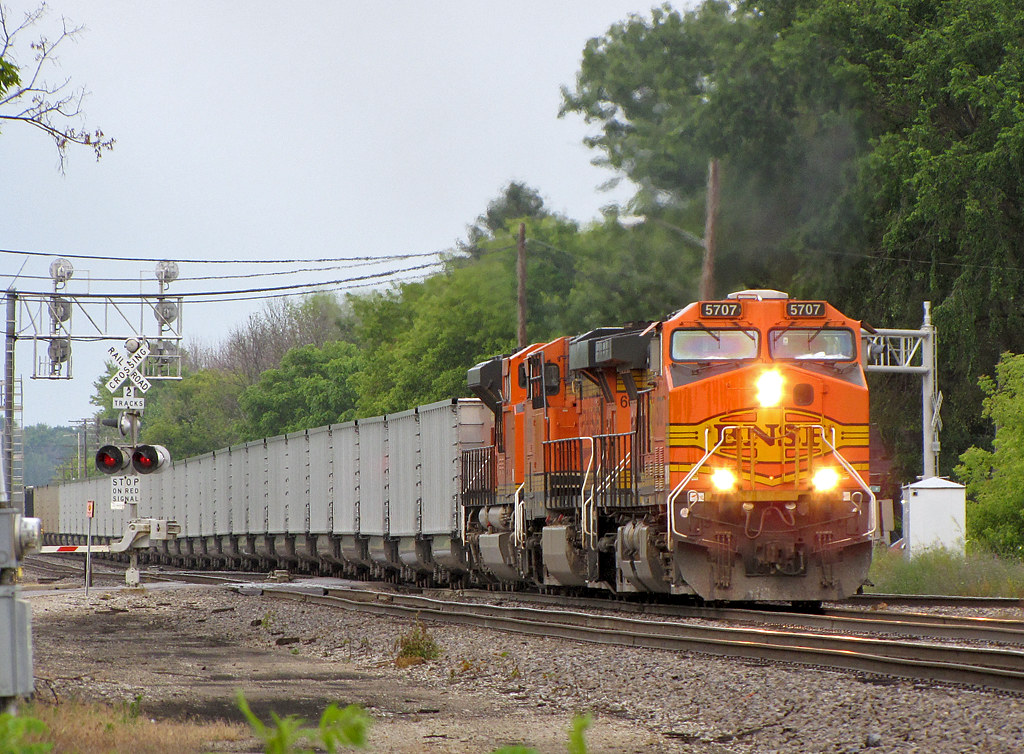
CN train consists through Durand often include a higher proportion of CN-owned equipment and Canadian containers than you'd see on US-centric railroads. Foreign power from UP, BNSF, and other roads appears regularly on CN trains, particularly on unit trains.
Best Angles for Photos & What Railfans Enjoy Most
The station platform offers the most accessible angles. From the southwest corner of the depot, you can capture northbound Holly Sub trains with the Chateau Romanesque station building as backdrop — best in late afternoon with the sun behind you.
East of the diamond, position yourself to frame westbound Flint Sub trains emerging past the station. Morning light from the southeast illuminates locomotive faces from this angle. The connecting wye tracks offer additional compositions as trains transition between subdivisions.
For a wider perspective, the station's turret (accessible during museum hours) provides an elevated view of the diamond and surrounding trackage — this was historically the command center for Grand Trunk and Ann Arbor operations.
Lens recommendations: a 70-200mm zoom covers most platform shots. For tight roster shots of locomotives crossing the diamond, 200-300mm works well. Wide-angle (24-35mm) is useful for capturing the full station building with trains passing. Night photography is feasible thanks to the platform lighting.
The coveted shot at Durand is catching simultaneous moves on both subdivisions — trains crossing the diamond from perpendicular directions at the same time.
Historical or Cultural Relevance
The Detroit and Milwaukee Railway brought rail service to this area in 1856, when the settlement was still called Vernon Center. In 1877, the Chicago and North Eastern Railroad arrived, creating the famous crossing. The Toledo, Ann Arbor and North Michigan Railroad (later the Ann Arbor Railroad) added its tracks in 1885. The village incorporated as Durand in 1887, named for congressman George H. Durand of Flint.
The Grand Trunk Railway System and the Ann Arbor Railroad built the current Union Station in 1903, designed by the Detroit architectural firm Spier & Rohns, at a cost of $60,000. The 239-foot-long depot was constructed of Missouri granite brick and Bedford cut stone. Just 18 months after completion, a fire nearly destroyed the building in 1905; it was rebuilt within six months as a near-replica.
At its peak, 42 passenger trains, 22 mail trains, and 78 freight trains passed through Durand daily, serving approximately 3,000 passengers per day. The Grand Trunk Roundhouse, built in 1908, was a unique 360-degree brick structure (since demolished in the 1960s). On March 27, 1960, Grand Trunk Western train No. 56 departed for Detroit — the last regularly scheduled passenger train in the United States pulled by a steam locomotive.
The station was listed on the National Register of Historic Places on June 6, 1971. GTW closed the station in 1974, but the city filed an injunction to prevent demolition and purchased it in 1979 for $1.00. Amtrak restored service in 1974. In 1990, the station became the official home of the Michigan State Railroad History Museum.
What Makes This Spot Different
Durand stands out as one of the few remaining active railroad diamond crossings in the United States where railfans can watch from a beautifully restored station platform just feet from the action. The combination of a National Register-listed 1903 depot, an active freight diamond, scheduled Amtrak service, and three different railroad operators at one location is exceptionally rare.
The station building itself houses three separate railroad museums — the Michigan Railroad History Museum, the Grand Trunk Western Railroad Museum, and the Ann Arbor Railroad History Museum — plus a model railroad club with over 1,300 feet of track on two levels, modeled after the local area. The turret that once served as the interlocking control point is now accessible to visitors.
The O.W.L.S. diamond frogs create a distinctive sound signature unique to this location. And the small-town atmosphere — where the city's identity is inseparable from its railroad heritage, from street murals to the Railroad Days festival — makes Durand feel like a living railroad museum rather than just a viewing location.
Frequently Asked Questions
QHow many trains pass through Durand per day?
Approximately 20-25 trains in a 24-hour period, including CN freights on the Flint and Holly Subdivisions, Amtrak Blue Water (2 daily), and occasional Huron & Eastern and Great Lakes Central movements.
QIs there an admission fee to watch trains at Durand?
No. The platform and grounds around the station are free and open to the public. The Michigan Railroad History Museum inside the station has a nominal admission fee and limited hours (typically Tuesday-Sunday, closed Mondays).
QWhat scanner frequencies should I use at Durand?
Key frequencies: CN Flint Sub Dispatcher (TD3) 161.220 MHz, CN Holly Sub Dispatcher (TD2) 160.530 MHz, also 160.845 MHz. HESR Road 160.575 MHz. GLC (CMGN) Road 161.280 MHz. Durand Yard 161.310 MHz.
QWhen is Durand Railroad Days?
Durand Railroad Days is held annually on the weekend after Mother's Day (typically mid-May). The festival has been running since 1975 and features parades, a carnival, historical tours, and railroad-themed activities.
QIs there food available near the station?
Nothing within immediate walking distance of the station. The Iron Horse Pub and Nick's Hometown Grill are a short drive into downtown Durand. Fast food restaurants (McDonald's, Subway) are located near the I-69 interchange north of town.
Safety Tips
The platform is protected by a low iron safety fence — stay behind it when trains are passing. CN road trains on the Flint Sub move fast. Holly Sub trains slow for the diamond but can still surprise you. Keep clear of the wye track connections. The station area is well-lit but use caution at night near the tracks. Standard railroad safety rules apply: never walk on or between tracks.
Seasonal Information
Durand is a year-round trainspotting destination. Summer offers the longest daylight hours and comfortable outdoor conditions. The Durand Railroad Days festival (weekend after Mother's Day, typically mid-May) is the peak event, featuring parades, historical tours, and extra activity around the station. Fall brings colorful foliage framing the tracks. Winter provides dramatic snow-on-rail photography but Michigan winters are cold — dress warmly and note that museum hours may be reduced. The museum is open Tuesday through Sunday in season (closed Mondays and holidays).
Nearby Lodging
- Quality Inn Durand I-69
The closest full-service hotel, located at the I-69 Durand exit (8511 East Lansing Rd). Free breakfast, pool, free parking. About 2 miles from the station.
- Sunset Motel
Budget-friendly motel in a quiet country setting off I-69, exit 118. Clean rooms with microwaves and refrigerators. $49-69/night. About 2 miles from the station.
- Comstock Inn & Conference Center
Full-service hotel with restaurant and bar in Owosso, about 11 miles north of Durand. Convenient if also visiting the Steam Railroading Institute.
Nearby Attractions
Located inside Durand Union Station itself. Features Michigan railroad artifacts, archives, and rotating exhibits. Also houses the Grand Trunk Western and Ann Arbor Railroad museums.
10 miles / 16 km
Home of Pere Marquette 1225 — the steam locomotive that inspired "The Polar Express." Located on the former Ann Arbor Railroad steam shops site in Owosso. Offers seasonal excursion train rides.
11 miles / 18 km
Writing studio of early 20th-century adventure novelist James Oliver Curwood, built as a replica Norman chateau on the banks of the Shiawassee River in Owosso. Now a museum.
7 miles / 11 km
Collection of historic buildings and artifacts in Hugh McCurdy Park, Corunna. Depicts early life in Shiawassee County.
11 miles / 18 km
Over 4 miles of trails through 136 acres of farmland, forest, restored prairie, and Shiawassee River floodplain near Owosso.
External Links
informative
informative
informative
informative
informative
informative
Looking for more spots? Browse the complete list of train spotting locations.
Quick Information
Country
USA
Region
Michigan
City
Durand
Spot Type
Railway Station
Best Times
Trains run around the clock but activity is most concentrated during daylight hours. CN road freights tend to cluster in morning and late afternoon. Amtrak Blue Water passes twice daily, once in each direction. Weekdays see more short-line activity from HESR and GLC.
Visit Duration
2-4 hours
Cost
Free access to the platform and grounds. Museum admission is nominal.
Train Activity
Train Types
Frequency
20-25 trains per day (all railroads combined)
Access & Amenities
Parking
Available (Free on-site parking)
Shelter
Available
Restrooms
Available