
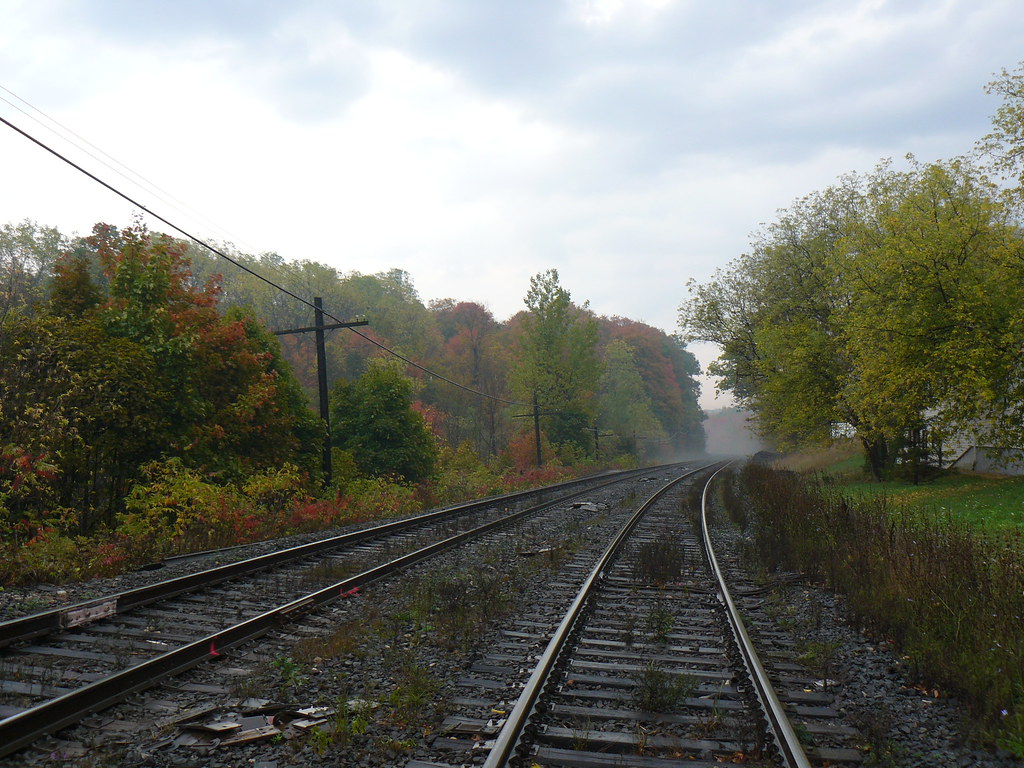
Guelph Junction
A major CPKC junction at mile 39 of the Galt Subdivision near Campbellville, Ontario, where the Hamilton Subdivision and the municipally owned Guelph Junction Railway converge on CP's Toronto–Detroit mainline freight corridor.
Photos
 Can Pac Swire
Attribution-ShareAlike License
Trainspotting Experience
Guelph Junction is one of Ontario's best-known railfan gathering spots, located where the CPKC Galt Subdivision mainline meets the Hamilton Subdivision and the Guelph Junction Railway. The primary vantage point is the Campbellville Road grade crossing. From the 401, take the Guelph Line exit southbound to Campbellville, then turn west onto Campbellville Road — the crossing is shortly ahead. Guelph Junction Road, the second road after the tracks, offers a secondary angle from the north side.
Trains climb a noticeable grade here heading westbound toward the Mountsburg reservoir, which means heavy freights are working hard with multiple locomotives — a real treat for both ears and cameras. The Railfan & Railroad Magazine (January 2025) described watching a Train 231 with four units on the head end struggling up this grade. The junction itself sees three distinct movements: east-west mainline traffic on the Galt Sub, trains diverging south onto the Hamilton Sub toward Hamilton and Buffalo, and local GEXR freight switching on and off the Guelph Junction Railway heading north to Guelph.
Shoulder parking is available along the road, and railfans have traditionally watched from their vehicles between trains. The area is exposed with limited shade in summer — dress accordingly and bring water during warm months.
Landscape, Setting & Local Atmosphere
The junction sits on the edge of the Niagara Escarpment in the Township of Milton, surrounded by gently rolling farmland and scattered stands of maple and cedar. Campbellville is a small rural community with about 1,600 residents, offering a quiet, low-traffic setting far removed from the fenced-off urban corridors of the Greater Toronto Area. Highway 401 hums in the distance to the north but does not intrude on the experience.
The open terrain provides long sightlines along the tracks in both directions. Spring and fall offer mild temperatures and photogenic backdrops — autumn foliage is particularly striking against CPKC's red and white locomotives. Winter brings crisp air and locomotive exhaust plumes, though cold and snow are factors (southern Ontario winters average around -5 to -10°C). Summer days are warm (25°C+) and humid, with extended daylight for longer watching sessions.
Type & Frequency of Train Activity
The CPKC Galt Subdivision is a 114.6-mile mainline from Toronto to London, forming the backbone of CPKC's Montréal–Detroit freight corridor. Between Toronto and Guelph Junction (mile 39), the line is double-tracked and governed by Centralized Traffic Control (CTC). West of the junction, it becomes primarily single track with sidings under OCS/ABS signaling.
CPKC runs intermodal stack trains, manifest freights carrying grain, potash, ethanol and mixed merchandise, autorack trains serving southwestern Ontario auto plants, and occasional unit trains. Distributed Power Units (DPUs) are common on heavy consists. GO Transit's Milton Line commuter trains share the Galt Sub east of Milton and formerly stored equipment at Guelph Junction on weekends, though a purpose-built Milton yard has since taken over that function.
The Hamilton Subdivision (63.9 miles from Brookfield East to Guelph Junction) brings additional freight from the Hamilton/Niagara corridor and Buffalo interchange traffic. The Guelph Junction Railway, a 38.6 km municipally owned shortline operated by Goderich-Exeter Railway (a Genesee & Wyoming subsidiary since September 2020), interchanges freight at the junction, carrying grain, plastics, chemicals, lumber and aggregates to and from Guelph's industrial park.
The CPKC Holiday Train typically passes through in late November or early December, drawing large local crowds.
Best Angles for Photos & What Railfans Enjoy Most
The Campbellville Road crossing offers the classic shot. For westbound trains, stand on the northwest quadrant in the afternoon for front-lit shots as trains climb the grade. Shift to the southeast side after mid-afternoon for eastbound movements catching the late sun. Summer evenings can produce golden-hour lighting aligned nearly straight down the tracks.
The Guelph Line road crosses the tracks south of the junction and provides a slightly different perspective looking along the Hamilton Sub connection. Longtime railfans use the surrounding rural road network (1st Line, 10th Sideroad, Guelph Line) to reposition and chase trains — David Graham of railfan.ca has documented years of productive sessions using this approach.
A 24–35mm wide-angle lens captures the sweep of long trains through the curve, while a 70–200mm telephoto isolates locomotive details and mid-train helpers. The rural darkness makes this a viable location for night photography with a tripod — locomotive headlights produce clean starbursts against the dark background.
Historical or Cultural Relevance
The Galt Subdivision traces its origins to the Credit Valley Railway, which built the line between Toronto and St. Thomas, opening in 1880. The Ontario & Quebec Railway absorbed the CVR in 1883, and Canadian Pacific soon took full control, extending the route to Windsor as its primary southwestern Ontario mainline.
The Guelph Junction Railway was separately incorporated in 1884 by Guelph merchants frustrated with the Grand Trunk Railway's monopolistic freight rates. Construction of the 15-mile link south from Guelph to the CPR mainline at Campbellville began in May 1887 and was completed on August 20, 1887. The GJR leased operations to CPR under a 99-year agreement and the City of Guelph acquired full ownership by 1910. This made the GJR the first federally chartered railway in the Commonwealth of Nations to be owned by a municipality.
When CPR declined to renew the lease in December 1997, the Ontario Southland Railway took over operations in January 1998 and ran the line for 22 years. Goderich-Exeter Railway (GEXR) assumed operations in September 2020. From 2008 to 2011, a tourist service called the Guelph Junction Express offered 4.5-hour rides along the full GJR route using 1950s-era stainless steel passenger cars.
What Makes This Spot Different
Guelph Junction's appeal lies in the convergence of three distinct railway operations at a single accessible rural location. The CPKC mainline between Toronto and Detroit provides heavy Class I freight, the Hamilton Subdivision adds variety with trains from the Niagara/Buffalo corridor, and the Guelph Junction Railway — one of Canada's few municipally owned railways — brings shortline character with GEXR power.
The grade westbound toward Mountsburg means locomotives are working hard rather than coasting, producing the growling exhaust sounds that railfans prize. The open, rural setting at the edge of the Niagara Escarpment provides unobstructed ground-level viewing without the fencing, concrete barriers, or traffic congestion typical of GTA locations. The nearby Halton County Radial Railway museum on Guelph Line adds a rail heritage dimension for visitors making a day of it.
Frequently Asked Questions
QHow do I get to Guelph Junction?
From Highway 401, take the Guelph Line exit and head south to Campbellville. Turn west onto Campbellville Road. The main viewing area is at the grade crossing. Guelph Junction Road, the second road past the tracks, offers additional angles.
QWhat scanner frequencies should I monitor?
For the Galt Subdivision east of mile 40: 161.475 MHz (CP 01 Mainline). West of mile 40: 161.325 MHz (CP 05 Mainline). Hamilton Subdivision: 160.815 MHz (CP 82 Mainline). Source: RadioReference.com.
QIs there parking at Guelph Junction?
There is no designated parking lot. Railfans typically use road shoulders along Campbellville Road or pull off onto Guelph Junction Road. Be mindful of traffic and do not block driveways or agricultural access.
QWho operates the Guelph Junction Railway?
The GJR is owned by the City of Guelph and has been operated by Goderich-Exeter Railway (GEXR), a Genesee & Wyoming subsidiary, since September 2020. It runs 38.6 km of track between Guelph Junction at Campbellville and Guelph's northwest industrial park.
Safety Tips
Stay well back from the tracks at the Campbellville Road crossing — mainline freight passes at speed on the double-track Galt Sub. The crossing has automatic warning signals with gates. Never stand on or between the rails. Be aware of trains approaching from three directions (east/west on the Galt Sub and south from the Hamilton Sub). In summer, the exposed location can be very hot with no shade — bring sun protection and water. In winter, dress warmly as there is no shelter from wind.
Seasonal Information
Spring (April–May) and fall (September–October) offer the most comfortable temperatures and best photographic light. Autumn foliage adds colour to the farmland backdrop. Summer provides the longest daylight hours but heat and humidity can be oppressive. Winter scenes with locomotive exhaust plumes are photogenic but temperatures regularly drop below -10°C. The CPKC Holiday Train typically passes through in late November or early December — check CPKC's website for the exact schedule as it varies annually.
Nearby Lodging
- Mohawk Inn and Conference Centre
Located on 100 acres of woodland just off Highway 401 in Campbellville, about 10 minutes from downtown Milton. The closest lodging option to the junction.
- Best Western Milton
Full-service hotel in Milton with indoor pool, on-site restaurant, and free parking. About 10 km east of Guelph Junction via Highway 401.
- Home2 Suites by Hilton Milton Ontario
Extended-stay hotel in Milton with kitchenettes, free breakfast, and easy 401 access. About 10 km from the junction.
- Holiday Inn Express & Suites Milton
Modern hotel off Highway 401 in Milton with indoor pool and complimentary breakfast. Convenient for early-morning railfanning sessions.
Nearby Attractions
3.1 miles / 5 km
Ontario's largest electric railway museum at 13629 Guelph Line, featuring historic TTC streetcars, subway cars, and radial cars operating on 2 km of scenic track. Open seasonally, run by volunteers.
3.7 miles / 6 km
Halton Conservation park featuring a Raptor Centre with birds of prey, hiking trails, maple syrup demonstrations, fishing and boating. Located at 2259 Milburough Line.
4.3 miles / 7 km
Rare meromictic lake with reconstructed 15th-century Iroquoian village, hiking trails along the Niagara Escarpment, and interpretive programs. At 3115 Conservation Road.
5 miles / 8 km
A 10-metre waterfall surrounded by hiking and mountain biking trails through Niagara Escarpment forest. Located at 4985 Campbellville Road — on the same road as the junction.
25 miles / 40 km
One of North America's busiest rail junctions in Hamilton, where CN and CPKC lines intersect at the Royal Botanical Gardens. Up to 75+ trains daily. About 40 km south via the Hamilton Subdivision.
External Links
informative
informative
informative
informative
Looking for more spots? Browse the complete list of train spotting locations.
Quick Information
Country
Canada
Region
Ontario
City
Campbellville
Spot Type
Yard/Depot
Best Times
Afternoon to dusk (roughly 4:00 PM onward) is the traditional peak window according to longtime railfans. Morning also sees westbound movements climbing the grade from Campbellville toward the Mountsburg reservoir.
Visit Duration
2-4 hours
Cost
Free
Train Activity
Train Types
Frequency
CPKC mainline freight runs day and night on the Galt Sub. Exact daily counts vary, but this is CP's primary Toronto–Detroit/Chicago corridor. Hamilton Sub adds several daily trains to/from the Buffalo gateway. GEXR operates local freight on the Guelph Junction Railway.
Access & Amenities
Parking
Available (Free (road shoulder parking))
Shelter
Not available
Restrooms
Not available