
Kinzua Bridge
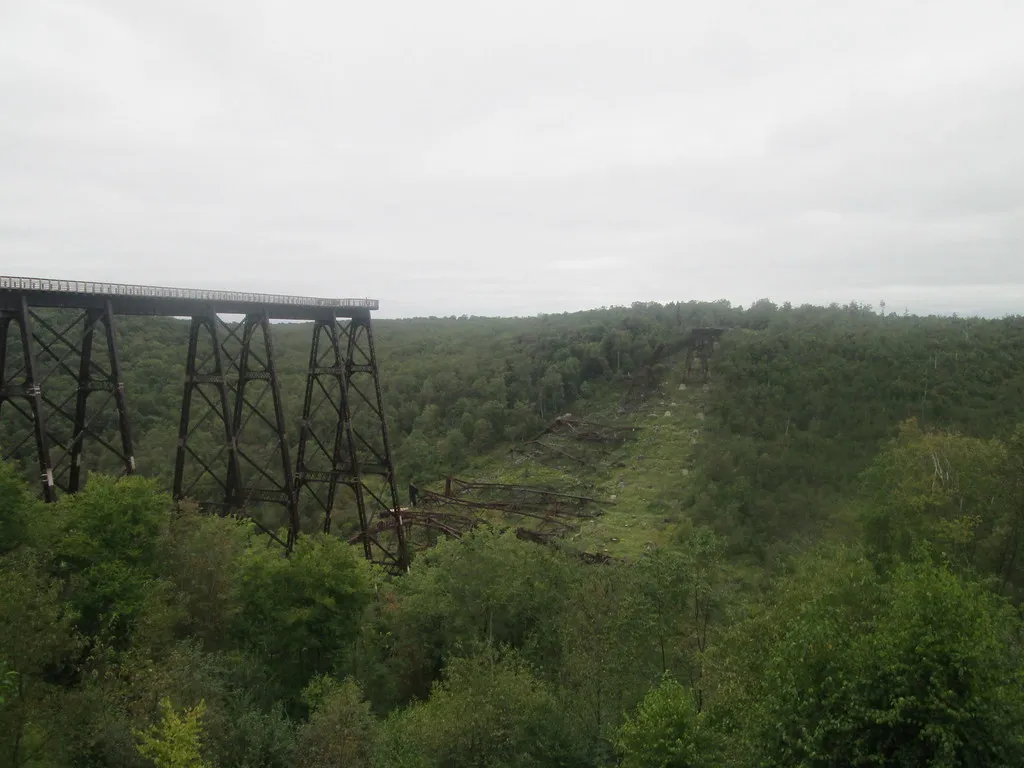
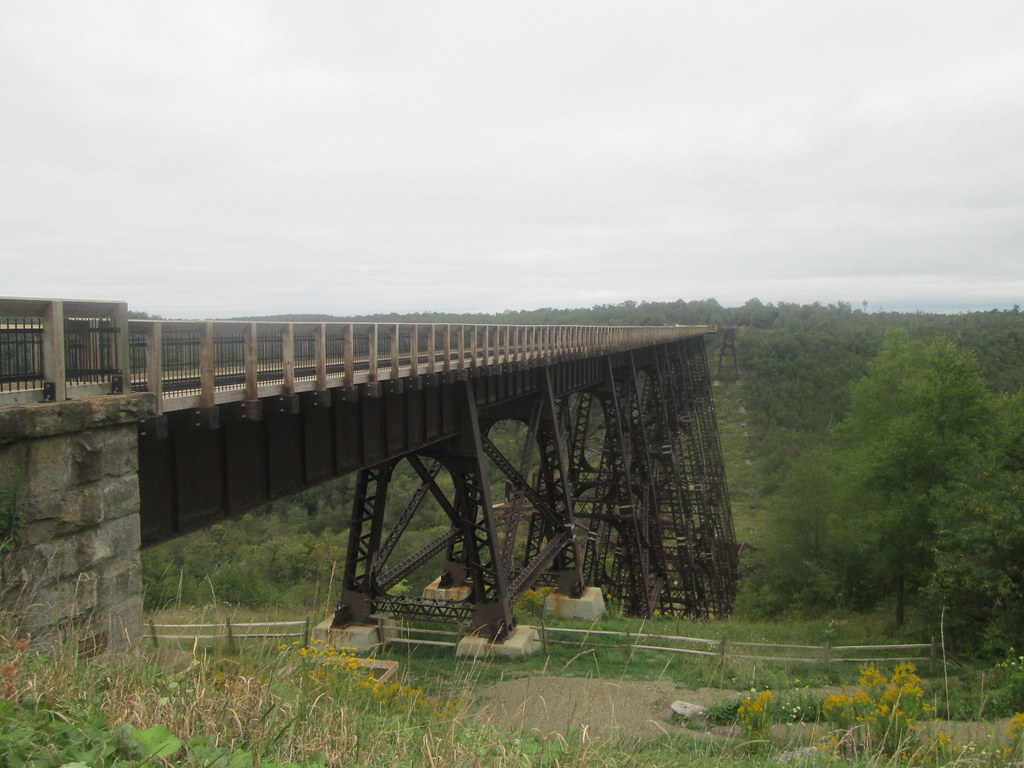
Completed in 1882 as the world's tallest railroad bridge and engineered by Octave Chanute, Kinzua Viaduct was partially toppled by an F1 tornado in 2003. Its surviving four towers now form a 624-foot skywalk 300 feet above a Pennsylvania gorge.
Photos
 Random Retail
Attribution License
Random Retail
Attribution License
Random Retail
Attribution License
Trainspotting Experience
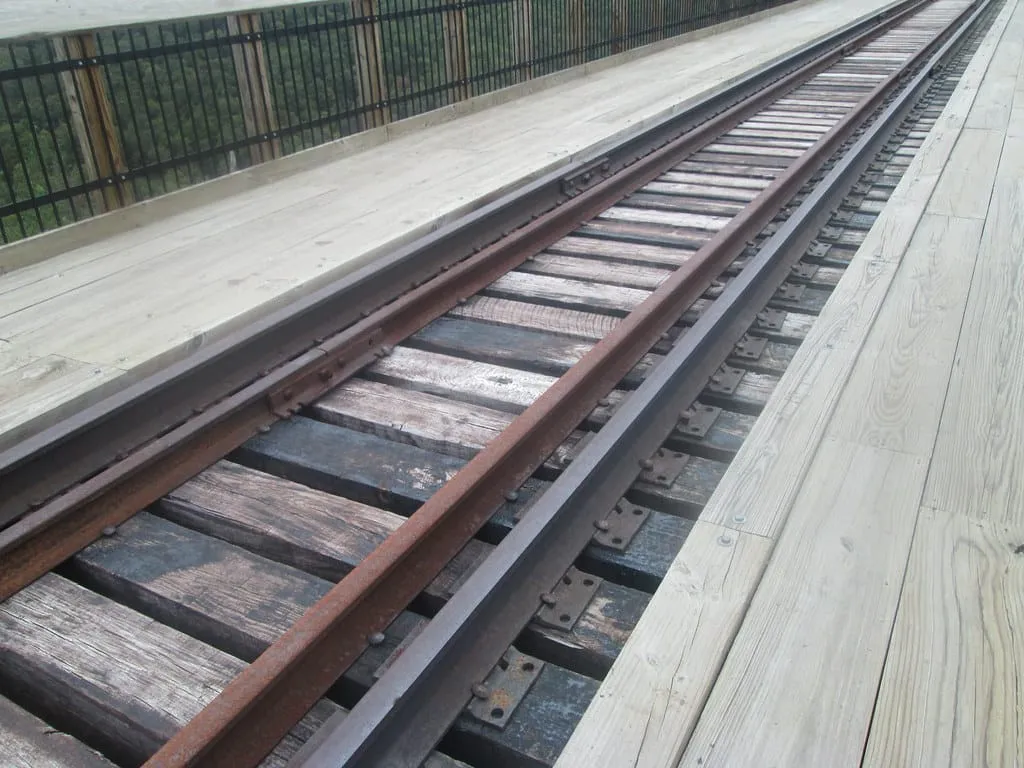
A visit to Kinzua Bridge is an exercise in railroad archaeology rather than active trackside spotting. The 624-foot Kinzua Sky Walk — built atop the four surviving northern towers — runs visitors directly over the original Erie Railroad alignment, with a partial glass floor at the end revealing original rail and weathered ties suspended 300 feet above Kinzua Creek. Note: the Sky Walk is closed for a multi-year structural rehabilitation through summer 2026, with reopening targeted for September 1, 2026. The Kinzua Creek Trail (1.2 miles, 330 ft elevation change via switchbacks) descends to the gorge floor, where eleven tornado-toppled towers rest exactly where the F1 storm left them on July 21, 2003 — anchor bolts sheared, Phoenix columns splayed open, 1900-era steel riveting exposed for inspection at close range. No active trains serve the site. The DCNR Visitor Center (open daily 8 AM to sunset) offers two floors of engineering exhibits, a gift shop, and restrooms.
Landscape, Setting & Local Atmosphere
Kinzua Bridge spans a forested gorge on the Allegheny Plateau at approximately 2,100 feet elevation in McKean County's Pennsylvania Wilds region. Hemlock, sugar maple, and black cherry cover the hillsides, with Kinzua Creek running 300 feet below the bridge deck. In autumn — particularly the third week of October — the valley erupts in orange and red foliage that frames the rust-brown painted steel towers for exceptional photography. Summer brings dense canopy creating dappled light on the valley floor by mid-morning; winter strips the hillsides bare, revealing the full lattice steelwork and allowing ice to form dramatic patterns on the ironwork. Prevailing westerly winds funnel through the gorge, occasionally gusting hard — a tangible reminder of the F1 winds that tore 11 towers from their concrete bases in 2003. The park road, SR 3011, runs four miles north from US Route 6 at Mt. Jewett.
Type & Frequency of Train Activity
No trains operate at Kinzua Bridge today. The line was built in 1882 for the New York, Lake Erie and Western Railway (NYLE&W) and carried freight and passenger traffic serving McKean County's coal, oil, and timber industries. Erie Railroad — the successor line — operated the viaduct until commercial service ended in 1959, after which the bridge was sold to a salvage company before the state intervened. From 1987 to 2002, the Knox and Kane Railroad revived the route as a heritage excursion operation: 97-mile round trips from Marienville in Forest County through Kane to the viaduct, led by steam locomotive No. 38, a Baldwin-built 2-8-0 Consolidation from 1927. DCNR banned all train crossings on June 27, 2002, after structural assessment found the bridge at risk of collapse. The Knox and Kane Railroad ceased tourist operations in 2004. No trains have crossed the viaduct since. This site is best suited to railfans interested in historical study, structural photography, and examining 1880s–1900s railroad engineering at close range.
Best Angles for Photos & What Railfans Enjoy Most
Three distinct positions provide different perspectives on the viaduct.
Skywalk overlook (when open): At the end of the 624-foot walkway, shoot straight down through the partial glass floor at original rail embedded in the deck — 300 feet of air beneath your lens. A 24–35mm lens captures the full panel in context. The north-facing walkway receives direct light on clear mornings.
Valley floor — Kinzua Creek Trail: Descend the 1.2-mile switchback trail (330 ft elevation change) to the gorge floor. Wide-angle lenses (16–24mm) capture standing intact towers alongside the toppled tornado wreckage in a single frame — a tableau impossible from the rim. Early-morning mist rising from Kinzua Creek adds atmosphere. Close-up lenses reveal Phoenix column cross-sections, rivet patterns, and 1900-era steel details in the fallen towers.
South rim parking area: Profile views of the intact towers against open sky are available from the parking area and overlook. Longer focal lengths (100–200mm) at golden hour warm the rust-brown ironwork. Autumn peak — around the third week of October — is the most photographed season; arrive before 9 AM on weekends to secure parking.
Historical or Cultural Relevance
Designed by civil engineer Octave Chanute — later an advisor to the Wright Brothers on aeronautics — the original viaduct was built by Phoenix Iron Works in just 94 working days between May 10 and August 29, 1882. It used 1,552 short tons of wrought iron formed into Phoenix columns, patented hollow iron tubes produced exclusively by Phoenix Iron Works of Phoenixville, Pennsylvania. At 301 feet (92 m) tall and 2,052 feet (625 m) long, it was the tallest railroad bridge in the world at completion, holding that record for two years. The New York, Lake Erie and Western Railway (NYLE&W) built the viaduct to eliminate eight miles of difficult terrain on a branch serving McKean County's coal, oil, and timber industries. The entire structure was dismantled and simultaneously rebuilt in steel in 1900 to accommodate heavier steam locomotives. Erie Railroad continued service until 1959. The Pennsylvania DCNR purchased the bridge in 1963; the 316-acre park deed was recorded January 20, 1965, with the park opening to the public in 1970. The F1 tornado of July 21, 2003 — striking at approximately 3:15 PM with winds of 73–112 mph — toppled 11 of 20 towers in minutes; the ruins remain in place as an outdoor engineering exhibit. The Kinzua Sky Walk opened in 2011; the Visitor Center opened July 1, 2016.
What Makes This Spot Different
Most railroad heritage sites offer a passive experience: stand trackside, watch equipment pass. Kinzua Bridge inverts this entirely — the trains are gone, but the infrastructure is accessible for close-range study in ways that active mainlines never permit. The tornado-toppled towers on the valley floor form an unintentional cross-sectional exhibit: Phoenix columns from 1900, interior anchor hardware, and rivet patterns from both the 1882 iron construction and 1900 steel rebuild are exposed and accessible on foot. The partial glass floor on the Sky Walk (when open) offers a unique perspective among eastern U.S. railroad heritage sites — original track as foreground, 300 feet of Pennsylvania gorge below. The site anchors a 74-mile rail trail network (the Knox & Kane Rail Trail) on the former railroad right-of-way through the Allegheny National Forest, connecting to Mount Jewett 7.8 miles to the south. Kinzua Bridge sits within a region rich in railroad heritage: the oil and timber industries that the Erie Railroad served still define the landscape of McKean County.
Frequently Asked Questions
QIs the Kinzua Sky Walk currently open?
As of 2026, the Sky Walk is closed for a multi-year structural rehabilitation project. Reopening is targeted for September 1, 2026, for the fall foliage season. The park grounds, Visitor Center, and valley floor trail remain open year-round.
QAre there any active trains at Kinzua Bridge?
No trains operate at the site. Commercial rail service ended in 1959, and the Knox and Kane Railroad's heritage excursion service ended in 2004. Kinzua Bridge is a railroad history and engineering heritage site, not an active spotting location.
QHow long is the hike to the valley floor?
The Kinzua Creek Trail is 1.2 miles with 330 feet of elevation change via switchbacks. Proper hiking footwear is recommended — rocks can be slippery when wet or icy. Allow 45 to 60 minutes for the round trip.
QIs there an admission fee?
Admission to Kinzua Bridge State Park is free. The park is open daily from 8 AM to sunset, year-round.
QWho designed the original Kinzua Bridge?
The original 1882 bridge was designed by engineer Octave Chanute, later known for advising the Wright Brothers on aeronautics. It was built by Phoenix Iron Works using their patented Phoenix column system in just 94 working days.
QWhat destroyed part of the bridge?
An F1 tornado struck at approximately 3:15 PM on July 21, 2003, with wind speeds of 73 to 112 mph. Eleven of the twenty towers were torn from their concrete bases and thrown to the valley floor. The ruins remain in place as part of the interpretive experience.
Safety Tips
Stay on designated trails — gorge slopes are steep and unstable. The Kinzua Creek Trail is slippery when wet or icy; hiking footwear with grip is essential. Do not climb or touch the fallen tower ruins on the valley floor; they remain structurally unstable. The Sky Walk (when open) reaches 300 feet elevation — those with severe acrophobia should be prepared for significant exposure. In winter, check SR 3011 road conditions before visiting. The park office can be reached at (814) 778-5467.
Seasonal Information
The park is open year-round, 8 AM to sunset daily. Fall foliage typically peaks the third week of October and draws the heaviest visitation; arrive early to secure parking. The Sky Walk was closed for rehabilitation from 2024 through summer 2026; reopening is targeted for September 1, 2026. Winter may bring snow and ice to trails and SR 3011. The visitor center operates reduced hours in winter — contact the park for current schedules.
Nearby Lodging
- Best Western Plus Bradford Inn
Comfortable 3-star hotel in Bradford, PA, approximately 16 miles east of the park. Pet-friendly with meeting rooms. A popular base for multi-day exploration of Kinzua Bridge and Allegheny National Forest.
- Holiday Inn Express Bradford
Full-service hotel in Bradford with indoor pool, fitness center, and free breakfast. About 16 miles from Kinzua Bridge State Park — one of the most complete lodging options near the park.
- Quality Inn & Suites Bradford
Budget-to-mid-range hotel in Bradford, PA, about 16 miles from the park. Pet-friendly with 24-hour business center. Reliable option for railfans spending multiple days exploring the region.
- Vacation Rentals near Mount Jewett
Several vacation rentals in Mount Jewett sit adjacent to the Knox & Kane Rail Trail, which leads 7.8 miles directly to Kinzua Bridge State Park. Ideal for cyclists or visitors wanting to walk or bike to the viaduct.
Nearby Attractions
0.3 miles / 0.5 km
A 74-mile trail built on the former Knox and Kane Railroad right-of-way through Allegheny National Forest. The 7.8-mile Mount Jewett to Kinzua Bridge section connects directly to the park entrance, making it ideal for cyclists and hikers seeking a rail-to-trail approach to the viaduct.
0.1 miles / 0.1 km
A 513,000-acre national forest covering McKean, Warren, Forest, and Elk counties, directly surrounding Kinzua Bridge State Park. Offers hiking, fishing, scenic drives, and campgrounds. The forest provides the backdrop for the gorge and much of the Erie Railroad history.
15 miles / 24 km
The 91-mile reservoir created by Kinzua Dam on the Allegheny River. Kinzua Beach offers swimming and picnicking; the surrounding forest provides fishing for walleye, muskie, and bass. Warren, PA is the main gateway to the reservoir area.
16 miles / 26 km
Commercial hub of McKean County approximately 16 miles east of the park, with hotels, restaurants, and fuel. Bradford was at the center of the 1870s Pennsylvania oil boom that the Erie Railroad and Kinzua Viaduct directly served, giving the region its railroad heritage.
68 miles / 110 km
A 13-mile heritage railroad operating diesel and steam excursions through Oil Creek State Park, site of the first commercial oil well. About 90 miles from Kinzua Bridge, this is the nearest active heritage railroad experience in the Pennsylvania Wilds region.
External Links
informative
informative
informative
informative
Looking for more spots? Browse the complete list of train spotting locations.
Quick Information
Country
United States
Region
Pennsylvania
City
Hamlin Township
Spot Type
Bridge/Overpass
Best Times
Morning (before 10 AM) for best gorge lighting and to avoid peak weekend crowds. Arrive early on fall weekends as the parking lot fills by mid-morning.
Visit Duration
2–3 hours
Cost
Free
Train Activity
Train Types
Access & Amenities
Parking
Available
Shelter
Available
Restrooms
Available