Kirkwood
Historic 1893 Richardsonian Romanesque depot on Union Pacific's Jefferson City Subdivision, with ~40 UP and ~22 BNSF trains daily. Third-busiest Amtrak station in Missouri, staffed entirely by volunteers.
Photos
 davidwilson1949
Attribution License
Philip Leara
Public Domain Dedication (CC0)
Trainspotting Experience
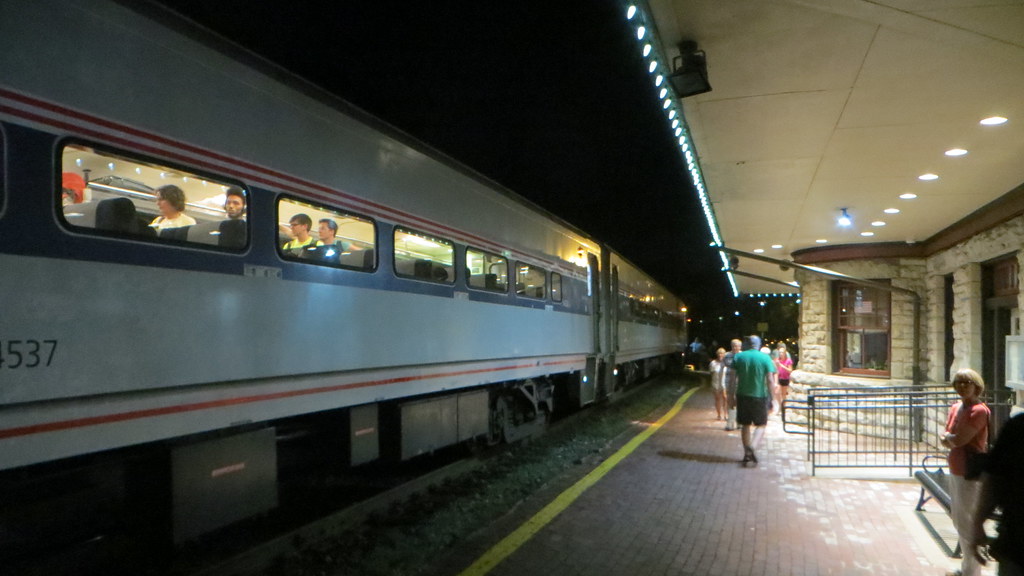
Kirkwood station sits at the summit of Kirkwood Hill on Union Pacific's Jefferson City Subdivision at milepost 13.5. The double-track mainline carries all UP traffic between St. Louis and Kansas City, making it one of the busiest corridors in the region. Railfans can watch from the brick platform flanking both main tracks or from Veterans Memorial Park directly across the tracks from the station.
The station is staffed by dedicated volunteers seven days a week, including holidays, and opens one hour before each scheduled Amtrak arrival. An ATCS monitor is available in the lobby, though volunteers note its reliability can be inconsistent. The waiting room has clean restrooms and a welcoming atmosphere. Volunteers are railfan-friendly and happy to share information about recent train activity.
A second mainline runs through Kirkwood as well: the BNSF Springfield Division's Cuba Subdivision at milepost 12.7 passes generally parallel and south of the UP tracks. This gives the area a combined traffic count well above 60 trains per day across both railroads. The former Frisco station in nearby Webster Groves (N 38.58039, W 90.36251) now houses the Big Bend Railroad Club.
Landscape, Setting & Local Atmosphere
Downtown Kirkwood sits at roughly 640 feet elevation on modest rolling terrain in western St. Louis County, about 14 miles from downtown St. Louis. The town was the first planned suburb west of the Mississippi River, laid out in 1852-1853 around the Pacific Railroad, and that heritage shows in the walkable downtown grid surrounding the station. Mature trees line the tracks, particularly toward the Argonne Drive crossing, creating a canopy from late spring through early fall. In winter, bare branches open wider sight lines and highlight the stone architecture of the 1893 depot.
The neighborhood has a relaxed, pedestrian-friendly character with cafes, shops, and a weekly farmers' market two blocks east. Historic Downtown Kirkwood offers enough variety for a non-railfan companion to stay occupied while you watch from the station or the park. The area is well-lit and generally safe for evening observation sessions.
Type & Frequency of Train Activity
According to a Union Pacific spokesman, an average of 39 trains per day (including four Amtrak runs) use the UP mainline through Kirkwood. FRA data corroborates approximately 40 daily movements on the Jefferson City Subdivision. Traffic includes UP manifest freight, double-stack intermodal linking St. Louis with Kansas City, and periodic unit trains (coal, grain, ethanol). The Amtrak Missouri River Runner makes four stops daily — two eastbound and two westbound — connecting St. Louis with Kansas City through seven Missouri cities.
The nearby BNSF Cuba Subdivision adds approximately 22 trains per day according to FRA data. This parallel route runs south of the UP main through the Kirkwood area. West of Jefferson City, UP freights generally run directionally with the southern track westbound, though both tracks are signaled for bidirectional operation. Amtrak runs bidirectionally on the southern track. The eastbound track follows the Missouri River roughly 25 miles to the north and is subject to periodic flooding, which can divert traffic to the southern route through Kirkwood, temporarily increasing activity.
Best Angles for Photos & What Railfans Enjoy Most
The Clay Avenue overpass, approximately 500 feet west of the station, offers a protected sidewalk and elevated perspective for photographing trains on the UP main. Late afternoon light works best here for westbound movements. From the station itself, the porte-cochere and stone arched entrance provide an architectural backdrop for platform-level shots of passing trains. A good vantage point on Scott Avenue east of the station (N 38.57861, W 90.40068) gives clear views of the mainline.
For a more distant view, Barrett Station Road west of Kirkwood passes through a deep rock cut as it descends toward the National Museum of Transportation — a scenic setting when timed with passing trains, though sun penetration into the cut depends on time of day and season. Lenses in the 35mm to 200mm range cover most needs around the station area: wider glass includes the depot facade, while telephoto isolates locomotive consists approaching from either direction.
Historical or Cultural Relevance
The town of Kirkwood was named for James Pugh Kirkwood, chief engineer and surveyor of the Pacific Railroad. In 1852, the Kirkwood Association purchased 240 acres along the new railroad route, about 13 miles west of St. Louis, making it the first planned suburb west of the Mississippi River. The first train arrived on May 11, 1853, for a lot auction sale. An original wood-frame depot was built in 1863.
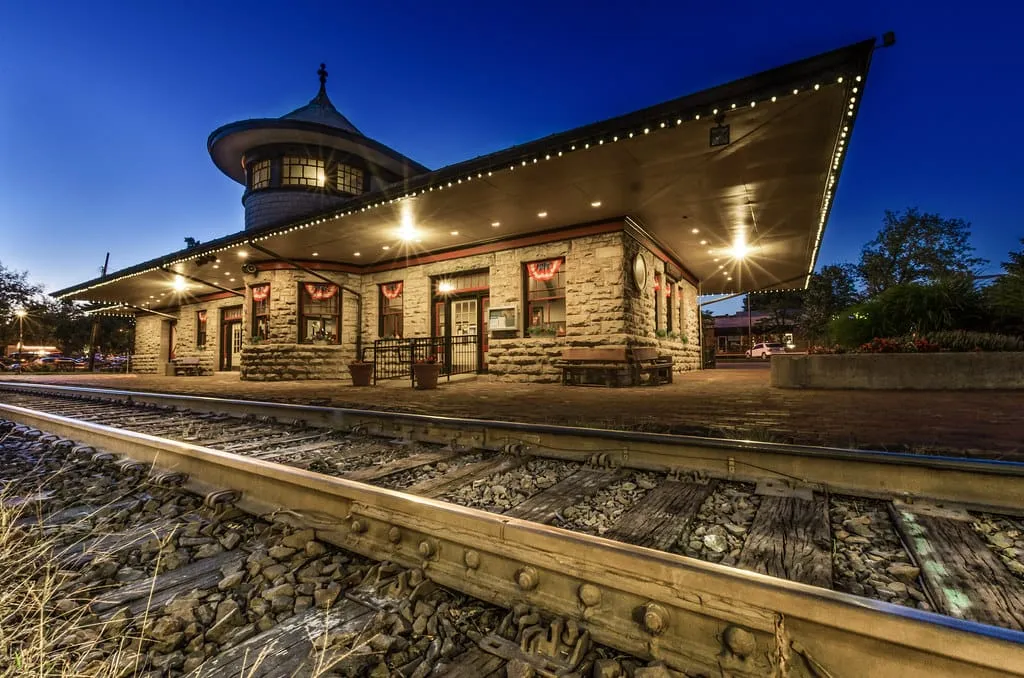
In 1893, the Missouri Pacific Railroad hired local builder Douglas Donovan to construct the current stone station in the Richardsonian Romanesque style — characterized by rough-faced stone, rounded arches, and thick columns. The depot features a porte-cochere, a curved bay topped by a conical-roofed turret, and deep-set round arches with decorative voussoirs. It was renovated in 1941, adding a Colonial-style interior. A turntable near the present-day farmers' market once turned engines for the return trip to St. Louis, and helper engines assisted freight trains up "Kirkwood Hill" before dieselization. Commuter service ran until 1961.
The station was listed on the National Register of Historic Places on July 5, 1985. In 2002, when Amtrak planned to close the station, the City of Kirkwood purchased it from Union Pacific Railroad for approximately $1 million. A call for volunteers brought 199 citizens, and the volunteer program won Amtrak's 2004 President's Service and Safety "Champion of the Rails" Award. As of FY2024, the station handles 56,828 annual riders and generates $2.16 million in ticket revenue, making it the third-busiest Amtrak station in Missouri. A major restoration project began in June 2025, including a new roof, geothermal HVAC, tuckpointing, and restoration of the original platform canopy.
What Makes This Spot Different
Kirkwood's distinction lies in the combination of two Class I railroad mainlines running through a walkable, historic downtown with an active volunteer-staffed Amtrak depot. The UP Jefferson City Sub and BNSF Cuba Sub together deliver 60+ trains daily within a compact area. The 1893 stone station — featured on the city seal and NRHP-listed — provides a sanctioned, well-maintained platform for observation without trespass concerns. The nearby National Museum of Transportation (5 miles west on Barrett Station Road) holds one of the world's largest transportation collections, including a Union Pacific Big Boy and 70+ locomotives, making Kirkwood an ideal base for a full day of rail-related exploration in the St. Louis region.
Frequently Asked Questions
QHow many trains pass through Kirkwood per day?
Approximately 40 trains daily on the UP Jefferson City Subdivision (including 4 Amtrak Missouri River Runner stops), plus about 22 trains daily on the nearby BNSF Cuba Subdivision.
QIs the Kirkwood station open to the public?
Yes. The station is staffed by volunteers seven days a week, including holidays. It opens one hour before each Amtrak arrival. Restrooms are available. Note: a major renovation began in June 2025, with a temporary station across Kirkwood Road during construction.
QIs there parking at Kirkwood station?
Yes, free parking is available near the station. The Yelp reviews and Amtrak listing confirm free parking. During the 2025 renovation, parking may be temporarily relocated.
QWhat scanner frequencies can I use at Kirkwood?
UP: 160.410, 160.470, 161.220 (road), 161.550. BNSF: 161.160.
QWhat else is there to do nearby for railfans?
The National Museum of Transportation (2933 Barrett Station Rd, ~5 miles west) has 70+ locomotives including a Union Pacific Big Boy. The Big Bend Railroad Club occupies a former Frisco station in nearby Webster Groves.
Safety Tips
Stay behind the clearly posted yellow line on the platform. Trains pass at speed through the station — do not cross tracks except at designated crossings. The Clay Avenue overpass has a protected sidewalk for safe elevated viewing. The area is well-lit and in a busy downtown setting, suitable for evening sessions.
Seasonal Information
Summer: hot and humid, long daylight. Fall: mild temperatures, fall foliage frames the stone depot. Winter: leafless trees open wider views of approaching trains; possible snow delays. Spring: comfortable weather, blooming gardens at the station. The annual Greentree Festival (September) brings crowds to downtown. Missouri River flooding can occasionally divert UP traffic, temporarily increasing movements through Kirkwood.
Nearby Lodging
- Best Western St. Louis-Kirkwood Route 66
113-room hotel at 1200 S. Kirkwood Rd, about 1.5 miles south of the station on Route 66. Free breakfast, outdoor pool, on-site restaurant. Pet-friendly.
- Holiday Inn St. Louis SW - Route 66
Full-service hotel near I-44 and Lindbergh Blvd, convenient to Kirkwood station area.
- Drury Inn & Suites St. Louis Southwest
Popular mid-range chain hotel in the Sunset Hills area, south of Kirkwood. Free hot breakfast and evening kickback with food and drinks.
Nearby Attractions
5 miles / 8 km
42-acre museum with 70+ locomotives including Union Pacific Big Boy #4006, vintage cars, and aircraft. One of the world's largest transportation collections, founded in 1944.
3.1 miles / 5 km
Model railroad club housed in a former Frisco station in Webster Groves. Open to visitors on select days.
0.5 miles / 0.8 km
Interactive children's museum at 516 S. Kirkwood Rd, a 15-minute walk south from the station. Great for families combining railfanning with kid-friendly activities.
3.5 miles / 5.6 km
Missouri Department of Conservation nature center with hiking trails and wildlife exhibits in a wooded setting south of Kirkwood.
14 miles / 22.5 km
The iconic 630-foot stainless steel arch on the St. Louis riverfront, about 14 miles east. Includes the Museum of Westward Expansion.
External Links
official
informative
informative
Looking for more spots? Browse the complete list of train spotting locations.
Quick Information
Country
USA
Region
Missouri
City
Kirkwood
Spot Type
Railway Station
Best Times
Station opens one hour before each Amtrak arrival. Freight runs throughout the day; UP intermodal tends toward early morning and late evening. Amtrak Missouri River Runner stops twice daily in each direction.
Visit Duration
2-4 hours
Cost
Free access, free parking
Train Activity
Train Types
Frequency
Approximately 40 trains/day on UP Jefferson City Sub (including 4 Amtrak Missouri River Runner), plus ~22 trains/day on nearby BNSF Cuba Sub
Access & Amenities
Parking
Available (Free)
Shelter
Available
Restrooms
Available