Little Rock Union Station
Historic 1921 Amtrak station on UP's Little Rock Subdivision in downtown Little Rock, Arkansas. Serves the daily Texas Eagle route and sees regular Union Pacific freight traffic through the state capital.
Photos
 wood.smoke
4
pasa47
4
Trainspotting Experience
Little Rock Union Station sits on Union Pacific's Little Rock Subdivision, the former Missouri Pacific main line that connects St. Louis to Texas via Arkansas. The station is built into a hillside at the foot of Markham Street, with the main entrance at street level and the tracks running below at basement level along the Arkansas River bank. Amtrak's waiting area is on the lower (track) level, accessible from Victory Street.
Railfans can watch trains from the public sidewalks along Markham Street above the tracks, or from Victory Street which runs alongside the station's east side down to track level. The tracks pass directly in front of the station building, with clear sight lines in both directions. Union Pacific runs freight traffic on this corridor, including manifest, intermodal, and unit trains. BNSF also operates through Little Rock via trackage rights on UP. The Little Rock & Western Railway (LRWN), a Genesee & Wyoming short line, interchanges with both UP and BNSF at nearby North Little Rock.
The station area is walkable from downtown Little Rock's River Market District, about a 10-minute walk east. Parking is available at the station, including overnight parking for Amtrak passengers. The neighborhood is urban and well-lit, though the late-night Amtrak arrivals mean the station area can be quiet after dark.
Landscape, Setting & Local Atmosphere
The station sits at approximately 260 feet elevation on the south bank of the Arkansas River, with the tracks running in a cut below the Markham Street level. Downtown Little Rock's modest skyline rises to the south, while the Arkansas River flows just north of the rail corridor. The Baring Cross Bridge, the only remaining active railroad bridge over the Arkansas River at Little Rock, is visible to the northwest carrying UP trains between Little Rock and North Little Rock.
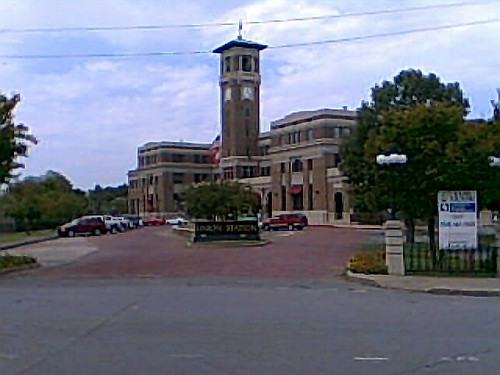
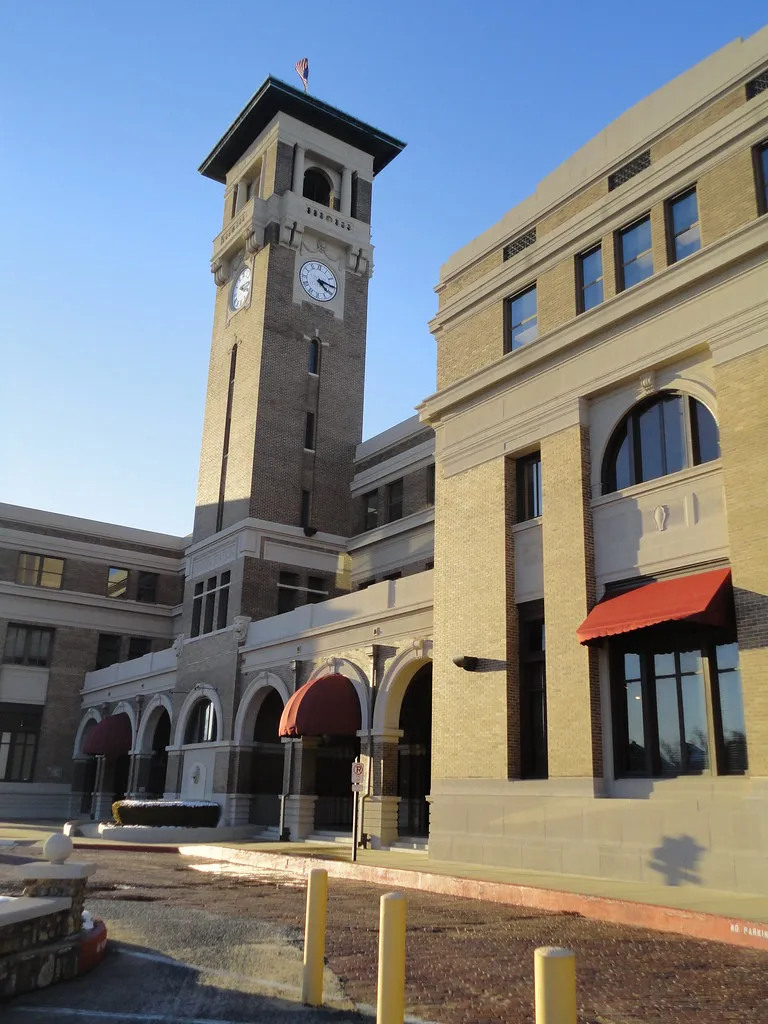
The 1921 station building itself is the dominant visual feature — a Renaissance Revival structure of brick and stone with ornate carvings, arched entrance, and the clock tower that survived the 1920 fire. The south facade faces diagonally toward downtown and the Arkansas State Capitol complex. Interior ceiling heights on the main level reach 24 feet. The building now houses offices and commercial tenants alongside the Amtrak waiting area on the lower level. The historic Terminal Hotel, a 1905 Classical Revival building, stands directly across Victory Street from the station.
Summers in Little Rock are hot and humid, frequently exceeding 90°F. Winters are mild, with temperatures rarely dropping below freezing. Spring and fall offer the most comfortable conditions for extended trackside sessions.
Type & Frequency of Train Activity
Union Pacific is the primary railroad operating through the station on the Little Rock Subdivision, the former Missouri Pacific main line. UP freight traffic includes manifest, intermodal, and unit trains moving between St. Louis, Texas, and points south. BNSF Railway operates through Little Rock on UP trackage rights, contributing additional freight movements — BNSF tank trains and other unit trains have been photographed passing the station.
Several short lines and switching railroads also operate in the greater Little Rock–North Little Rock area. The Little Rock & Western Railway (LRWN), owned by Genesee & Wyoming, operates 79 miles from Danville to Pulaski and interchanges with both UP and BNSF at North Little Rock. The Little Rock Port Authority Railroad (LRPA) operates 20 miles of switching track serving the port industrial park, connecting to both UP and BNSF.
Amtrak's Texas Eagle (Trains 21 and 22) makes a daily stop in each direction on the 1,306-mile Chicago–San Antonio route. The station code is LRK. In FY2024, the station handled 22,369 passengers and generated $1.85 million in ticket revenue. Note that both Amtrak arrivals occur at inconvenient hours for spotting — the northbound pass is typically around 3:30 AM and the southbound around 10:30 PM.
Best Angles for Photos & What Railfans Enjoy Most
The best vantage points around Union Station include the Markham Street sidewalk above the tracks, which provides an elevated perspective looking down at passing trains with the station's brick and stone facade as backdrop. Morning light from the east illuminates westbound trains against the station. Victory Street, running along the east side of the station down to track level, offers a closer approach for ground-level shots.
The Junction Bridge Pedestrian Walkway, about 0.3 miles north, is a former railroad bridge (built 1884, converted to pedestrian use in 2008) spanning the Arkansas River with a permanently raised 360-foot lift span at 38 feet above the water. It offers elevated panoramic views of trains threading between the river and the downtown skyline. LED lighting on the bridge trusses creates an atmospheric nighttime backdrop for long-exposure photography when trains pass below.
For shots of UP and BNSF trains crossing the Arkansas River, the Baring Cross Bridge — the only active railroad bridge linking Little Rock and North Little Rock — can be framed from several points along the Arkansas River Trail or Riverfront Park. A 200mm lens from the Markham Street level captures locomotive detail against the station architecture, while wide-angle shots from the Junction Bridge encompass the full river-and-skyline panorama.
Historical or Cultural Relevance
The present station opened on August 1, 1921 at midnight, built by the Missouri Pacific Railroad after a fire on April 7, 1920 destroyed the previous station. Architect E.M. Tucker of St. Louis designed the building, retaining the Renaissance Revival characteristics of the 1909 predecessor while changing the roof from gabled to flat. The Stewart Construction Company of St. Louis built the new station at a cost of $1.25 million, reusing existing foundations, some exterior walls, and the clock tower that survived the fire. The Arkansas Gazette called it "one of the finest and most modern in the South."
The site has hosted rail service since 1872-73, when the Cairo & Fulton Railroad built the first depot here. Despite the name "Union Station," the 1921 building was used by only one railroad — Missouri Pacific. Earlier structures on the site were served by two additional railroads: the Memphis & Little Rock Railroad (1874-1893) and the St. Louis Southwestern Railway, known as the Cotton Belt (ca. 1892-1910).
During its peak years, the station was a junction for Missouri Pacific trains running northeast to St. Louis, east to Memphis, and southwest to Dallas, San Antonio, and beyond. Famous named trains that stopped here included the Sunshine Special, the Southerner, and the original Texas Eagle. Missouri Pacific passenger service ended just after midnight on May 1, 1971. Amtrak did not serve Little Rock until spring 1974, when the Inter-American was extended from Fort Worth to St. Louis. The station is listed on the National Register of Historic Places as "Mopac Station."
What Makes This Spot Different
Little Rock Union Station combines an active Amtrak stop with a well-preserved 1921 railroad station that still retains original architectural details including ornate carvings, brick arches, and a historic clock tower. The station sits at the junction of rail history and downtown Little Rock's revitalized riverfront — the River Market District, Clinton Presidential Library, and Junction Bridge Pedestrian Walkway are all within walking distance.
For railfans, the nearby Downing B. Jenks Locomotive Shop in North Little Rock adds extra appeal. It is Union Pacific's largest locomotive overhaul facility in North America, dismantling and rebuilding roughly 200 units per year. The shop also paints UP's special commemorative locomotives, including the No. 4141 George H.W. Bush locomotive and the No. 1616 Lincoln locomotive unveiled in April 2025. The Jenks Shop is not open to public tours, but locomotives heading to and from the facility pass through the Little Rock area.
The Arkansas Railroad Museum in Pine Bluff, about an hour's drive south, houses the restored Cotton Belt steam locomotive SSW #819 and a significant collection of historic railroad equipment in the original Cotton Belt machine shops — making it a worthwhile day-trip pairing with Union Station.
Frequently Asked Questions
QWhat trains stop at Little Rock Union Station?
Amtrak's Texas Eagle (Trains 21 and 22) stops daily in each direction on the Chicago–San Antonio route. Union Pacific freight trains also pass through on the Little Rock Subdivision. The station code is LRK.
QWhat time does the Amtrak Texas Eagle pass through Little Rock?
Both arrivals are at inconvenient hours: the northbound train (Train 22, toward Chicago) typically passes around 3:30 AM, and the southbound (Train 21, toward San Antonio) around 10:30 PM. Check Amtrak.com for current schedules as times can vary.
QIs there parking at Little Rock Union Station?
Yes, Amtrak confirms that same-day and overnight parking is available at the station. The station is located at 1400 West Markham Street in downtown Little Rock.
QIs Little Rock Union Station on the National Register of Historic Places?
Yes, the station is listed on the National Register as 'Mopac Station.' The current building dates to 1921 and was built by the Missouri Pacific Railroad after a fire destroyed the previous station in 1920.
QWhat railroad owns the tracks through Little Rock?
Union Pacific Railroad owns the Little Rock Subdivision, the former Missouri Pacific main line. BNSF Railway also operates through the area on trackage rights. Several short lines including the Little Rock & Western Railway interchange nearby.
Safety Tips
Stay on public sidewalks and behind any safety barriers when watching trains. The tracks run in a cut below street level, so do not attempt to climb down to track level. Downtown Little Rock is generally safe during daytime hours. For late-night Amtrak arrivals, the station waiting area provides shelter. Be aware of grade crossings in the area — trains may sound horns at nearby street crossings.
Seasonal Information
Little Rock has a humid subtropical climate. Summer (June-August) brings temperatures regularly above 90°F with high humidity — bring water and sun protection. Spring and fall are ideal with mild temperatures in the 60-80°F range. Winter is generally mild but variable. The Arkansas River occasionally floods in spring, which can affect access to some riverside trails and viewpoints but does not impact the station itself.
Nearby Lodging
- DoubleTree by Hilton Little Rock
Downtown hotel connected to the Robinson Center, blocks from the River Market District and about 0.5 miles from Union Station. Seasonal outdoor pool, restaurant, and free area shuttle.
- Capital Hotel
Historic boutique hotel in downtown Little Rock, operating since 1870. Member of Historic Hotels of America. Located on Markham Street within walking distance of Union Station.
- Little Rock Marriott
Full-service hotel in the River Market District with views of the Arkansas River and downtown skyline. On-site restaurant, fitness center, and outdoor pool. Short walk to Union Station.
Nearby Attractions
0.3 miles / 0.5 km
Former 1884 railroad bridge converted to pedestrian/bike use in 2008. Spans the Arkansas River with a permanently raised 360-foot lift span at 38 feet above the water. LED-lit at night. Offers elevated views of trains passing below.
0.8 miles / 1.3 km
Presidential library on the Arkansas River banks with exhibits including Oval Office and Cabinet Room replicas. On a 30-acre campus in the River Market District. The adjacent Clinton School of Public Service is housed in the restored 1899 Choctaw Station of the Rock Island Railroad.
0.3 miles / 0.5 km
Little Rock's premier dining and entertainment neighborhood, with the Ottenheimer Market Hall indoor food market, restaurants, museums, and access to the Arkansas River Trail. A short walk east from Union Station.
45 miles / 72 km
Located in the former Cotton Belt machine shops, this museum houses the restored SSW #819 steam locomotive — the last steam engine built in Arkansas (1942). Collection includes historic passenger cars, diesel locomotives, and railroad artifacts. About an hour's drive south of Little Rock.
0.03 miles / 0.05 km
A 1905 Classical Revival building constructed as a railroad hotel directly across Victory Street from Union Station. Listed on the National Register of Historic Places. No longer a hotel but retains its architectural significance.
External Links
informative
informative
informative
Looking for more spots? Browse the complete list of train spotting locations.
Quick Information
Country
USA
Region
Arkansas
City
Little Rock
Spot Type
Railway Station
Best Times
Freight movements occur throughout the day and night. Amtrak's northbound Texas Eagle (Train 22) typically passes through Little Rock around 3:30 AM, and the southbound (Train 21) around 10:30 PM — both inconvenient for casual spotting. Daytime hours offer the best freight activity and photography light.
Visit Duration
1-2 hours for the station area; half-day if combining with Junction Bridge walk and River Market District
Cost
Free to watch trains from public sidewalks. Amtrak waiting area accessible to ticketed passengers.
Train Activity
Train Types
Frequency
Amtrak Texas Eagle stops once daily in each direction (northbound and southbound). UP freight traffic passes through regularly on the Little Rock Subdivision.
Access & Amenities
Parking
Available (Free parking available at the station per Amtrak)
Shelter
Available
Restrooms
Available