Morant’s Curve
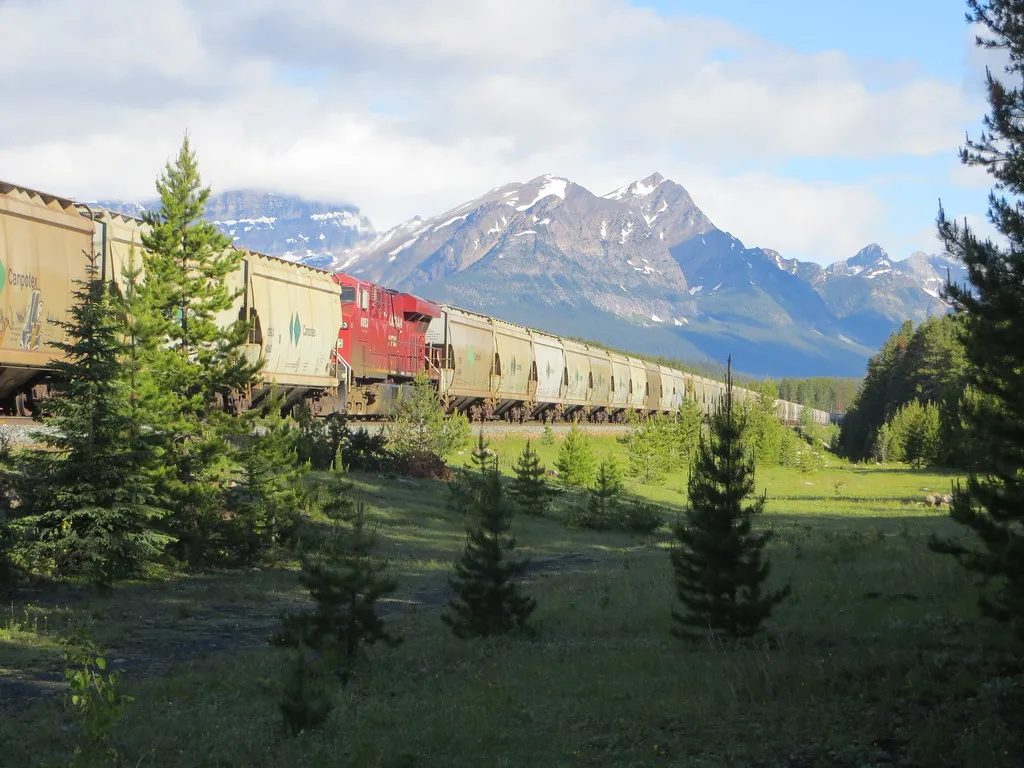
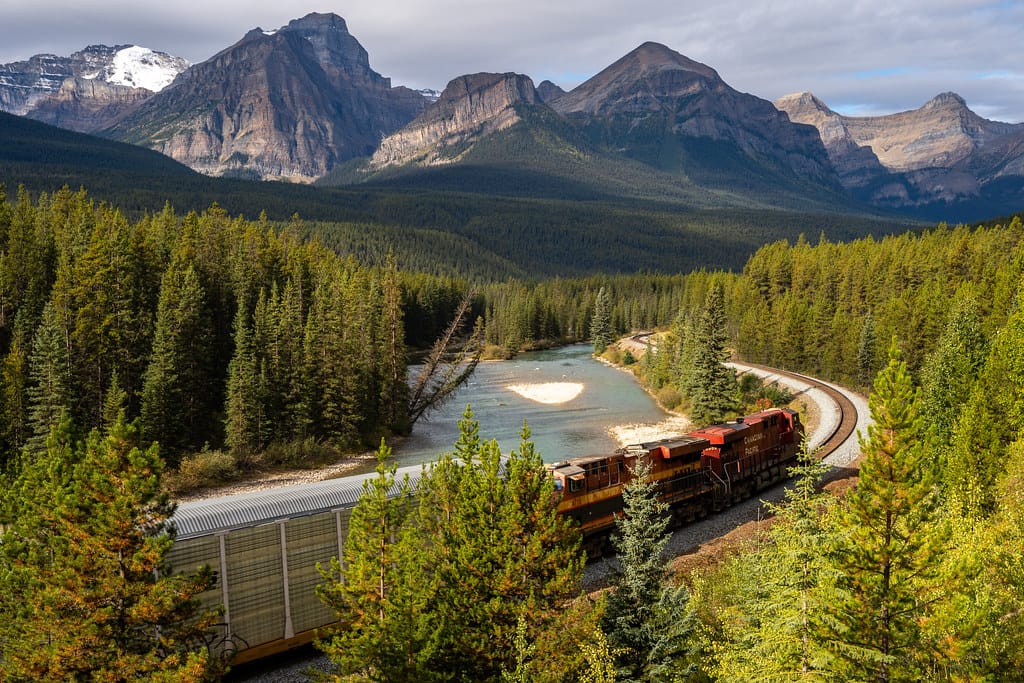
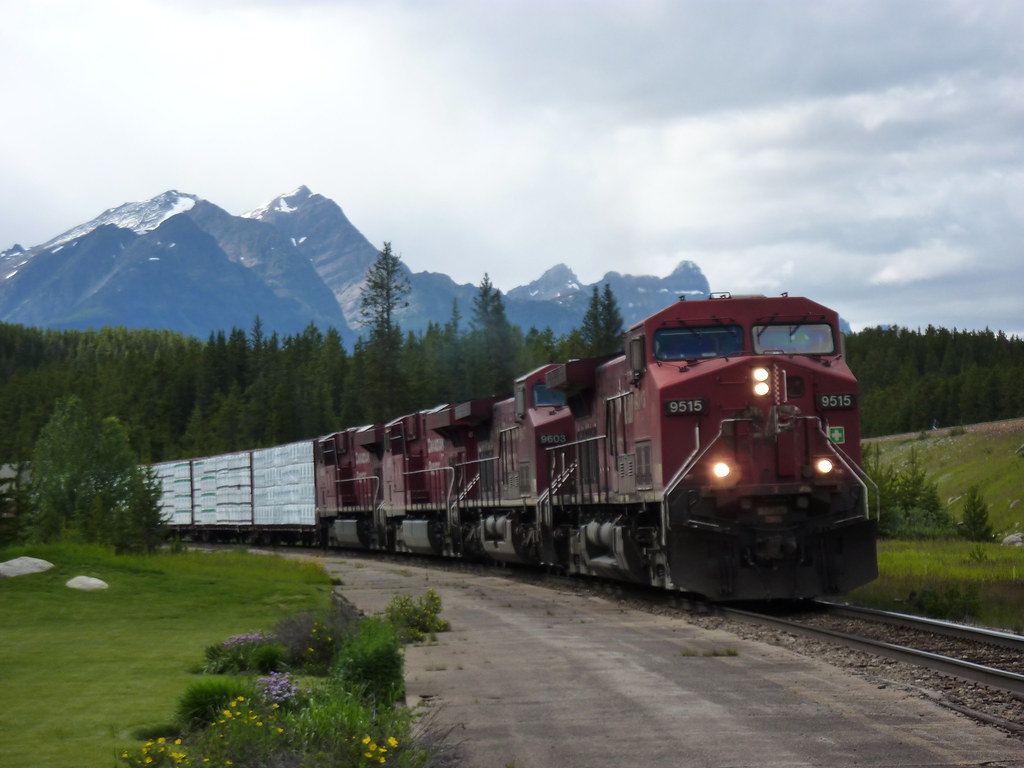
Morant's Curve sits at milepost 113 on the CPKC Laggan Subdivision, where the transcontinental mainline sweeps alongside the turquoise Bow River with the Canadian Rockies as a backdrop. Named after legendary CPR photographer Nicholas Morant (1910–1999), it is arguably the most photographed railfan location in North America.
Photos
 davidwilson1949
Attribution License
davidwilson1949
Attribution License
WayofWindy
Attribution License
Bods
Attribution-ShareAlike License
Trainspotting Experience
A concrete viewing platform with metal railings sits directly across the Bow Valley Parkway from the parking pull-off—cross the road and you're there in under a minute. The platform is elevated just enough above the single-track mainline to frame passing trains at near-cab level, with the turquoise Bow River curving behind and the Bow Range filling the horizon.
Eastbound trains announce themselves well in advance: the rumble of locomotives throttling up or the whine of dynamic brakes echoes off the valley walls a full minute before the head-end rounds the bend from dense conifer forest. Consists routinely exceed 10,000 feet, so a single train takes three to four minutes to pass, with every car visible against the river for most of its length. Westbounds approach from the Lake Louise direction and curve away from you into the trees—still photogenic, but the classic composition favors eastbounds.
Between trains, the stillness is remarkable. No highway drone reaches the platform, just rushing water, wind through spruce and pine, and the occasional distant whistle. Wildlife sightings are common—elk grazing near the tracks, osprey diving the river, and bears (particularly in spring and fall) foraging along the corridor. A scanner tuned to CPKC frequencies can help predict approaching movements.
Landscape, Setting & Local Atmosphere
Morant's Curve sits inside Banff National Park at roughly 1,340 m (4,400 ft) elevation, on a broad gravel bar where the Bow River sweeps through a pronounced S-bend. The river runs a vivid glacial turquoise from late spring through autumn, fed by meltwater from the Wapta Icefield upstream. Lodgepole pine, Engelmann spruce, and subalpine fir crowd the banks and frame the composition on both sides.
The mountain backdrop from the viewing platform includes Mount Temple (3,544 m / 11,627 ft), the tallest peak in the Lake Louise area, and Mount Fairview to its right. On clear mornings, the peaks catch alpenglow well before direct sun reaches the valley floor. Temperatures can dip below 10 °C at dawn even in July, and frost is possible into June. Winter transforms the scene entirely: deep snow blankets the forest, the river freezes in patches, and locomotive exhaust plumes hang in the cold air, adding dramatic contrast to photographs. Wildlife—elk, coyotes, wolves, and black and grizzly bears—frequents the river corridor year-round.
Type & Frequency of Train Activity
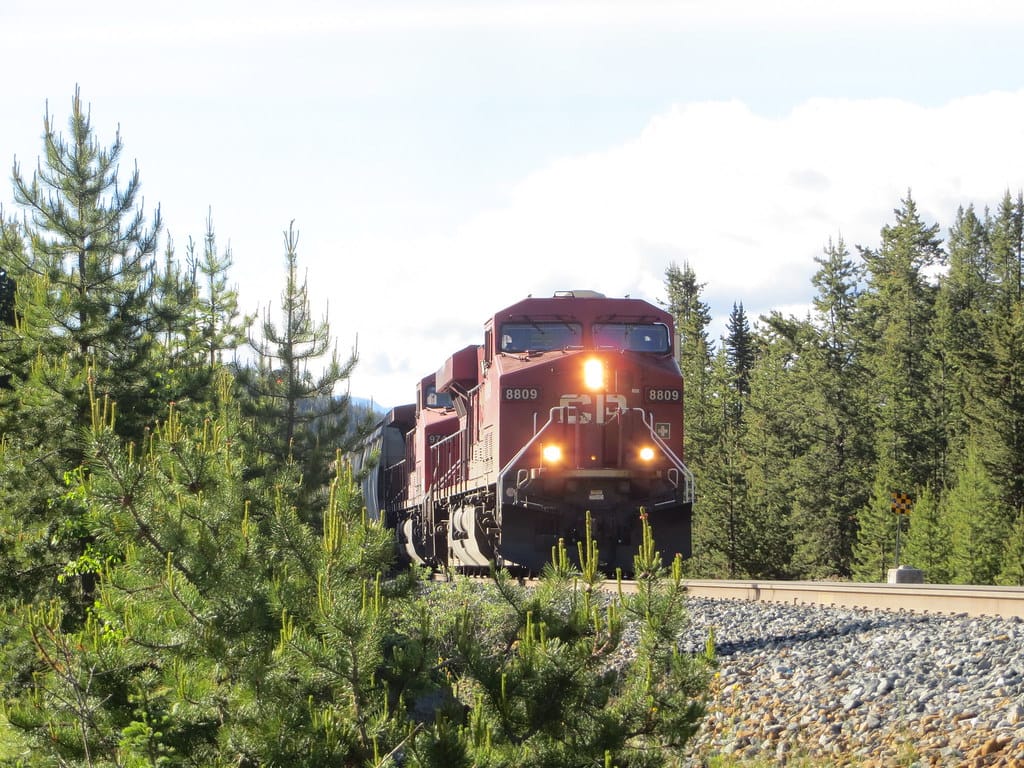
The line is the CPKC Laggan Subdivision, part of CPKC's transcontinental mainline connecting Calgary with the Pacific coast via the Kicking Horse Pass. It is single track at milepost 113 with CTC (Centralized Train Control) dispatching. Freight dominates: long unit grain trains, potash hoppers, double-stacked intermodal containers, and mixed manifest are the staples, powered by CPKC's fleet of GE and EMD road units often running in distributed power configurations (head-end plus mid-train or tail-end helpers).
The Rocky Mountaineer tourist train—identifiable by its blue-and-gold "First Passage to the West" consist—passes through twice weekly in each direction during its April-to-October season, typically arriving mid-morning or late afternoon. In late November and December, the CPKC Holiday Train may also pass through, decorated with holiday lights.
Important correction: VIA Rail's "The Canadian" does NOT pass through Morant's Curve. That train runs Toronto–Jasper–Vancouver via CN tracks through the Yellowhead Pass, not via CPKC's Laggan Subdivision.
Best Angles for Photos & What Railfans Enjoy Most
The classic composition is shot from the concrete viewing platform on the inside of the curve. A 24–70 mm lens frames the full S-bend with the Bow River and peaks in a single wide shot. For telephoto compression that stacks the locomotives against Mount Temple, step roughly 30 metres east along the informal footpath and use a 100–400 mm focal length.
Morning light (8–11 AM) gives front-three-quarter illumination on eastbound trains—this is the iconic angle that Nicholas Morant made famous. Mid-afternoon (2–4 PM) works best for westbounds, with warm sidelight on the river. In winter, low sun angles provide soft, even light throughout the day. A tripod helps for long exposures capturing headlight glow at twilight or in overcast conditions.
Trains can approach from either direction, so keep watch both ways. The viewpoint platform has a flat railing top suitable for a Platypod or small tripod head. Some trees near the platform can obstruct peripheral angles when busy; arriving early secures the best position. For video and audio recording, the location is remarkably quiet between trains—flange squeal through the curve and river rush are the dominant sounds with no highway interference.
Historical or Cultural Relevance
The curve is named after Nicholas Everard Morant (June 29, 1910 – March 13, 1999), born on a dairy farm near Kamloops, BC, who served as the Canadian Pacific Railway's Special Photographer from 1929 to 1935 and again from 1944 until his retirement in 1981. Over a career spanning more than 50 years, Morant produced over 12,000 images for the CPR archives and an additional 50,000-plus photographs preserved in the Nicholas Morant Fonds at the Whyte Museum of the Canadian Rockies in Banff.
This particular S-curve along the Bow River at milepost 113 was reportedly Morant's favorite shooting location. His photographs of trains rounding the bend appeared in CPR promotional campaigns that helped define Canada's image as a rail and wilderness destination. Several of Morant's landscape photographs (taken at other Rocky Mountain locations) appeared on Canadian banknotes: Emerald Lake on the 1954-series $10 bill, Okanagan Lake on the 1954-series $100 bill, and Moraine Lake on the 1969-series $20 bill.
The CPKC Laggan Subdivision itself dates to the 1880s construction of the original CPR transcontinental mainline—the engineering feat that unified Canada coast to coast. The route through the Bow Valley and over the Kicking Horse Pass remains one of the most celebrated stretches of mountain railroading anywhere.
What Makes This Spot Different
Morant's Curve combines active Class I mainline railroading with a pristine national park setting in a way that is extremely rare globally. The composition—a sweeping S-curve framed by glacial river and 3,000-metre peaks—has no catenary, signal gantries, highway overpasses, or industrial structures to clutter the frame. National park protection ensures the surrounding landscape will never be developed.
The viewpoint's accessibility is another standout feature: a paved parking area, a concrete viewing platform with railings, and zero hiking required. Visitors with mobility limitations can observe from the platform or even from their parked car across the road—listen for the horn, then cross. This ease of access, combined with the world-class scenery and consistent freight traffic, makes Morant's Curve a destination that rewards both the patient railfan and the passing tourist with a 15-minute stop.
Frequently Asked Questions
QIs there a train schedule for Morant''s Curve?
No. This is an active CPKC freight mainline and trains do not follow a public schedule. During weekday business hours, trains reportedly pass every 30–60 minutes. On weekends and outside business hours, expect waits of 1–2 hours. The Rocky Mountaineer tourist train passes twice weekly per direction during its April–October season but exact times vary.
QDo I need to hike to reach the viewpoint?
No hiking is required. The concrete viewing platform is directly across the Bow Valley Parkway from the parking pull-off—less than a 1-minute walk on flat ground. The platform has railings and is wheelchair-accessible.
QDo I need a Parks Canada pass?
Yes. Morant''s Curve is inside Banff National Park. A Parks Canada Discovery Pass is required (C$11/day for adults, or an annual Discovery Pass for C$72.25). Passes can be purchased at park gates or online.
QDoes VIA Rail''s Canadian pass through here?
No. VIA Rail''s Canadian runs Toronto–Jasper–Vancouver via CN tracks through the Yellowhead Pass. It does not use CPKC''s Laggan Subdivision through Lake Louise. The passenger train you may see here is the Rocky Mountaineer (April–October season).
Safety Tips
This is an active CPKC transcontinental mainline—stay behind the viewing platform railings and never walk on or near the tracks. Trains pass at approximately 30–50 km/h (20–30 mph) through the curve but are quieter than expected due to the river noise. The viewpoint is elevated above track level, providing a safe distance. Watch for wildlife, especially bears—carry bear spray and make noise when walking to the platform. In winter, the parking pull-off can be icy and the wind chill severe; dress in layers. The Bow Valley Parkway has a 60 km/h speed limit; watch for cyclists and wildlife when crossing the road to the viewpoint.
Seasonal Information
Summer (June–August) offers the longest daylight and the most vivid turquoise river color, but the small parking lot fills quickly, especially on weekends. Temperatures range from 5 °C at dawn to 25 °C mid-afternoon. The Rocky Mountaineer runs through during this peak season. Fall (September–October) brings golden larch season in the surrounding valleys, thinner crowds, and crisp light. Bear activity increases as animals forage before hibernation—stay alert. Winter (November–March) is many photographers' favorite: fresh snow transforms the scene, locomotive exhaust plumes contrast against powder, and you may have the viewpoint entirely to yourself. The Bow Valley Parkway may be slow to plow after storms, and the road section nearest Banff closes to vehicles seasonally (though the Morant's Curve end remains accessible from Lake Louise year-round). Dress warmly—wind funnels through the valley and temperatures can drop below -30 °C. Spring (April–May) brings variable conditions: some days snowbound, others showing early wildflowers. The Rocky Mountaineer season begins in mid-April.
Nearby Lodging
- Baker Creek by Basecamp
Rustic log cabins and lodge rooms along the Bow Valley Parkway, about 20 minutes from the curve. Wood-burning stoves, on-site restaurant. Mid-range pricing.
- Lake Louise Inn
Largest hotel in Lake Louise village with indoor pool and hot tubs. 10-minute drive from Morant's Curve. Multiple room types from standard to suites.
- Fairmont Chateau Lake Louise
Iconic luxury resort on the shore of Lake Louise with glacier views. Premium pricing. About 10 minutes from the curve.
- HI Lake Louise Alpine Centre
Budget-friendly hostel jointly run by HI and the Alpine Club of Canada. Dorm and private rooms available. In Lake Louise village.
- Castle Mountain Chalets
Family-run chalets at Castle Junction on the Bow Valley Parkway, about 25 minutes from the curve. Full kitchens and gas fireplaces. Operating since 1939.
Nearby Attractions
18.6 miles / 30 km
Another iconic CPKC railfan stop where trains enter figure-eight tunnels to descend the Kicking Horse Pass. Interpretive panels and a scale model explain the engineering. Free access from a Trans-Canada Highway pull-off.
5 miles / 8 km
One of Canada's most famous glacial lakes, with turquoise waters backed by Victoria Glacier. A 10-minute drive from Morant's Curve. Lakeshore walking trail and the Fairmont Chateau are at the shore.
34 miles / 55 km
Houses the Nicholas Morant Fonds—over 50,000 photographs by the CPR photographer who gave the curve its name. Located in Banff townsite.
18.6 miles / 30 km
Popular hiking trail with catwalks bolted to canyon walls leading to lower and upper waterfalls. Trailhead is along the Bow Valley Parkway, roughly 25 minutes from the curve.
6.2 miles / 10 km
Gondola ride offering panoramic views of the Bow Valley, Lake Louise, and grizzly bear habitat on the avalanche slopes below. Open seasonally.
External Links
blog
informative
informative
tourism
Looking for more spots? Browse the complete list of train spotting locations.
Quick Information
Country
Canada
Region
Alberta
City
Lake Louise
Spot Type
Curve/Loop
Best Times
Weekday business hours (9 AM–5 PM) offer the most frequent freight traffic, with trains reportedly passing every 30–60 minutes during peak periods. Eastbound trains are best shot in morning light (8–11 AM) and westbounds in afternoon sun (2–4 PM). Weekend traffic is lighter and waits can stretch to 2 hours or more.
Visit Duration
15 minutes for a quick photo stop; 1–2 hours if waiting for a train
Cost
Free (Parks Canada pass required: C$11/day adult)
Train Activity
Train Types
Frequency
CPKC runs freight around the clock on this transcontinental mainline. During weekday business hours, trains reportedly pass every 30–60 minutes; outside those windows or on weekends, gaps of 1–2 hours are common. There is no published schedule—this is a Class I freight corridor and train timing is unpredictable. The Rocky Mountaineer tourist train passes twice weekly per direction during its April–October season.
Access & Amenities
Parking
Available (Free (but Parks Canada pass required for Banff NP: C$11/day adult))
Shelter
Not available
Restrooms
Not available