Newton (Transcon)
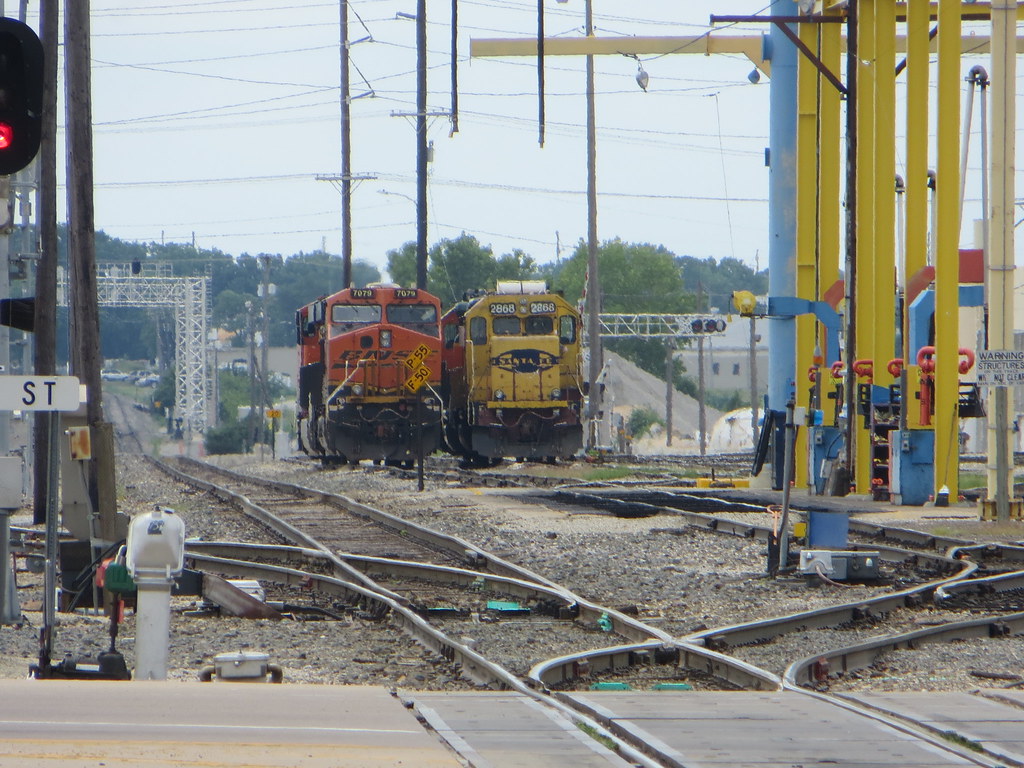
A key junction on BNSF's Southern Transcon at Newton, Kansas, where the Arkansas City Subdivision meets the main line. Home to BNSF mechanical shops with a working turntable, the historic Tudor Revival Amtrak station, and heavy freight traffic on one of America's busiest rail corridors.
Photos
 davidwilson1949
Attribution License
Trainspotting Experience
Newton sits at a strategic junction on BNSF's Southern Transcon, the railroad's premier Chicago-to-Los Angeles freight corridor. The town is located on the Arkansas City Subdivision, which historically handled primarily eastbound traffic as an overflow route while the Emporia Subdivision carried westbounds and priority intermodal. With the completion of double-tracking on the Emporia Sub in November 2024, traffic patterns through Newton may shift, but the corridor remains heavily used.
The BNSF mechanical facility east of downtown is one of the most accessible shop operations for railfans. About 200 BNSF employees work here in Mechanical and Engineering roles, performing freight car repair, locomotive maintenance, and equipment refurbishment. Newton is one of a small number of BNSF sites that still operates a turntable, used primarily to position PTC-equipped locomotives in the correct orientation. The former roundhouse has been torn down, but the turntable remains visible from public roads and a nearby park.
The Amtrak station at 414 North Main Street serves as the natural focal point for railfanning. Free public parking is available in a lot west of the depot, across Main Street. The station sits at the intersection of the railroad and US-81 (Main Street), giving clear sightlines in both directions along the tracks. The rail corridor runs roughly northeast-southwest through town, with multiple grade crossings providing additional viewpoints.
Landscape, Setting & Local Atmosphere
Newton sits on the Kansas prairie at roughly 1,450 feet elevation, on the east bank of Sand Creek in Harvey County. The terrain is flat with vast, unobstructed horizons — typical of south-central Kansas wheat country. These open sightlines let you spot approaching headlights well before trains arrive, and the flat topography means minimal visual clutter for photography.
The town of approximately 19,000 people has a quiet, small-city Midwest character. Downtown Newton retains some historic commercial buildings along Main Street, with the landmark Amtrak depot at the railroad crossing. The tracks cut through the heart of town, a physical reminder that Newton exists because of the railroad. Seasonal conditions vary considerably: summers are hot (regularly above 95°F) with intense sun and occasional thunderstorms that create dramatic skies. Winters bring cold north winds and occasional snow, though accumulation is typically light. Spring and fall offer the most comfortable weather for extended trackside sessions, with wheat fields transitioning through green, gold, and brown stages across the surrounding farmland.
Type & Frequency of Train Activity
BNSF's Southern Transcon is one of the highest-volume freight corridors in North America. A 2006 BNSF report cited 100 trains per day on the expanded Transcon mainline, up from 60 per day in 2000 — and volumes have continued growing since. At any given time, approximately 300 trains are moving somewhere along the 2,200-mile route between Chicago and Los Angeles.
Traffic through Newton historically included a mix of both through Transcon traffic and Arkansas City Subdivision moves. Grain is the largest commodity passing through Newton, according to BNSF Terminal Manager Matthew Hainline, reflecting Kansas's agricultural economy. Intermodal container and trailer traffic — BNSF's bread and butter — dominates the Transcon overall, with high-priority Z-symbol hotshots running around the clock.
Amtrak's Southwest Chief (trains #3 and #4) calls at Newton station once daily in each direction. Scheduled arrival times are approximately 2:16 AM for the westbound #3 and 1:55 AM for the eastbound #4, though the Southwest Chief frequently runs late — its on-time average has been around 35% over the past year, with delays averaging over two hours. The late-night schedule makes Amtrak spotting challenging, but the station's proximity to Wichita (25 miles south) keeps the depot relatively busy despite the hours. Union Pacific also has trackage rights on portions of the Transcon between Kansas City and Joliet, so UP power occasionally appears on through intermodal trains.
Best Angles for Photos & What Railfans Enjoy Most
Newton's flat terrain and open sightlines provide straightforward photography conditions. The tracks run roughly northeast-southwest through town, which means morning light favors shooting eastbound (northeast-facing) trains and afternoon light works best for westbound (southwest-facing) consists.
The area around the Amtrak station on North Main Street offers the most convenient shooting positions, with the historic Tudor Revival depot providing an attractive backdrop. The BNSF mechanical shops east of downtown are visible from public roads and a nearby park, according to railfan David Graham, who notes the shops are "easily observed from the road and a park in the downtown." This area allows you to photograph locomotives being serviced and occasionally turned on the turntable.
Grade crossings throughout town provide additional angles. The flat Kansas landscape means telephoto lenses (200-400mm) are particularly effective for compressing the perspective of approaching trains against the prairie horizon. Wide-angle shots work well near grade crossings to capture full train lengths with grain elevators as context. Newton's open skies also present opportunities for dramatic storm-cloud compositions during Kansas's active severe weather season from April through June.
Historical or Cultural Relevance
Newton was founded in July 1871 when the Atchison, Topeka & Santa Fe Railway extended its line westward from Emporia. The town was named by Santa Fe Railroad stockholders after their hometown of Newton, Massachusetts. It quickly became the northern terminus of the Chisholm Trail, succeeding Abilene as the destination for Texas cattle drives — though this cattle boom lasted only a single summer before the railhead moved south to Wichita in 1872.
During its brief cowtown era, Newton earned the nickname "the wickedest town in the West." The railroad brought a different kind of prosperity: Newton became an ATSF division point, and the Fred Harvey Company operated a Harvey House restaurant at the depot. The current station building, the third on this site, was designed by Kansas architect E.H. Harrison and built between 1929 and 1931 at a cost of $350,000. Its Tudor Revival style, modeled after Shakespeare's house in Stratford-on-Avon, features a steep slate roof, half-timbering, and heavy-beamed ceilings. It was added to the National Register of Historic Places in 1985.
Newton remained an ATSF division center and headquarters until the mid-1980s. A large group of Russian Mennonite farmers who arrived in 1879 brought Turkey Red hard winter wheat, transforming the region into one of America's premier wheat-growing areas. In Military Park, Santa Fe steam engine #1880, a Prairie-class 2-6-2, stands as a static display alongside a Civil War-era cannon.
What Makes This Spot Different
What distinguishes Newton from other Transcon watching points is the combination of an active BNSF mechanical facility with a stunning National Register-listed depot. The turntable — one of only a handful still operating on the BNSF system — adds a historic dimension rarely seen at modern railroad facilities. Newton also sits at the junction of the Arkansas City Subdivision (heading south toward Wichita) and the main Transcon routing, providing variety in train movements.
The town is also significant as the nearest Amtrak station to Wichita, Kansas's largest city (25 miles south). In 2021, Amtrak proposed extending the Heartland Flyer from Oklahoma City through Wichita to connect with the Southwest Chief at Newton — a service that KDOT indicated could start as early as 2029. If realized, this would significantly increase passenger rail activity at the station.
Newton offers something increasingly rare: a genuine railroad town where the infrastructure predates the modern era but the traffic volume is thoroughly 21st century. You can stand at a grade crossing on Main Street, watch a 12,000-foot intermodal train thunder past at track speed, and then walk across the street to a depot that Fred Harvey's waitresses once served meals in.
Frequently Asked Questions
QHow many trains per day pass through Newton?
Newton sits on BNSF's Southern Transcon, one of North America's busiest freight corridors. BNSF reported 100+ trains per day on the Transcon as of 2006, with volumes growing since. The exact count at Newton depends on routing decisions between the Arkansas City and Emporia subdivisions.
QWhen does the Amtrak Southwest Chief stop at Newton?
The westbound Southwest Chief #3 is scheduled to arrive around 2:16 AM CT, and the eastbound #4 around 1:55 AM CT. Both trains frequently run late — the route's on-time performance averages around 35%. The station has a staffed waiting room open during train arrival hours.
QIs there parking for railfans at Newton?
Free parking is available in a public lot west of the Amtrak depot, across Main Street from the station. The city asks visitors to park on the side closest to the post office. Additional street parking is available throughout downtown Newton.
QWhat scanner frequencies should I use at Newton?
The BNSF Arkansas City Subdivision road channel is 161.055 MHz (Newton to East Arkansas City). The Sand Creek/Newton Yard frequency is 161.160 MHz. The PBX (phone patch) for Newton is 160.260 MHz.
QCan you see the BNSF shops and turntable?
Yes. The BNSF mechanical shops and turntable in Newton are visible from public roads and a nearby park. The former roundhouse has been demolished, but the turntable remains operational and is used to position locomotives for PTC requirements.
Safety Tips
Newton has multiple active grade crossings with frequent train traffic. Always obey crossing signals and never stand on or between the tracks. Trains on the Transcon can approach at up to 70 mph with limited warning on the flat terrain. Kansas summers bring extreme heat — bring water, sunscreen, and shade. Severe weather season (April-June) can produce tornadoes and dangerous lightning; monitor weather conditions and seek shelter if storms approach.
Seasonal Information
Spring brings green wheat fields and wildflowers, with mild temperatures ideal for extended outdoor sessions. Summer offers the longest daylight hours but extreme heat requires preparation. Fall provides golden harvest scenery and comfortable temperatures. Winter is cold with north winds, but light snowfall can create atmospheric photos. Train traffic is consistent year-round with possible peaks during harvest season (June-July for wheat) when unit grain trains increase.
Nearby Lodging
- Holiday Inn Express & Suites Newton
Modern hotel right off I-135. Pool, breakfast included. Popular choice and closest brand-name option to downtown Newton.
- Comfort Inn & Suites Near Bethel College
Located off I-135. Pet-friendly. Close to Bethel College and within a short drive of the Amtrak station and rail corridor.
- Newton Inn
Budget option on East 2nd Street, conveniently located on I-135 with easy access to downtown Newton and the railroad. Basic amenities with microwave and fridge in rooms.
- Red Coach Inn
Budget-friendly motel in Newton. Simple accommodations close to the rail corridor.
Nearby Attractions
0.2 miles / 0.3 km
Housed in the 1904 Carnegie Library, features permanent exhibits on Harvey County history including railroad artifacts, the Chisholm Trail era, and Mennonite immigration. Includes a restored 1873 one-room schoolhouse on the grounds.
0.3 miles / 0.5 km
The 1886 Victorian home of Bernhard Warkentin, who introduced Turkey Red hard winter wheat to Kansas. Listed on the National Register of Historic Places, with 80% original furnishings intact.
1.9 miles / 3 km
Award-winning museum on the Bethel College campus in North Newton exploring the history of central plains Mennonites and their role in Kansas agriculture.
34 miles / 55 km
Kansas's official Heritage Railroad, operating steam and diesel excursion trains on 5.5 miles of ex-Rock Island track between Abilene and Enterprise. Features ATSF 3415, a restored 1919 Baldwin Pacific locomotive — the only operating steam engine in Kansas.
35 miles / 56 km
Presidential library and museum in Abilene, adjacent to the Abilene & Smoky Valley Railroad depot. Covers the life and presidency of Dwight D. Eisenhower, who grew up in Abilene.
External Links
informative
informative
informative
official
informative
Looking for more spots? Browse the complete list of train spotting locations.
Quick Information
Country
USA
Region
Kansas
City
Newton
Spot Type
Yard/Depot
Best Times
Daytime hours offer the best photography light and visibility of BNSF shop operations. Amtrak's Southwest Chief stops around 2:16 AM (westbound #3) and 1:55 AM (eastbound #4), making passenger train observation impractical for most visitors.
Visit Duration
2-4 hours
Cost
Free — public viewing from streets, sidewalks, and the Amtrak station area
Train Activity
Train Types
Frequency
High-density corridor with trains approximately every 15-20 minutes on the Transcon. Newton also sees traffic on the Arkansas City Subdivision heading south toward Wichita.
Access & Amenities
Parking
Available (Free public parking near the Amtrak depot and throughout downtown)
Shelter
Available
Restrooms
Available