
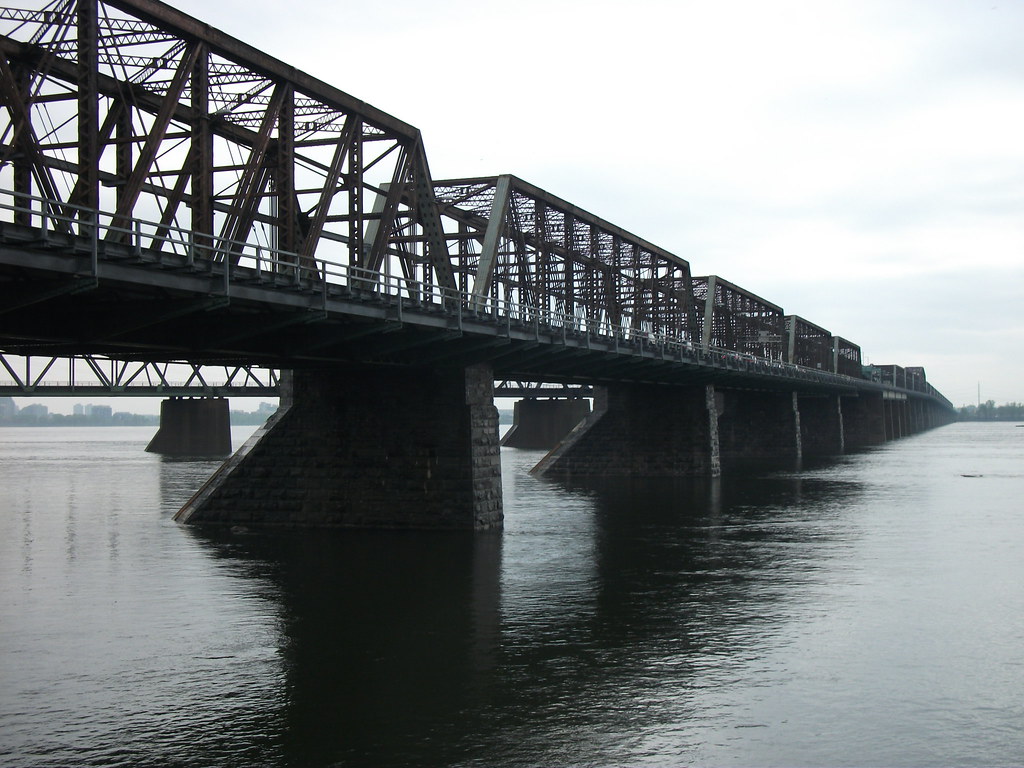
Pont Victoria
Historic 1859 railway bridge where CN freight, VIA Rail, and Exo commuter trains cross the St. Lawrence River between Montreal and Saint-Lambert.
Photos
 Dougtone
5
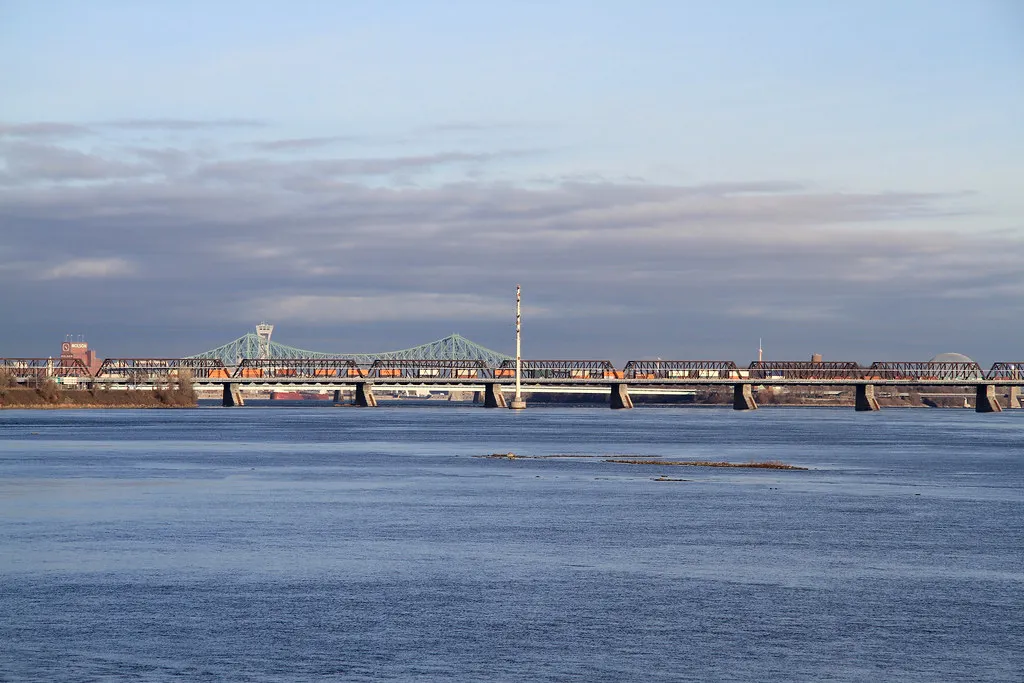
Parcours riverain - Ville de Montréal
4
Trainspotting Experience
Victoria Bridge sits at mile 71.4 of CN's Saint-Hyacinthe Subdivision, the primary CN main line connecting Montreal to the Maritimes. Two primary vantage zones serve railfans: the north shore in Pointe-Saint-Charles near Parc Marguerite-Bourgeoys, which overlooks the rail junction funnelling traffic from the bridge toward Central Station; and the south shore in Saint-Lambert, accessible via the bike path along Parc de la Voie Maritime. A parking area is available near the Rue des Irlandais/Route 112 intersection on the Saint-Lambert side.
Traffic is consistent and varied. On weekdays, the Exo Mont-Saint-Hilaire commuter line generates 14 train movements — 7 inbound toward Central Station in the morning peak and 7 outbound in the afternoon — but runs no service on weekends. CN freight crosses the 2-km span at all hours; long intermodal and mixed-manifest consists are audible well before emerging from the truss spans. VIA Rail uses the bridge for both the Ocean (Montreal–Halifax, 3x/week) and Quebec City corridor services on weekdays.
The deep resonance of a heavy CN freight moving at 60–80 km/h through the steel truss spans is a defining sensory feature of any visit. From the south shore, headlamps approach from the Montreal side with several seconds of warning before a consist accelerates onto the open bridge. Binoculars or a telephoto lens help resolve locomotive details from the embankment.
Landscape, Setting & Local Atmosphere
Victoria Bridge spans 2 km of the St. Lawrence River, its paired steel truss spans and original 1850s limestone piers defining the horizon between urban Montreal and the quieter south shore of Saint-Lambert. The current truss structure dates to 1898, replacing the original tubular iron design, while the stone piers remain from the 1850s construction. Route 112 road traffic occupies the outer lanes; the single CN rail track runs through the central span.
From the Saint-Lambert embankment, the view opens across open water toward the Montreal skyline — the dome of the Basilique Notre-Dame and the silhouette of Mont-Royal visible on clear days. The Saint-Lambert Seaway lock basin lies immediately to the east; during the navigation season (late March to December), vessels queue at the lock in the foreground while freight trains roll overhead on the bridge. In winter, ice floes drift beneath the truss spans against a backdrop of sharp, cold air that clarifies locomotive detail at distance. Summer brings sailboats on the river and golden late-afternoon light hitting westbound locomotive noses around 5–7 PM from the south shore.
Type & Frequency of Train Activity
Victoria Bridge carries traffic for three railway operators, all on CN's Saint-Hyacinthe Subdivision (mile 71.4):
CN Freight: A principal link on CN's Halifax corridor, the bridge carries mixed-manifest, intermodal double-stack, and bulk commodity trains throughout the day and night. Motive power is typically GE ET44AC or EMD SD70M-2 locomotives in two- or three-unit consists. The Saint-Hyacinthe Subdivision is a high-priority main line segment with consistent heavy freight volume.
VIA Rail: The Ocean (trains 14/15, Montreal–Halifax) crosses Victoria Bridge three times per week in each direction — Montreal departures on Wednesdays, Fridays, and Sundays. VIA Rail's Quebec City corridor services also use the bridge on weekdays, providing additional passenger sightings beyond the Ocean. All VIA services originate at Montreal Central Station, making Victoria Bridge their first main-line segment out of the city.
Exo (Mont-Saint-Hilaire Line): Seven inbound and seven outbound movements on weekdays only — no weekend service. As of early 2026, this is the only Exo commuter rail line still serving Montreal Central Station. Trains are operated by Alstom under contract to Exo using push-pull bi-level equipment.
No CP Rail or Amtrak traffic uses this bridge. CN controls all dispatching on the subdivision.
Best Angles for Photos & What Railfans Enjoy Most
South Shore (Saint-Lambert) — Primary Vantage: Access via the bike path along Parc de la Voie Maritime, east of the bridge approach on the south bank. Trains frame against the bridge truss with the Montreal skyline behind. Morning light illuminates eastbound consists (outbound from Central Station); late afternoon and evening light catches westbound freights nose-on. Telephoto lenses (200–400 mm) isolate locomotives within the truss framing.
North Shore (Pointe-Saint-Charles): The informal observation area near Parc Marguerite-Bourgeoys overlooks the railway junction where Victoria Bridge traffic splits toward Central Station. This angle captures trains entering and exiting the bridge from the Montreal side, with headlamps visible approaching across the river on clear days. Wide-angle glass (16–35 mm) captures the urban junction context effectively.
Diversion Bridge (south embankment, Saint-Lambert): When a vessel transits the Saint-Lambert Seaway lock, CN traffic shifts to the 1958 diversion bridge immediately south of the main heritage span. Spotters on the south embankment can photograph a freight on the lower diversion span framed against the original 1898 truss — a shot unique to this location and only possible during the shipping season.
Night photography rewards long exposures: the navigation lights on the bridge piers cast red and green reflections across the river, and approaching locomotive headlamps create light streaks against the illuminated truss structure. Tripods are essential for evening sessions.
Historical or Cultural Relevance
Victoria Bridge stands as one of North America's defining railway engineering achievements. Construction for the Grand Trunk Railway began in 1854 under chief engineer Alexander MacKenzie Ross, with structural design by Robert Stephenson — the engineer behind England's tubular Britannia Bridge across the Menai Strait. The contractor was the English firm of Peto, Brassey and Betts, with James Hodges as superintendent of construction.
The first passenger train crossed on December 17, 1859, making Victoria Bridge the first permanent fixed crossing of the St. Lawrence River. At 2 km between abutments, it was the longest bridge in the world and was widely called the "Eighth Wonder of the World." The official royal inauguration followed on August 25, 1860, when Prince Albert Edward (the future King Edward VII), then on a royal tour of Canada, crossed the bridge in honour of his mother, Queen Victoria.
The original hollow tubular iron design — trains ran through a rectangular iron tube — was replaced between 1897 and 1898 with the current two-track steel truss structure, which has carried rail traffic without interruption since. In 1958, a secondary diversion bridge was added south of the main span to accommodate the new Saint-Lambert lock of the St. Lawrence Seaway, allowing trains to continue operating while ships transit the lock. The original limestone piers, cut and assembled in the 1850s, remain in service beneath the modern truss.
What Makes This Spot Different
Victoria Bridge is the only mainline railway bridge in Canada where three categories of rail traffic — heavy CN mainline freight, a VIA Rail long-distance sleeper service (the Ocean), and urban commuter rail (Exo) — share a single-track structure whose stone piers predate Confederation. The 1958 diversion bridge south of the main span adds an operational curiosity visible from the south shore: when a ship enters the Saint-Lambert lock, CN dispatching reroutes trains to the lower span, creating the unusual sight of a freight on the diversion bridge framed against the original 1898 truss. No other publicly observable mainline crossing in Canada combines active heritage infrastructure, heavy freight, scheduled long-distance passenger, and suburban commuter operations — all visible from accessible public shoreline on both banks.
Frequently Asked Questions
QWhat railway subdivision is Victoria Bridge on?
Victoria Bridge carries CN's Saint-Hyacinthe Subdivision at mile 71.4, linking Montreal Central Station to CN's main line east toward Saint-Hyacinthe, Moncton, and Halifax.
QDoes Exo commuter rail operate on weekends at Victoria Bridge?
No. The Exo Mont-Saint-Hilaire line operates weekdays only — 7 inbound and 7 outbound movements per day. There is no weekend commuter service over Victoria Bridge.
QWhen does VIA Rail's Ocean train cross Victoria Bridge?
The Ocean (Montreal to Halifax) departs Montreal on Wednesdays, Fridays, and Sundays. Consult VIA Rail's current timetable at viarail.ca for exact departure times from Central Station.
QWhere is the best place to watch trains at Victoria Bridge?
The south shore embankment in Saint-Lambert, accessible via Parc de la Voie Maritime's bike path, offers open views of the full bridge span and the Montreal skyline. Parking is available near the Rue des Irlandais/Route 112 intersection. On the north shore, the observation area near Parc Marguerite-Bourgeoys in Pointe-Saint-Charles overlooks the railway junction.
QCan visitors access the railway track on Victoria Bridge?
No. The railway track on Victoria Bridge is active CN operational territory and is not accessible to the public. Viewing is from shoreline pathways on both banks. The Route 112 road lanes on the bridge are for vehicle traffic only.
Safety Tips
The railway track on Victoria Bridge carries active CN trains at all hours — never attempt to access the bridge structure or the railway track. Stay on designated shoreline pathways and respect all fencing. Trains on the Saint-Hyacinthe Subdivision travel at 60–80 km/h and give little advance warning at ground level. The river embankment can be icy and slippery in winter — wear footwear with grip. Wind off the St. Lawrence is strong year-round; secure loose camera equipment and dress in layers.
Seasonal Information
Exo Mont-Saint-Hilaire commuter service operates weekdays year-round. CN freight and VIA Rail run year-round regardless of weather. The Saint-Lambert Seaway lock is operational from approximately late March through December; ships are only visible transiting the lock during this navigation season. Winter conditions (November–March) can be cold and windy on the open river embankment — no shelter is available. Summer evening light (June–August) hits westbound trains on the bridge around 5–7 PM from the south shore.
Nearby Lodging
- Holiday Inn Montreal-Longueuil
Full-service hotel in Longueuil, approximately 5 km from Victoria Bridge. Amenities include an indoor pool, complimentary parking, two restaurants, and free Wi-Fi. The closest major hotel chain to the spotting location on the south shore.
- Hotels & Rentals in Saint-Lambert (Booking.com)
Booking.com search results for Saint-Lambert, showing accommodation options from approximately $85/night including hotels and apartment rentals within cycling or walking distance of Victoria Bridge.
- Downtown Montreal Hotels (via Exo rail)
A wide range of hotels is available in downtown Montreal, approximately 15–20 minutes by Exo Mont-Saint-Hilaire commuter rail from Saint-Lambert station. Ideal for railfans who want to base themselves in the city and commute to the bridge by train.
Nearby Attractions
13.7 miles / 22 km
Canada's largest railway museum in Saint-Constant, with over 140 pieces of rolling stock spanning 150 years of Canadian railway history. Visitors can board exhibits, ride a historic streetcar, and explore the largest collection of railway equipment in Canada.
0.3 miles / 0.5 km
Waterfront park immediately east of Victoria Bridge in Saint-Lambert, featuring a dedicated observation platform for watching ships transit the Saint-Lambert Seaway lock. During the navigation season (late March to December), vessels of all sizes maneuver through the lock gates while trains cross overhead.
1.2 miles / 2 km
Informal elevated observation point near Parc Marguerite-Bourgeoys on the Montreal (north) side of Victoria Bridge, overlooking the CN rail junction where the Victoria Bridge line splits toward Central Station. Accessible by metro (Charlevoix station, Green Line) or on foot from Pointe-Saint-Charles neighbourhood.
3.7 miles / 6 km
Montreal's historic waterfront district along the St. Lawrence, approximately 6 km north of Victoria Bridge. Features the Clock Tower, science centre, and panoramic views of the river. A logical add-on stop for railfans visiting from out of town.
3.1 miles / 5 km
The terminus of all VIA Rail and Exo trains crossing Victoria Bridge. The 1943 underground Beaux-Arts station is worth a visit in its own right, and the concourse offers views of arriving and departing trains at track level. Located 5 km north of the bridge.
External Links
informative
informative
Looking for more spots? Browse the complete list of train spotting locations.
Quick Information
Country
Canada
Region
Québec
City
Saint-Lambert
Spot Type
Bridge/Overpass
Best Times
Weekday mornings for Exo commuter inbound rush (before 9am); early afternoon for CN freight with south-facing light on the Saint-Lambert embankment
Visit Duration
1-2 hours
Cost
Free
Train Activity
Train Types
Frequency
CN freight: mainline traffic, est. 20-25 daily movements; VIA Rail Ocean: 3 departures per week in each direction (Wed/Fri/Sun); Exo Mont-Saint-Hilaire: 14 weekday movements (no weekend service)
Access & Amenities
Parking
Available (Free — public parking available near the Rue des Irlandais/Route 112 intersection on the Saint-Lambert side)
Shelter
Not available
Restrooms
Not available