Spiral Tunnels (Kicking Horse)
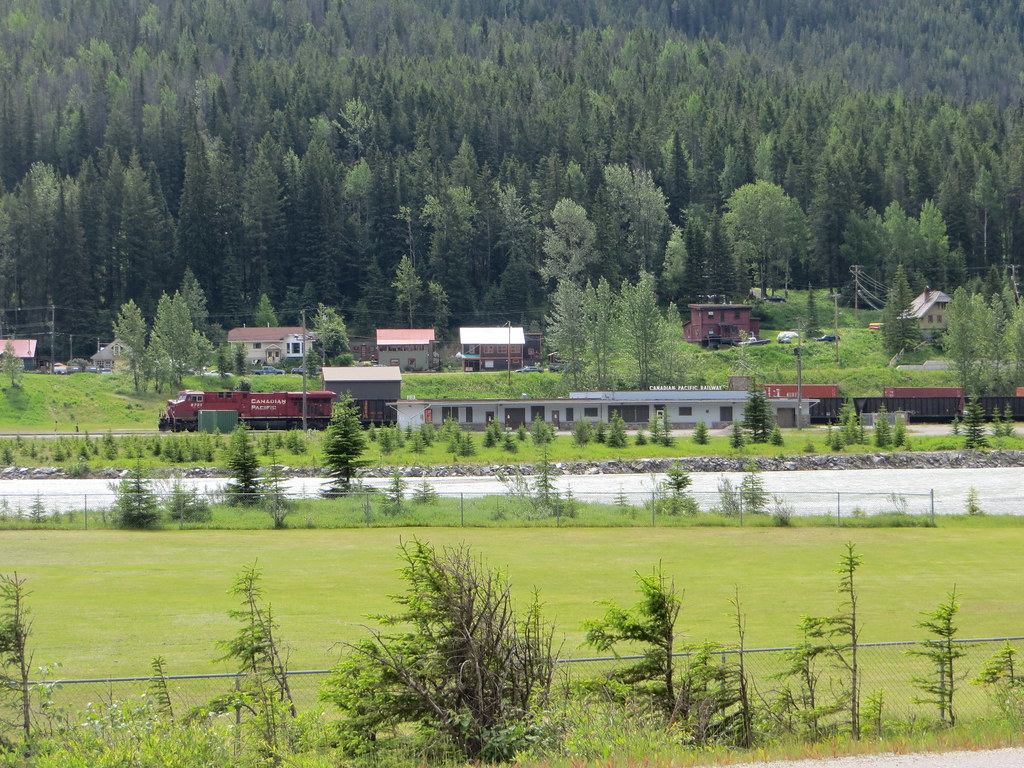
Two 270-degree spiral tunnels where CPKC freight and passenger trains loop through Cathedral Mountain and Mount Ogden in Yoho National Park. Built in 1909 to replace the dangerous 4.5% Big Hill grade, 25-30 trains per day still navigate this century-old engineering marvel. Two Parks Canada viewpoints with interpretive panels offer safe, unobstructed views.
Photos
 davidwilson1949
Attribution License
davidwilson1949
Attribution License
railfan 44
10
Trainspotting Experience
Two official Parks Canada viewpoints provide safe, elevated vantage points over the spiral tunnels. The Lower Spiral Tunnel Viewpoint sits 7.4 km east of Field on the Trans-Canada Highway and looks directly at the east portal of the 891-metre tunnel through Mount Ogden. A raised wooden platform gives clear sightlines of trains entering and exiting, with the head-end often visible while mid-train power is still inside. The Upper Spiral Tunnel Viewpoint is 2.3 km up Yoho Valley Road, overlooking the 991-metre tunnel through Cathedral Mountain.
Trains grind uphill at roughly 15-20 mph (25-30 km/h), with dynamic brakes audibly squealing on downhill movements. CPKC consists are typically 7,500-9,500 ft (2.3-2.9 km) long, so expect each passage to last 8-12 minutes as the full train coils through the tunnels. With Distributed Power Units (mid-train and rear remote locomotives), you get multiple engine passes to photograph per train. A scanner tuned to 161.565 MHz (CP Road 1) gives 10-15 minutes advance warning of approaching traffic.
Both viewpoints have paved parking, interpretive panels explaining the tunnels' history and engineering, and are at safe distances of 150-300 m from the tracks. A Parks Canada Discovery Pass is required for entry to Yoho National Park.
Landscape, Setting & Local Atmosphere
Set at approximately 1,280 m (4,200 ft) above sea level inside Yoho National Park, the viewpoints occupy a narrow valley flanked by sheer limestone cliffs. Mount Ogden rises directly above the Lower Tunnel portal while Cathedral Mountain frames the Upper Tunnel. The surrounding forest is lodgepole pine, Engelmann spruce, and subalpine fir, with wildflowers in the understorey during summer.
Summer daylight stretches past 9 PM, bathing the rails in warm side light during golden hour. Autumn (mid-September to early October) brings golden larches and crisp, clear air — arguably the most photogenic season, though overnight frost is common. Winters are harsh with snow exceeding 1.5 m (5 ft); avalanche control occasionally halts rail traffic, but the contrast of red CPKC locomotives against fresh snow is spectacular for those willing to brave the cold. The Kicking Horse River runs through the valley below, adding water sounds to the rumble of approaching trains.
Type & Frequency of Train Activity
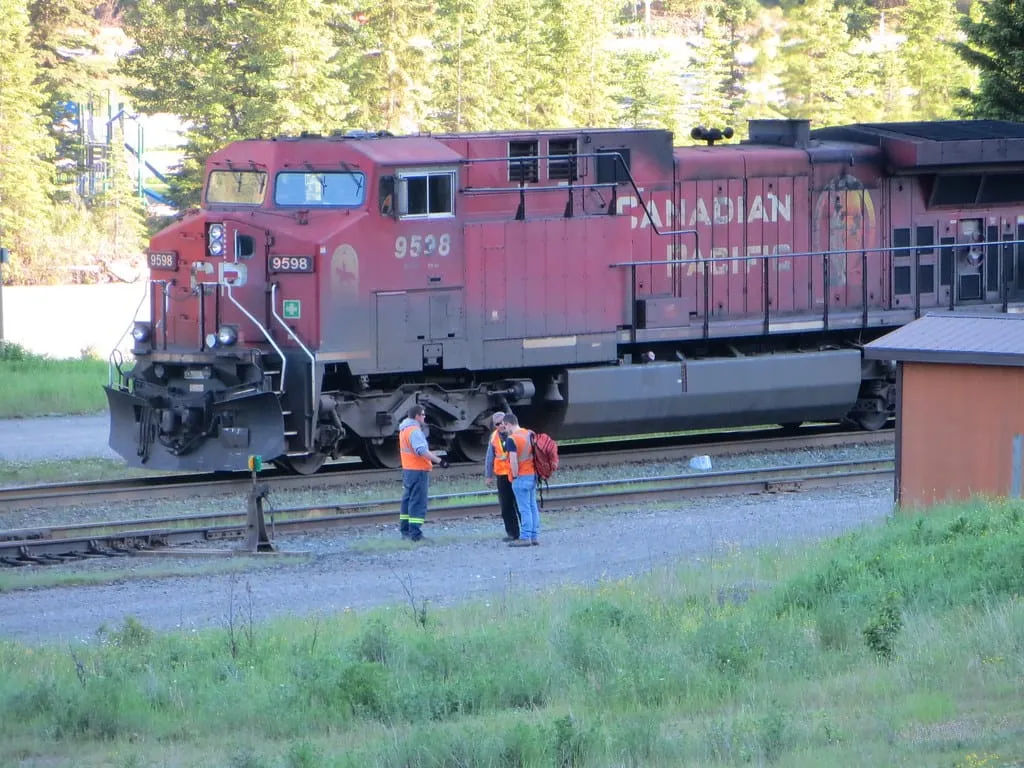
This is the CPKC (Canadian Pacific Kansas City) transcontinental mainline between Calgary and Vancouver — one of the busiest freight corridors in western Canada. On average, 25-30 trains pass through daily, though not on a fixed schedule. Freight dominates: unit grain trains, potash, mixed manifest, double-stacked intermodal containers, and occasional crude oil trains. Typical motive power includes GE ES44AC and AC4400CW units, often with one or two remote DPU sets positioned mid-train for the mountain grades.
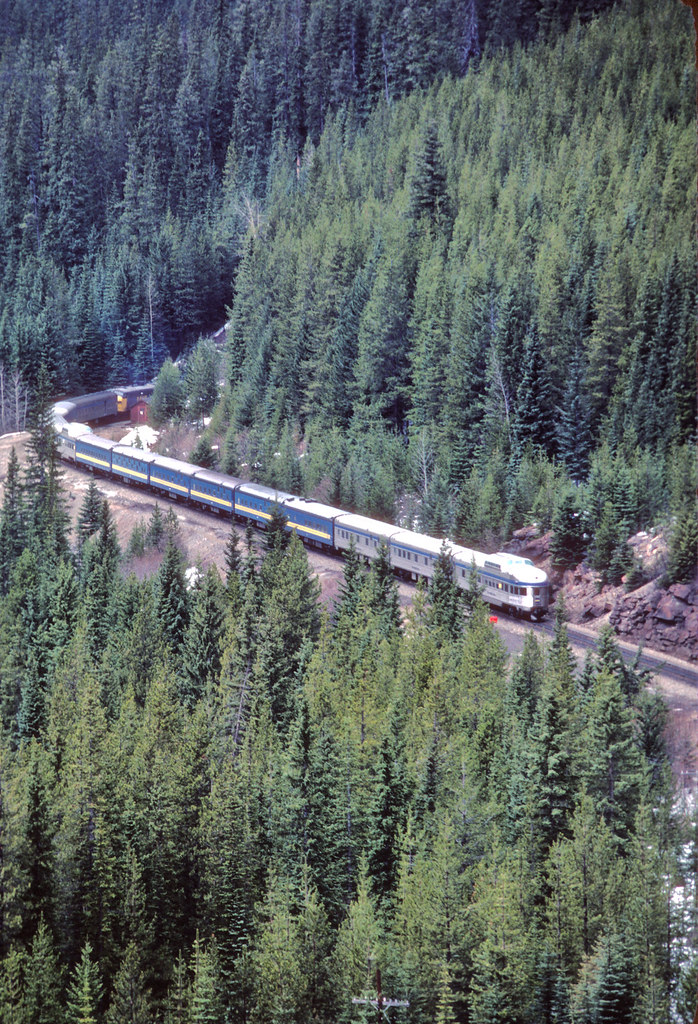
Passenger traffic is limited but photogenic: VIA Rail's "Canadian" (Toronto-Vancouver, twice weekly each direction, year-round) and the luxury Rocky Mountaineer (April-October, daylight hours only). Both slow considerably for the curves, offering extended photo opportunities. The Rocky Mountaineer is particularly popular for its distinctive two-tone blue and gold consist.
Best Angles for Photos & What Railfans Enjoy Most
Lower Spiral Tunnel Viewpoint (Trans-Canada Highway): The raised wooden platform looks straight onto the east portal of the Mount Ogden tunnel. Morning light (07:30-11:00) illuminates locomotive noses. You can capture the iconic "split-screen" composition: head-end exiting the lower level while the caboose or rear DPU is visible on the upper track above — a double-deck image unique to spiral tunnel locations. A 70-200mm lens is ideal for this shot.
Upper Spiral Tunnel Viewpoint (Yoho Valley Road): From the gravel shoulder, frame trains against Cathedral Mountain with the full curve visible. Midday sun gives front-lit shots; a polarizing filter deepens the forested backdrop. Wider lenses (24-70mm) work well here for context shots showing the mountain scale.
General tips: Bring both telephoto (70-200mm) and wide-angle lenses. A tripod helps for long exposures when morning fog drifts through the valley. Note that tree growth has somewhat obscured views compared to historical photos — telephoto helps punch through gaps. Shutter speeds of 1/500s or faster freeze moving trains; slower speeds (1/60-1/125s) create a sense of motion with panned shots.
Historical or Cultural Relevance
The Spiral Tunnels were built to replace the notorious "Big Hill," the steepest section of the original Canadian Pacific Railway main line. When the CPR was completed in 1884, this segment had a punishing 4.5% grade — one of the steepest adhesion railway grades anywhere in the world. The very first train to descend the Big Hill derailed, killing three workers, and runaway accidents continued for 25 years despite safety switches and strict speed limits.
In 1907, the CPR awarded the contract to Vancouver engineering firm MacDonnell, Gzowski and Company. About 1,000 workers blasted through the quartzite rock using black powder and early air drills. The project cost approximately $1.5 million. The tunnels opened on September 1, 1909, reducing the ruling grade to a manageable 2.2% by effectively doubling the length of the climb through two helical loops — a technique borrowed from Swiss mountain railways.
The Lower Tunnel (Mount Ogden) turns 217 degrees over 891 metres (2,923 ft), gaining 15 m (50 ft) of elevation. The Upper Tunnel (Cathedral Mountain) turns 291 degrees over 991 metres (3,251 ft), gaining 17 m (56 ft). If placed portal to portal, the two tunnels would form a figure-8. The engineering has remained virtually unchanged for over a century, with modern CPKC freight trains still using the same tunnels daily.
What Makes This Spot Different
The Spiral Tunnels are one of the very few places in North America where you can watch a single train cross over its own path — the head-end emerging from a tunnel while the tail is still entering it. The prolonged 8-12 minute passage through the spirals gives photographers ample time to compose and reshoot, a luxury that most high-speed rail corridors don't offer. The two official Parks Canada viewpoints with interpretive signage, paved parking, and safe distances from the tracks make this one of the most accessible mountain railfanning spots on the continent — no trespassing or risky trackside hiking required. The combination of heavy mainline freight traffic (25-30 trains daily), dramatic Rocky Mountain scenery, and century-old engineering visible in action is unmatched.
Frequently Asked Questions
QHow many trains pass through the Spiral Tunnels per day?
On average, 25-30 trains pass through daily, roughly one every 20-30 minutes during busy periods. However, there is no fixed schedule — gaps of 1-2 hours can occur. Traffic is heavier overnight.
QDo I need a Parks Canada pass to visit the Spiral Tunnels viewpoint?
Yes. The viewpoints are inside Yoho National Park, so you need a Parks Canada Discovery Pass. Daily passes cost approximately $10.50 CAD per adult, or you can purchase an annual Discovery Pass for $72.25 CAD covering all national parks.
QWhat is the best time of year to visit?
Summer (June-September) offers the longest daylight and warmest conditions. The Lower Viewpoint is accessible mid-May to mid-October; the Upper Viewpoint on Yoho Valley Road opens later, around mid-June. Autumn (mid-September) brings golden larch colours. Winter visits are possible but snow and cold limit comfort.
QCan I see trains enter and exit the tunnel at the same time?
Yes — that is the iconic spectacle. With trains typically 7,500-9,500 ft long, the head-end exits the tunnel while the tail is still entering, creating the signature visual of a train crossing over itself.
QAre there restrooms at the viewpoints?
No restrooms are available at either viewpoint. The nearest facilities are in the town of Field (7.4 km west of the Lower Viewpoint) or at other Parks Canada day-use areas in Yoho National Park.
QHow do I get to the viewpoints?
The Lower Spiral Tunnel Viewpoint is directly off the Trans-Canada Highway (Highway 1), 7.4 km east of Field, BC — look for Parks Canada signs. The Upper Viewpoint is 2.3 km up Yoho Valley Road from the highway junction.
Safety Tips
Stay within the designated Parks Canada viewpoints — the tracks are on active CPKC mainline with no warning system for approaching trains. The tunnels amplify sound unpredictably, so a train can appear quieter than expected until it exits a portal. Both viewpoints are well back from the tracks (150-300 m), but never attempt to approach the tunnel portals or tracks. In winter, roads can be icy and the Trans-Canada Highway requires winter tires (October 1 - April 30 by BC law). Bear country: store food properly and carry bear spray, especially if hiking nearby trails.
Seasonal Information
The Lower Spiral Tunnel Viewpoint is accessible roughly mid-May through mid-October. The Upper Viewpoint on Yoho Valley Road typically opens mid-June and closes with the first significant snowfall (usually mid-October). Winter visitors can still see the Lower Viewpoint area from the Trans-Canada Highway but pullout access may be limited by snow. The Rocky Mountaineer runs April through October only. VIA Rail's Canadian runs year-round but twice weekly. Train traffic volume is relatively consistent year-round as CPKC freight operates regardless of season.
Nearby Lodging
- Spiral Tunnels Guesthouse
Aptly named B&B at 306 1st Avenue in Field. Private self-contained apartment with mountain views, fireplace, king bed, wifi. Accommodates one couple. Walking distance to Field amenities.
- Canadian Rockies Inn
Hotel at 308 Stephen Avenue in Field. Well-reviewed for cleanliness and peaceful setting. The closest hotel-style accommodation to the viewpoints.
- Cathedral Mountain Lodge
Log cabin lodge on Yoho Valley Road, near the Upper Spiral Tunnel Viewpoint. Rustic luxury with a restaurant on site. Seasonal operation (summer).
- Mt Burgess Guesthouse
Vacation rental apartments in Field with privacy, EV charging, and wifi. Well-equipped for longer stays exploring Yoho National Park.
- Emerald Lake Lodge
Historic lodge on Emerald Lake, about 17 km from the viewpoints. Premium option with lake views, dining, and canoe rentals. Seasonal.
Nearby Attractions
9.3 miles / 15 km
One of Canada's highest waterfalls at 254 m (833 ft), fed by the Daly Glacier. A short paved walk from the parking lot leads to the base. Yoho Valley Road access (mid-June to mid-October).
10.6 miles / 17 km
The largest lake in Yoho National Park, surrounded by the President Range. Canoe rentals available in summer. A 5.2 km loop trail circles the lake.
6.2 miles / 10 km
A rock formation where the Kicking Horse River has carved through a natural stone bridge. Viewpoint with interpretive signs, just 3 km west of Field.
7.5 miles / 12 km
UNESCO World Heritage Site with 508-million-year-old fossils from the Cambrian Explosion. Guided hikes only (Parks Canada or Burgess Shale Geoscience Foundation). Book well in advance.
15.5 miles / 25 km
The largest waterfall by volume on the Kicking Horse River — 30 m high and 150 m wide. Reached via a gentle 2.3 km trail through forest.
18.6 miles / 30 km
Iconic turquoise glacial lake just 30 minutes east over Kicking Horse Pass in Banff National Park. Year-round destination with hiking, skiing, and the historic Fairmont Chateau.
External Links
official
informative
informative
informative
informative
Looking for more spots? Browse the complete list of train spotting locations.
Quick Information
Country
Canada
Region
British Columbia
City
Field
Spot Type
Tunnel Portal
Best Times
Morning (7:30-11:00 AM) for front-lit locomotive noses at the Lower Viewpoint. Late afternoon for dramatic side-lighting. Rocky Mountaineer passes during daylight hours (April-October). VIA Rail's Canadian runs twice weekly in each direction. Allow 1-2 hours for a good chance of seeing multiple trains.
Visit Duration
1-2 hours (allow time to wait for trains; some visitors spend half a day)
Cost
Free access. Parks Canada Discovery Pass required ($10.50 CAD/adult daily).
Train Activity
Train Types
Frequency
25-30 trains per day on average, roughly one every 20-30 minutes during busy periods. Traffic is heavier overnight with westbound priority intermodal. Not on a fixed schedule — gaps of 1-2 hours can occur.
Access & Amenities
Parking
Available (Free parking at both viewpoints. However, a Parks Canada Discovery Pass is required for entry to Yoho National Park (approximately $10.50 CAD/adult daily or $72.25 CAD/annual for all national parks).)
Shelter
Not available
Restrooms
Not available