Temple (BNSF/UP Crossing)
A major railroad junction in Central Texas where BNSF and Union Pacific lines cross at the historic Tower 24 diamond. The adjacent Temple Railroad & Heritage Museum, housed in the 1911 Santa Fe depot, makes this one of the most railfan-friendly spots in the state.
Photos
 davidwilson1949
Attribution License
Trainspotting Experience
Temple's Tower 24 diamond is where BNSF's northwest-southeast main line crosses Union Pacific's northeast-southwest route in an X-pattern just southeast of downtown. The best public vantage point is the East Avenue H bridge, which passes almost directly over the diamond and gives you a bird's-eye view of trains on both railroads. From the bridge you can watch BNSF and UP trains negotiate the interlocking, with horn blasts echoing off nearby buildings as crews call signals approaching the crossing.
A second prime location is the area around the Temple Railroad & Heritage Museum at 315 W Avenue B. The museum occupies the restored 1911 Santa Fe depot—a red brick and stucco building in Prairie Beaux Arts style designed by Chicago architect Jarvis Hunt. Outdoor exhibits include three static locomotives, passenger cars, and cabooses displayed on the grounds right beside active BNSF trackage. You can literally watch live freight movements while touring vintage rolling stock.
Temple is a strategic BNSF crew change point and fueling stop: every train coming through stops here before heading south to Beaumont, west toward Amarillo, or north to Fort Worth. This means you get extended dwell times and locomotive shuffling in addition to through movements. A scanner tuned to local railroad frequencies adds significantly to the experience. The museum is open Tuesday through Saturday, 10 AM to 4 PM, with admission ranging from free (children under 5, active military) to $4 for adults.
Landscape, Setting & Local Atmosphere
Temple sits on the Blackland Prairie of Central Texas, a landscape of gently rolling farmland and scattered live oaks. The immediate area around the diamond crossing and museum is flat and urban, bordered by the red-brick Santa Fe depot, downtown storefronts, and mowed park areas. To the north, grain elevators and the Baylor Scott & White hospital complex mark the skyline; to the south, the tracks curve away through mixed vegetation.
Summers in Temple are hot—average highs reach the mid-90s °F from June through September—so the depot's covered areas and the museum's air conditioning provide welcome relief between trains. Winter days are mild by northern standards, with clear skies that make diesel exhaust plumes stand out sharply against blue backgrounds. Spring (March-May) and fall (October-November) offer the most comfortable conditions for extended trackside sessions. Rain is spread fairly evenly through the year but thunderstorms can roll in quickly during spring.
Type & Frequency of Train Activity
Combined BNSF and Union Pacific traffic through Temple runs approximately 30 to 35 freight trains per day. BNSF's main line through Temple is part of the busy route connecting Fort Worth to Galveston, carrying intermodal, manifest, grain, military equipment (Fort Cavazos is roughly 30 miles away), and unit trains. Union Pacific's crossing route handles mixed freight on a north-south alignment.
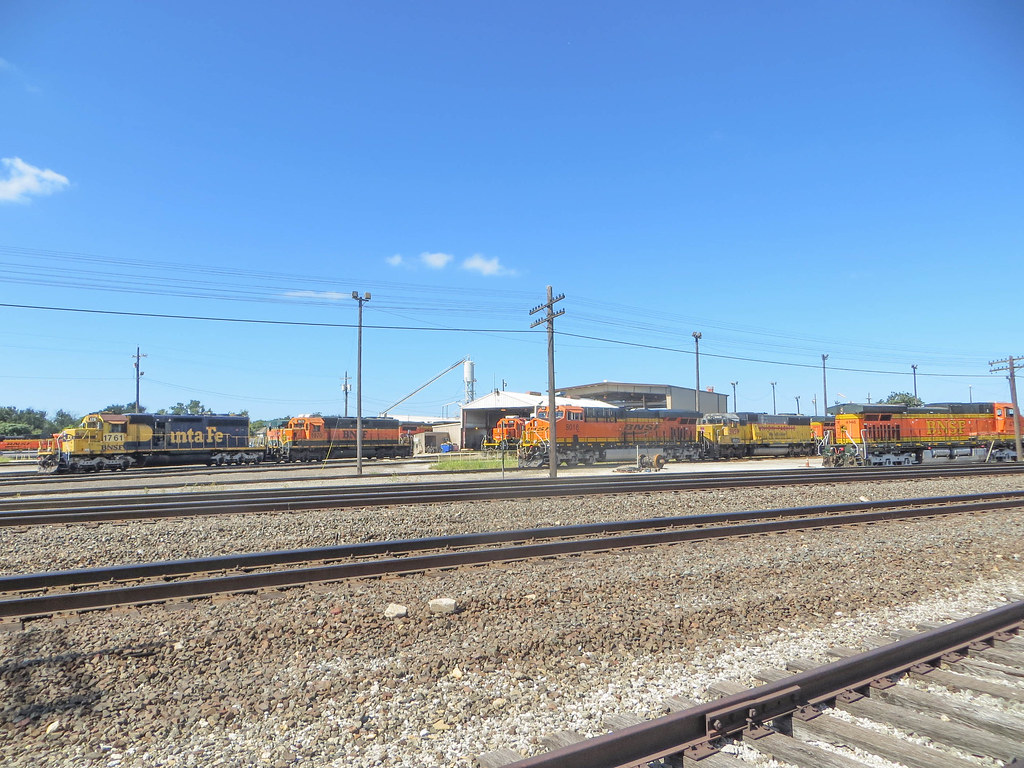
Temple is more than a pass-through point. The BNSF yard here performs railcar switching, locomotive fueling, and serves as a crew change location. BNSF also maintains a locomotive maintenance facility capable of motor changes and major repairs. Trains arriving from all directions stop to fuel before continuing south to Beaumont and Eagle Pass, north to Fort Worth, or west toward Amarillo. This yard activity means you'll frequently see power moves, light engines, and consist changes in addition to revenue trains.
The Temple & Central Texas Railway (TC), a Patriot Rail shortline operating over 10 miles of track, interchanges with BNSF and serves the Central Pointe Rail Park, handling steel, grain, and other commodities.
Amtrak's Texas Eagle (trains #21 and #22) provides daily passenger service through Temple with one northbound and one southbound stop. The station shares the historic Santa Fe depot with the Heritage Museum.
Best Angles for Photos & What Railfans Enjoy Most
East Avenue H Bridge — The definitive vantage point for the Tower 24 diamond. This overpass passes almost directly above the crossing, giving an elevated view of trains on both the BNSF and UP alignments. A medium telephoto (70-200mm) captures the full diamond with approaching trains. Morning light favors the east side of the bridge.
Museum Grounds / Depot Platform — Standing near the Heritage Museum puts you at track level beside the BNSF main. Morning sun from the east illuminates northbound locomotives cleanly. The red-brick depot and static locomotive displays make excellent background elements for framing shots of passing trains.
24th Street Overpass — This bridge crosses over the north end of BNSF's six-track fuel facility. It provides a wide-angle view of locomotives being serviced, trains waiting to depart, and yard activity. Best used for surveying operations and getting roster shots of power consists.
Rector Road / Metro Crossovers — A grade crossing east of the main yard where lighting on the east side of the tracks is favorable for photography, especially from fall through spring when the sun sits lower in the sky.
Tripods work well at all locations but avoid blocking pedestrian walkways on the bridges. Wide-angle lenses capture the junction geometry, while a 200mm+ telephoto isolates approaching trains from a distance.
Historical or Cultural Relevance
Temple owes its existence to the railroad. The city was founded in 1881 as a construction point on the Gulf, Colorado & Santa Fe Railway (GC&SF), named after Bernard Moore Temple, the railroad's chief engineer. Within 20 years the population exceeded 7,000, and Temple became a major division point on the Santa Fe system.
The Tower 24 diamond marks where the GC&SF (running northwest to southeast) crossed the Missouri-Kansas-Texas Railroad, known as the Katy (running northeast to southwest). Historical records from the Railroad Commission of Texas show an average of 74 train movements per day past Tower 24 as early as 1906, illustrating the crossing's importance even in the steam era.
The current depot was designed by noted Chicago architect Jarvis Hunt in Prairie Beaux Arts style; construction began in August 1909 and was completed on January 29, 1911. It served as both a passenger station and Santa Fe division headquarters. In 1891, railroad officials established the Gulf, Colorado & Santa Fe Hospital Association in Temple, and by 1892 Dr. Arthur Carroll Scott arrived as chief surgeon—laying the foundation for what would become the Scott & White medical system, one of the largest multi-specialty practices in the country.
Through successive mergers, the GC&SF became part of the Atchison, Topeka & Santa Fe (and then BNSF in 1995), while the Katy merged into Missouri Pacific in 1988, which was absorbed by Union Pacific. The Tower 24 diamond thus carries the DNA of four historic railroad companies on two sets of rails.
What Makes This Spot Different
Temple stands out among Texas railfan spots because it combines a genuine working junction with a first-rate heritage facility in one walkable area. The Tower 24 diamond is one of the few remaining Class I railroad grade crossings in the state where BNSF and Union Pacific traffic physically intersects, producing the distinctive clatter of wheels on diamond frogs that has largely disappeared as railroads grade-separate busy crossings.
The co-location of the BNSF fueling and maintenance facility means Temple delivers more than just through-train action—you get extended views of locomotives idling, power being shuffled between consists, and the occasional rare visitor cycling through the shop. The Temple & Central Texas Railway shortline adds another layer, with its switching moves interchanging cars with the Class I's.
Having the Amtrak Texas Eagle stop at the same depot where you're watching freight traffic means you can arrive by train, spend the day railfanning, and leave by train—a rarity in modern American railfanning. The museum's $4 admission, clean restrooms, and covered exhibit area make this a particularly comfortable location for full-day visits, especially during Texas summers.
Frequently Asked Questions
QHow many trains per day pass through Temple?
Combined BNSF and Union Pacific traffic averages approximately 30 to 35 freight trains per day, plus the daily Amtrak Texas Eagle with one northbound and one southbound movement.
QIs there an admission fee to watch trains?
Watching trains from public bridges and sidewalks is free. The Temple Railroad & Heritage Museum charges $4 for adults (ages 13-59), with reduced rates for seniors, children, and free admission for active military and children under 5.
QWhat are the museum hours?
The Temple Railroad & Heritage Museum is open Tuesday through Saturday, 10 AM to 4 PM.
QCan I arrive by train?
Yes. Amtrak's Texas Eagle stops daily at Temple station (code TPL), which shares the historic depot with the Heritage Museum. This makes Temple one of the few railfan destinations in Texas accessible by passenger rail.
QWhere is the best viewing spot for the diamond crossing?
The East Avenue H bridge passes almost directly over the Tower 24 diamond crossing and provides an elevated view of both BNSF and UP movements.
Safety Tips
Stay on public sidewalks, bridges, and designated areas. The East Avenue H bridge and 24th Street overpass have pedestrian walkways. Never trespass on railroad property, tracks, or the BNSF yard—Temple is an active crew change and fueling point with trains moving at all hours, including light engines and yard moves that can be difficult to hear. Ear protection is advisable when trains pass at close range on the bridges. Be aware of your surroundings when photographing near grade crossings.
Seasonal Information
Spring (March-May) and fall (October-November) offer the best balance of comfortable temperatures and good light. Summer heat regularly exceeds 95°F, making shade and hydration essential—the museum's indoor exhibits provide air-conditioned breaks. Winter is mild but occasional cold fronts can drop temperatures into the 30s-40s°F. Thunderstorms are most common in spring. Train traffic runs year-round with no significant seasonal variation, though military moves to and from Fort Cavazos may increase during training cycles.
Nearby Lodging
- Holiday Inn Express & Suites Temple
Modern hotel with IHG amenities, conveniently located off I-35 with easy access to downtown Temple and the railroad museum area.
- Hampton Inn Temple
Reliable mid-range option near I-35 with complimentary breakfast, about 10 minutes drive from the downtown railroad district.
- La Quinta Inn & Suites Temple
Budget-friendly hotel on the I-35 corridor, convenient to Temple's railroad attractions and restaurants.
- American Inn Temple
Extended-stay option on I-35 near Baylor Scott & White Hospital and Lake Belton. Weekly rates available starting at $249.
Nearby Attractions
0.06 miles / 0.1 km
Housed in the restored 1911 Santa Fe depot, this museum features three static locomotives, passenger cars, cabooses, and railroad memorabilia. Open Tue-Sat 10 AM - 4 PM, admission $4 adults.
0.9 miles / 1.5 km
Tells the story of Czech immigrants who settled in Central Texas in the late 19th century. Houses artifacts and exhibits examining Czech culture from the 6th century through the Cold War.
9.3 miles / 15 km
A large recreational lake just east of Temple offering boating, fishing, camping, and picnicking. Several parks along the shores provide public boat ramps and swimming areas.
30 miles / 48 km
One of the largest U.S. Army installations, located roughly 30 miles west of Temple. The National Mounted Warrior Museum outside the main gate is accessible without military ID.
0.3 miles / 0.5 km
Monthly downtown event on the first Friday of each month featuring street music, live performances, food, drinks, and after-hours shopping in Temple's historic downtown district.
External Links
informative
tourism
informative
official
Looking for more spots? Browse the complete list of train spotting locations.
Quick Information
Country
USA
Region
Texas
City
Temple
Spot Type
Junction
Best Times
BNSF fueling and crew changes run around the clock, but peak freight windows are early morning (6-9 AM) and late afternoon (4-7 PM). The Amtrak Texas Eagle passes through daily, one northbound and one southbound.
Visit Duration
2-4 hours (full day if combining museum visit and yard watching)
Cost
Free from public areas. Museum admission $4 adults, reduced for children/seniors.
Train Activity
Train Types
Frequency
30-35 freight trains per day combined (BNSF and UP), plus daily Amtrak Texas Eagle service
Access & Amenities
Parking
Available
Shelter
Not available
Restrooms
Not available