Tower 55 (Fort Worth)
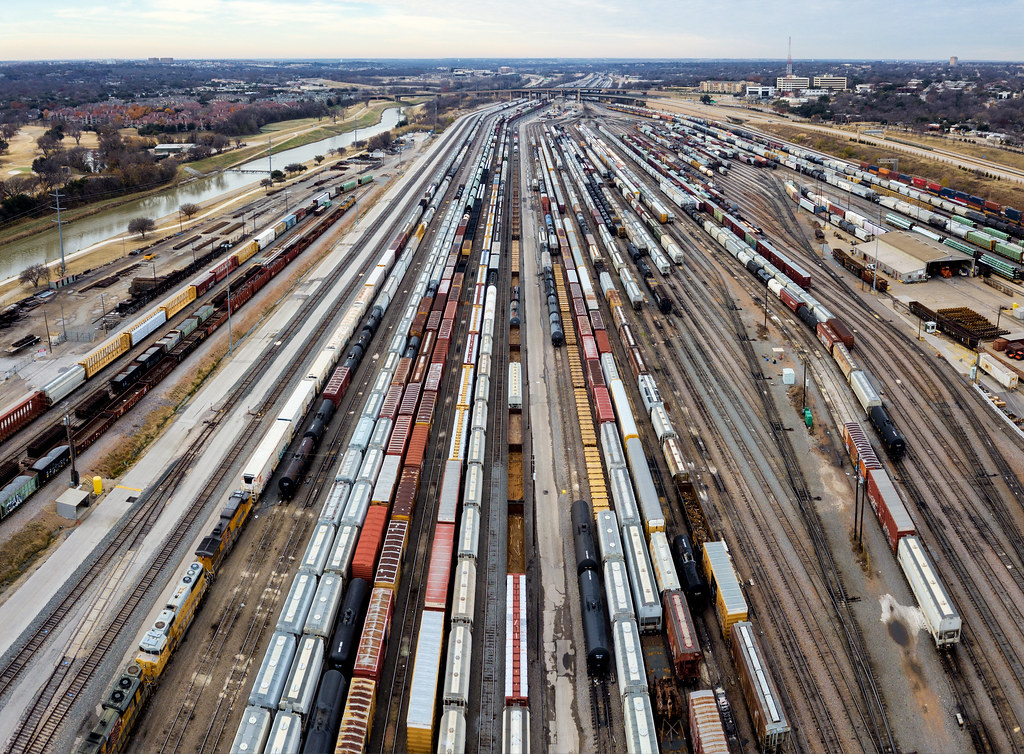
Tower 55 is the busiest railroad diamond interlocking in the United States outside of Chicago, where BNSF's triple-track north–south main meets Union Pacific's double-track east–west corridor at six grade-level diamond crossings. With roughly 100 trains per day from UP, BNSF, FWWR, Trinity Rail Express, and Amtrak, this Fort Worth junction delivers near-constant rail action from public sidewalks steps away from the interlocking.
Photos
 Lars Plougmann
Attribution-ShareAlike License
Trainspotting Experience
Take up position on public sidewalks along Crawford Street or S. Peach Street for front-row access to one of the most complex pieces of active railroad infrastructure in the South. Six diamond crossings form the interlocking where BNSF's triple-track north–south main (ex-AT&SF) meets Union Pacific's double-track east–west corridor (ex-Texas & Pacific). Fort Worth & Western Railroad (FWWR) trains also use the plant via trackage rights, adding short-line power to the Class I parade. Trinity Rail Express commuter trains share the UP corridor on weekdays. Because two competing dispatching territories converge at the same plant, holds and meets are frequent — trains queue up, inch forward, then accelerate hard through the diamonds in a sequence that rewards patient observers. Tune a scanner to BNSF road channels (160.695 or 160.920 MHz) or UP channels (160.410 or 160.470 MHz) to anticipate movements before they arrive. Street parking is available on side streets off S. Main St., a short walk from the best viewing positions. The Virtual Railfan live-stream camera at Tower 55 lets you check activity remotely before making the drive.
Landscape, Setting & Local Atmosphere
The junction sits on the flat Trinity River floodplain at approximately 640 feet elevation, just southeast of downtown Fort Worth's skyline. Industrial lots, access roads, and standard right-of-way fencing create open sightlines in all four compass directions — a consist can be spotted approaching from half a mile out. Low scrub, cottonwood, and hackberry line the margins of the right-of-way, but nothing blocks the main viewing angles. Downtown Fort Worth's modern towers rise distinctly to the northwest, providing an urban backdrop that distinguishes Tower 55 from comparable rural junctions. Summer afternoons bring towering cumulonimbus clouds that frame freight trains in dramatic fashion. In winter, low-angle northern sun rakes across locomotive paint and creates hard shadows off the cab sides. The constant hum of the I-30/I-35W interchange gives way instantly to the full-throated roar of Tier-4 GEs or EMD SD70s accelerating out of a dispatcher-cleared hold.
Type & Frequency of Train Activity
Rail-traffic studies tied to the 2014 Tower 55 improvement project placed total movements at roughly 100–125 trains per 24-hour period—numbers that still hold. BNSF dispatches coal drags from the Powder River Basin, hot intermodal Z-trains bound for Alliance and Chicago, plus grain and mixed merchandise. Union Pacific contributes stack trains, automotive racks, ethanol blocks, and heavy manifest freights heading toward Houston, El Paso, or Little Rock. Kansas City Southern and Texas Pacifico occasionally appear via trackage rights. Passenger action is lighter but noteworthy: Amtrak’s Texas Eagle (Trains 21/22) rolls through midday, and the Heartland Flyer (Trains 821/822) joins the lineup in the morning and evening. Train lengths average 7,000–10,000 feet, with distributed power common on the longest sets.
Best Angles for Photos & What Railfans Enjoy Most
For roster shots and cab-side detail on southbound BNSF freights, the Crawford Street crossing is the prime position: morning light falls cleanly on the engineer's side, and the tracks are only a few yards away. The same crossing in afternoon light works well for UP consists running east, with the sun behind the camera. A short walk east to S. Peach Street opens a wider perspective of the full diamond sequence — a 70–200mm lens at its longest end compresses three parallel tracks into a single dense frame. The East Vickery Boulevard overpass provides an elevated vantage where 300mm+ glass can isolate locomotives against the downtown Fort Worth skyline or reduce the track geometry to an abstract pattern. The best glint-shot window occurs in winter when the sun sets far enough south to align low light along the north–south BNSF main near 5 PM — the window lasts roughly 20 minutes but produces dramatic front-quarter lighting on northbound trains.
Historical or Cultural Relevance
The Tower 55 interlocking was commissioned by the Railroad Commission of Texas on September 26, 1904, originally coordinating movements for the Santa Fe, Missouri Pacific, and Texas & Pacific railroads. The electric interlocking, built by Taylor Signal Co., featured 122 functions controlled by 89 levers — among the largest plants of its era in Texas. A three-story brick tower in the southeast quadrant of the diamond replaced an earlier wooden structure and remained visible through the mid-20th century. As Class I consolidations reduced the number of independent operators at the plant, the tower was decommissioned in 1994 and subsequently demolished, though the "55" designation was retained in active dispatcher parlance. By the 2000s congestion had become severe enough that the Federal Railroad Administration labeled Tower 55 a national bottleneck. A $104 million public-private improvement project — $65 million contributed by BNSF and Union Pacific, the remainder from federal ARRA funds and state grants — was completed with a dedication ceremony on November 7, 2014. The project added a third north–south track, high-speed crossovers, and modernized signaling, increasing junction capacity by an estimated 25 percent and reducing average train delay by more than 30 minutes. Environmental benefits cited at completion included annual fuel savings equivalent to 14,000 Fort Worth commuters and a reduction of 93,000 tons of CO2 emissions per year.
What Makes This Spot Different
Tower 55 places observers within yards of six live diamonds and two Class I main lines simultaneously — an access level almost unmatched at any junction of comparable traffic density in the United States. Unlike most busy interlockings buried inside fenced industrial complexes, the street grid around Tower 55 preserves public sightlines established before the automobile era. The layering of 120 years of railroad history is visible in the infrastructure itself: the original diamond geometry from 1904 is still in use, while the 2014 high-speed crossovers and PTC-equipped signals represent the latest generation of railroad engineering. The Fort Worth skyline directly behind northbound consists creates a recognizable visual identity unavailable at comparable high-traffic locations like Cajon Pass or Tehachapi. A Virtual Railfan camera with full-audio microphone streams the diamond 24/7, enabling real-time remote scouting before any visit.
Frequently Asked Questions
QHow many trains pass through Tower 55 per day?
Approximately 100 trains per day pass through Tower 55, including roughly 50 Union Pacific freight movements, around 30 BNSF freight movements, Fort Worth and Western Railroad trains, Trinity Rail Express commuter trains on weekdays, and Amtrak Texas Eagle and Heartland Flyer passenger trains.
QWhat railroads can I see at Tower 55?
BNSF Railway and Union Pacific are the primary operators, along with Fort Worth and Western Railroad (FWWR) via trackage rights. Trinity Rail Express commuter trains operate on the UP corridor on weekdays. Amtrak Texas Eagle and Heartland Flyer also pass through.
QWhen do the Amtrak trains pass Tower 55?
The southbound Heartland Flyer typically arrives in Fort Worth around 12:27 PM; the northbound departs around 5:25 PM. The Texas Eagle (Trains 21 and 22) passes Fort Worth near 2 PM in both directions. Verify current times on the Amtrak website, as schedules change seasonally.
QIs Tower 55 free to visit?
Yes. All viewing is from public sidewalks and street crossings at no cost. Street parking is available on side streets off S. Main St. and is free.
QIs it safe to railfan at Tower 55 at night?
Solo nighttime visits are not recommended. The junction borders higher-crime neighborhoods; visiting with at least one companion after dark is strongly advised by the railfan community. Daytime visits are generally considered safe.
QWhere are the best viewing spots at Tower 55?
The Crawford Street crossing is best for close-up roster shots. S. Peach Street offers a wider view of the full diamond sequence. The East Vickery Boulevard overpass provides an elevated angle with the Fort Worth skyline in the background. A Virtual Railfan live-stream camera also lets you scout activity remotely 24/7.
Safety Tips
Stay strictly on public sidewalks and designated road crossings — never step onto railroad right-of-way. Trains approach from all four directions and ambient noise from I-30/I-35W can mask an approaching consist until it is very close. The area around Tower 55 borders higher-crime neighborhoods; solo visits after dark are not recommended by the local railfan community. Always visit with at least one companion for evening sessions. In summer, heat exhaustion risk is real — bring a minimum of 1 liter of water per hour outdoors. Monitor weather for afternoon thunderstorms common June through August.
Seasonal Information
Fall (September–November) and spring (March–May) offer ideal conditions: 60–80°F temperatures, lower humidity, and clear air for sharp telephoto shots. Summer pushes past 100°F regularly — bring water, sunscreen, and a hat, as there is no shade at the viewing positions. Long summer daylight (sunset after 8:30 PM CDT) enables late golden-hour sessions. Winter is mild (lows rarely below 25°F) but north winds are biting and occasional ice storms can delay trains while creating dramatic photographic conditions. Coal and grain traffic historically peaks in fall harvest season and during winter heating demand, potentially pushing daily counts above the usual 100-train average.
Nearby Lodging
- Omni Fort Worth Hotel
Luxury full-service hotel in the heart of downtown Fort Worth, approximately 0.8 km from Tower 55. Connected to the Fort Worth Convention Center and a 10-minute walk from the T&P Station. Pool, spa, and multiple dining options on-site.
- Courtyard by Marriott Fort Worth Downtown/Blackstone
Mid-range business hotel housed in the historic Blackstone Hotel building in downtown Fort Worth, approximately 1 km from Tower 55. Walking distance to Sundance Square, the T&P Station, and the ITC.
- Embassy Suites by Hilton Fort Worth Downtown
All-suite hotel in downtown Fort Worth offering complimentary breakfast and evening manager's reception. Located approximately 1.2 km from Tower 55, within walking distance of the historic T&P Station and ITC Amtrak stop.
Nearby Attractions
0.3 miles / 0.5 km
The striking Art Deco T&P Station at 221 W. Lancaster Ave. was completed in 1931 and now serves as the Fort Worth Amtrak stop (Texas Eagle and Heartland Flyer). The building is a landmark of Zigzag Moderne architecture and houses restaurants and event spaces inside the restored terminal.
0.5 miles / 0.8 km
The modern ITC at 9th and Jones Streets serves as Fort Worth's central transit hub, connecting Amtrak, Trinity Rail Express, and local bus services. A good secondary railfan vantage point for watching Texas Eagle and Heartland Flyer arrivals and departures in a covered station environment.
3.7 miles / 6 km
The historic Stockyards District 4 miles north of Tower 55 preserves Fort Worth's cattle-drive heritage and offers railfan interest through Stockyards Station, the depot for the Tarantula Steam Train that runs to Grapevine on the historic Cotton Belt route using a restored 1896 steam locomotive ("Puffy") and a 1953 GP-7 diesel.
20 miles / 32 km
The Grapevine Vintage Railroad operates heritage excursions between Fort Worth Stockyards and downtown Grapevine (approximately 20 miles) aboard 1920s–1930s Victorian coaches hauled by either "Puffy" — the oldest continuously operated steam engine in the South, an 1896 Baldwin — or a 1953 GP-7 diesel. Advance tickets recommended on weekends.
3.1 miles / 5 km
The FWMSH in the Cultural District, 5 km west of Tower 55, features exhibits on Texas history including railroad and industrial heritage. Planetarium and IMAX on-site. A good half-day complement to a Tower 55 session.
External Links
informative
informative
official
informative
Looking for more spots? Browse the complete list of train spotting locations.
Quick Information
Country
USA
Region
Texas
City
Fort Worth
Spot Type
Junction
Best Times
Train activity runs 24/7, but 10 AM–3 PM is prime time for mixed traffic. Amtrak's southbound Heartland Flyer arrives around 12:27 PM; the Texas Eagle makes its Fort Worth stop near 2 PM, adding passenger moves to the steady freight parade. BNSF Z-trains and UP stack trains run at all hours. Avoid solo visits after dark due to neighborhood safety concerns.
Visit Duration
1–3 hours; train frequency is high enough that most visitors see multiple consists within the first 30 minutes
Cost
Free — all viewing is from public sidewalks and road crossings. Street parking on side streets off S. Main St. is free.
Train Activity
Train Types
Frequency
Approximately 100 trains per day: UP ~50 freight movements, BNSF ~30 freight movements, plus Fort Worth & Western Railroad trains, Trinity Rail Express commuter trains (weekdays), and Amtrak Texas Eagle and Heartland Flyer
Access & Amenities
Parking
Not available
Shelter
Not available
Restrooms
Not available