Triple Crossing (Richmond)
The only place in North America where three Class I railroad lines cross at different levels. Norfolk Southern operates the ground-level track while CSX runs both the middle trestle and the 36-foot-high C&O viaduct on top, creating a layered railfan spectacle in Richmond's Shockoe Bottom.
Photos
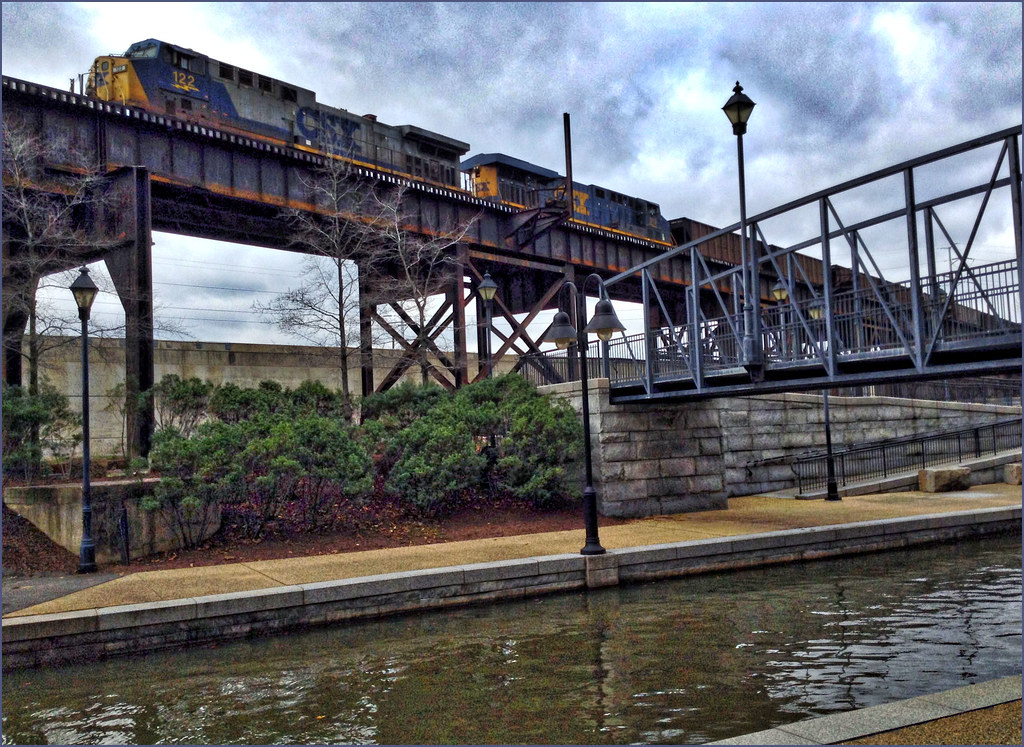
 Ron Cogswell
Attribution License
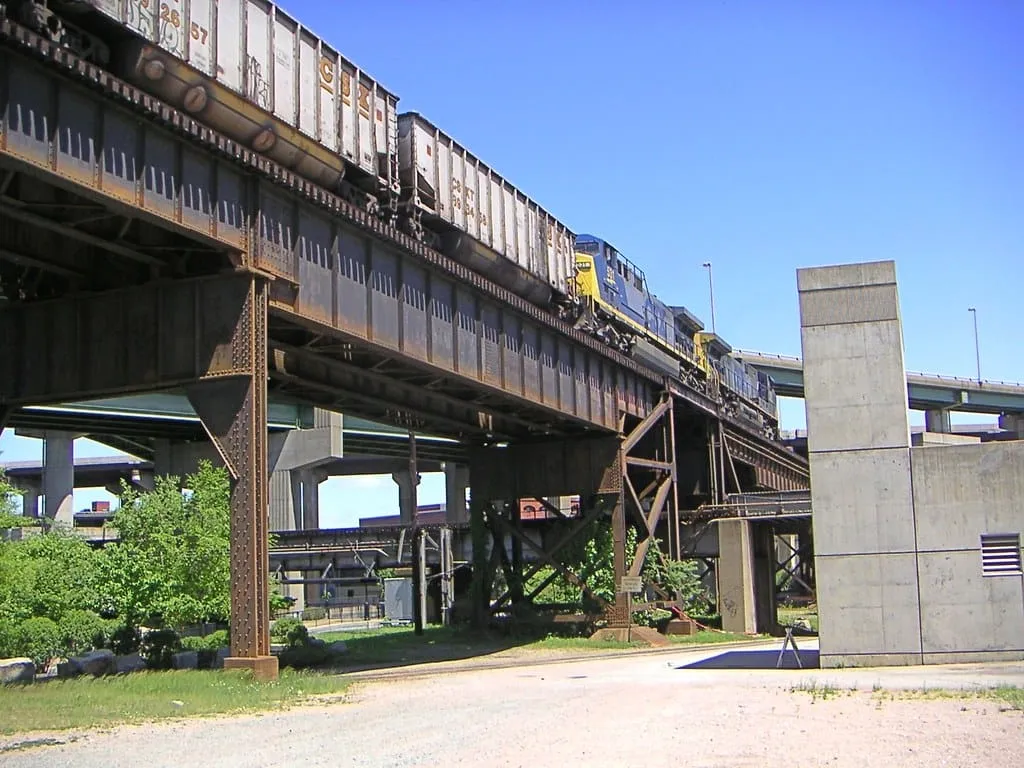
Roberto Robles
Attribution-ShareAlike License
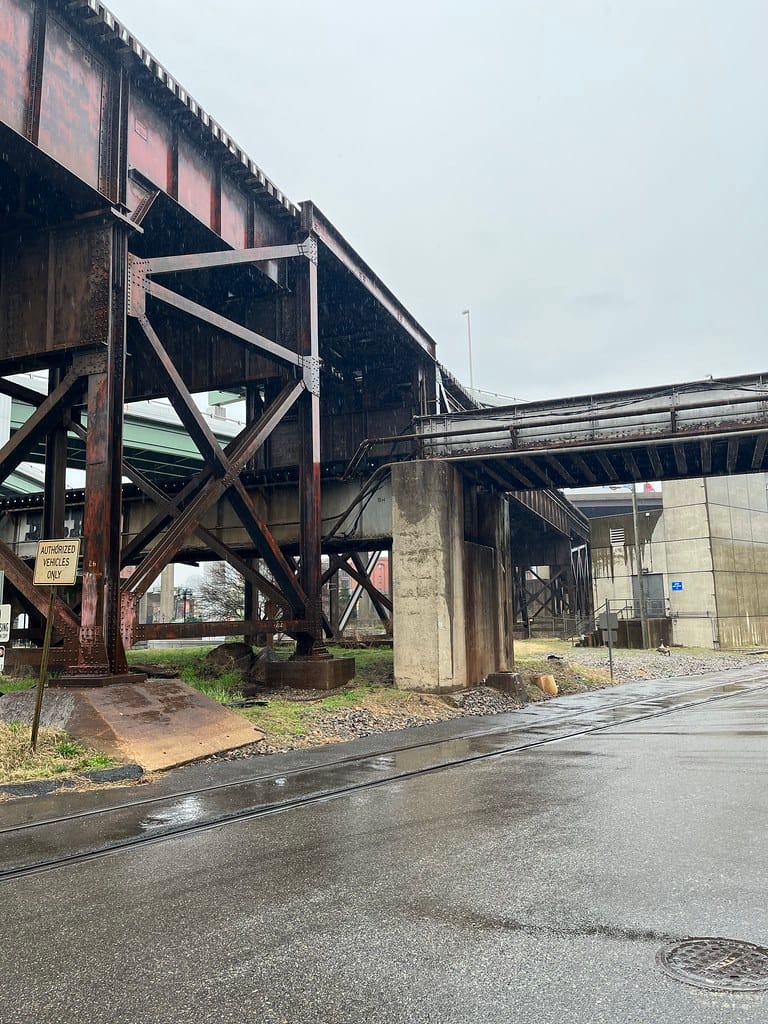
isaac_egger
Attribution-ShareAlike License
Trainspotting Experience
Triple Crossing is one of only two places in North America where three railroad main lines cross at three different elevations — the other being Santa Fe Junction in Kansas City. At ground level, Norfolk Southern operates its Richmond District line to West Point, Virginia, originally built in 1859 by the Richmond & York River Railroad. The middle trestle, standing 18 feet (5.5 m) high, carries CSX Transportation's "S" line, the former Seaboard Air Line Railroad main built between 1897 and 1900 by the Richmond, Petersburg & Carolina Railroad. The top deck rises 36 feet (11 m) overhead on CSX's Peninsula Subdivision Trestle, a 3-mile-long viaduct built by the Chesapeake & Ohio Railway in 1901 to connect coal traffic to Newport News export piers.
Railfans access the crossing from public vantage points along the Canal Walk State Historic Park trail, which runs parallel to the James River between South 15th Street and South 17th Street. A historical marker at the intersection of Dock Street and South 15th Street marks the site. Trains move at reduced urban speeds — typically 15-25 mph — and the compact layering of tracks means two-level meets are common. A true three-level simultaneous crossing is rare but does happen for the patient observer.
Landscape, Setting & Local Atmosphere
The crossing sits in a low river plain just east of downtown Richmond, where the James River's floodwall borders the Shockoe Bottom neighborhood. Brick warehouses, sycamore trees, and industrial-era retaining walls frame the three-tiered rail structure, creating an almost amphitheater-like setting. The Canal Walk trail provides a landscaped pedestrian approach with historical markers and interpretive panels. Note that a flood wall constructed in the 1990s reduced the number of clear photography angles compared to earlier decades, so expect to explore a bit to find the best vantage points. Early morning mist or late-day golden light filtering through the arches of the upper viaduct adds a dramatic quality to photographs.
Type & Frequency of Train Activity
The majority of the action at Triple Crossing comes from CSX Transportation, which operates both the middle and top levels. CSX runs approximately 20-25 freight trains daily through the Richmond corridor, including mixed manifest, intermodal, and unit trains (coal, grain). Not all of this traffic passes directly through Triple Crossing — trains are distributed across multiple CSX subdivisions in the area.
Norfolk Southern operates the ground-level track on its Richmond District line. The most notable NS movement here is the V30 (Richmond–West Point Turn), a local freight. The best day to catch V30 is Sunday, when it runs during daylight hours, typically departing around 9-11 AM. On weekdays, V30 often runs as a night turn, making it harder to photograph.
Amtrak does not use any of the three Triple Crossing levels. Amtrak trains serving Richmond use the former RF&P line (now Virginia-owned) through nearby Main Street Station, located about 0.3 miles northwest of the crossing.
Best Angles for Photos & What Railfans Enjoy Most
The classic shot is from the southwest side of the crossing, looking northeast to stack all three levels in a single frame. Dock Street, east of I-95, offers several angles for train-on-bridge shots. East Byrd Street provides closer access, and the nearby parking garage can give an elevated perspective. For a wider panorama incorporating the James River, walk along the Canal Walk trail toward Brown's Island or the T. Tyler Potterfield Memorial Bridge.
Morning light from the east illuminates locomotive noses on the lower levels; late afternoon backlights the upper viaduct while providing warm sidelight on the middle and lower tiers. A 200mm telephoto compresses the three layers effectively, while a 24-35mm wide angle exaggerates the vertical separation. The 1990s flood wall does limit some angles — plan to walk around and experiment. Night photography is rewarding: LED ditch lights streak against the dark girders, and long exposures capture city glow reflecting off the James River.
Historical or Cultural Relevance
The ground-level crossing dates to 1859, when the Richmond & York River Railroad (later absorbed by the Southern Railway, now Norfolk Southern) laid track through this corridor. The middle trestle followed in 1897-1900, built by the Richmond, Petersburg & Carolina Railroad as part of the Seaboard Air Line Railroad's main line into Richmond. The crowning achievement came in 1901, when the Chesapeake & Ohio Railway completed its 36-foot-high, 3-mile-long Peninsula Subdivision viaduct to carry Allegheny coal trains to export piers at Newport News, creating North America's first and most famous triple railroad crossing.
The site is commemorated by a Virginia Department of Historic Resources historical marker and is documented in the Library of Congress's Historic American Engineering Record. Throughout the 20th century, the three railroads occasionally staged promotional photographs with trains on all three levels simultaneously.
What Makes This Spot Different
Triple Crossing is one of only two places in North America where three railroad main lines cross at three different elevations — the other being Santa Fe Junction in Kansas City. What makes Richmond's crossing distinctive is its compactness: the three levels are stacked within just 36 feet of vertical space, all visible from a single public vantage point along the Canal Walk. The crossing represents three different eras of railroad engineering (1859, 1900, 1901) and two different Class I railroads (CSX and Norfolk Southern), creating a living cross-section of 160+ years of American railroading. The Library of Congress has documented it as an engineering landmark.
Frequently Asked Questions
QHow many railroad levels are at Triple Crossing?
Three levels: Norfolk Southern at ground level, CSX on an 18-foot trestle in the middle, and CSX on a 36-foot viaduct (the former C&O Peninsula Subdivision) on top.
QIs Triple Crossing the only one in the world?
It is one of two triple-level railroad crossings in North America. The other is Santa Fe Junction in Kansas City, operated by BNSF.
QCan you see trains on all three levels at once?
Two-level meets are fairly common, but a true three-level simultaneous crossing is rare. Patience and timing are needed — Sunday mornings offer better chances when Norfolk Southern's V30 local freight operates during daylight.
QWhere is the best place to view and photograph the crossing?
The Canal Walk trail between South 15th and 17th Streets provides public access. Dock Street east of I-95 and East Byrd Street offer additional angles. A nearby parking garage provides an elevated vantage point.
QIs there parking nearby?
Street parking is available along Dock Street and East Byrd Street. A parking structure on the west side of I-95 near Main Street Station also provides access to the area.
QDoes Amtrak use the Triple Crossing?
No. Amtrak trains in Richmond use the former RF&P line through nearby Main Street Station, about 0.3 miles northwest.
Safety Tips
Stay on public sidewalks and the Canal Walk trail — do not trespass on railroad property or climb any of the bridge structures. The area is in Shockoe Bottom, which is generally safe during daytime but quieter at night. Watch for uneven terrain near the floodwall. During heavy rain or James River flooding, the Canal Walk trail may be partially submerged — check conditions before visiting.
Seasonal Information
Spring (April-May) and fall (September-October) offer the most comfortable conditions with temperatures around 55-75°F and low humidity. Summer afternoons bring heat and haze that can soften distant details. Winter is cooler but the bare trees open up sightlines to the upper viaduct. The Canal Walk area can flood during heavy James River rain events — check river levels before visiting in spring.
Nearby Lodging
- Omni Richmond Hotel
Full-service hotel in Shockoe Slip Historic District at 100 South 12th Street, with indoor pool and on-site restaurant. Walking distance to Triple Crossing.
- Residence Inn Richmond Downtown
Extended-stay hotel in Shockoe Slip with complimentary breakfast, pet-friendly. Good base for railfanning the Richmond area.
- The Commonwealth
Boutique hotel near Main Street Station with restaurant and bar, dog-friendly. Within walking distance of Shockoe Bottom and Triple Crossing.
- Linden Row Inn
Historic boutique hotel in seven restored 19th-century row houses. About 1.2 miles from Main Street Station — charming atmosphere at a moderate price.
- The Berkeley Hotel
Upscale boutique hotel in downtown Richmond with spacious accommodations. A short walk to the Shockoe Bottom and Canal Walk areas.
Nearby Attractions
2 miles / 3.2 km
Housed in a restored Southern Railway station, featuring historic locomotives, railcars, artifacts, and the area's largest permanent model railroad layout.
0.3 miles / 0.5 km
Historic 1901 Beaux-Arts train station, still active as Richmond's Amtrak downtown station (RVM). Located just 0.3 miles northwest of Triple Crossing.
0.06 miles / 0.1 km
A 1.25-mile landscaped trail along the James River and Kanawha Canal, passing directly beneath Triple Crossing with historical markers and interpretive panels.
0.4 miles / 0.6 km
Located in the "Old Stone House" (circa 1740), the oldest residential building in Richmond. Houses one of the world's largest collections of Poe manuscripts and memorabilia.
1 miles / 1.6 km
Civil War museum complex on the riverfront at the Tredegar Iron Works, with exhibits and gardens overlooking the James River.
0.6 miles / 1 km
The 1741 church where Patrick Henry delivered his famous "Give Me Liberty or Give Me Death" speech. Located in the Church Hill neighborhood overlooking Shockoe Bottom.
External Links
informative
informative
informative
tourism
Looking for more spots? Browse the complete list of train spotting locations.
Quick Information
Country
USA
Region
Virginia
City
Richmond
Spot Type
Urban Crossing
Best Times
Weekday daytime for CSX freight traffic on the middle and upper levels. Sunday mornings (9-11 AM departure) for Norfolk Southern's V30 West Point Turn on the bottom level. Early morning and late afternoon provide the best light for photography.
Visit Duration
1-3 hours
Cost
Free
Train Activity
Train Types
Frequency
CSX runs 20-25 freight trains daily through the Richmond corridor. Norfolk Southern's West Point Turn (V30) operates on Sundays during daytime hours, departing around 9-11 AM. Total through-train count at the crossing itself is lower since not all Richmond traffic passes through this specific point.
Access & Amenities
Parking
Available (Street parking is free in the immediate area. A parking structure near Main Street Station is available for a fee.)
Shelter
Not available
Restrooms
Not available