
SpotatrainSpotatrain
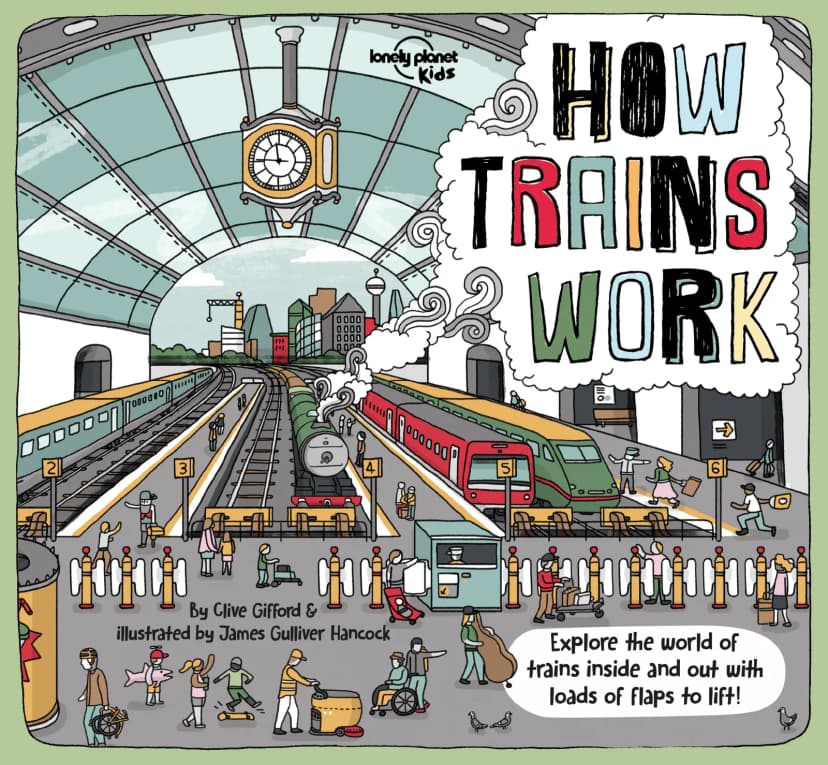
Cover of How Trains Work: a station with a steam locomotive and two modern trains

Image: Lonely Planet Kids · source

Railway books

How Trains Work (North and South America edition)

Lonely Planet Kids · Mid-range

A lift-the-flap nonfiction book by Clive Gifford, illustrated by James Gulliver Hancock, that takes young readers through the history of trains and around the world's railways.

Check price on Amazon (affiliate link, opens Amazon in a new tab)

As an Amazon Associate I earn from qualifying purchases. How we pick our gear

We have not tested it ourselves: strengths and weaknesses below come from the tests cited.

Why Railfans Carry It

The publisher describes a ride from the fastest train to the longest and from the oldest to the newest, through tunnels, across bridges and up mountainsides. Readers unfold pages and lift flaps to reveal bustling stations, old steam locomotives fuelled with coal, and high-speed trains in Japan at almost 400 miles per hour. The book also covers how trains reach the top of mountains, carry people under cities and work beneath the sea, and it includes luxurious journeys: the Trans-Siberian Railway from Moscow to Vladivostok and The Ghan across Australia. The publisher says it was created in consultation with Anthony Coulls, Senior Curator of Rail Transport and Technology at the National Railway Museum in the UK.

In the Field

The cover on the publisher's page carries the line "loads of flaps to lift" and shows a station with a steam locomotive and two modern trains at numbered platforms. The publisher names it a follow-up to How Cities Work and How Airports Work. The publisher's shop places the book on its 6-8 kids shelf; the page gives no other age range.

Strengths and Weaknesses

Strengths

  • Flaps to lift and pages to unfold, as the cover and description say
  • Steam locomotives, Japanese high-speed trains, tunnels, mountains and undersea lines in one book
  • Trans-Siberian Railway and The Ghan among the journeys
  • Created in consultation with a National Railway Museum curator

Weaknesses

  • Only 24 pages
  • Not a Christmas book: the publisher's description has no holiday theme
  • The publisher's page states no age range beyond its 6-8 kids shelf
  • Regional edition for North and South America; the publisher's page lists a second ISBN, so check 9781788683289 when ordering

Key Specifications

How Trains Work (North and South America edition) — key specifications
SpecificationValue
Size10.83 x 10 inches
Pages24
AuthorClive Gifford
EditionNorth and South America edition, 1st edition
ISBN-139781788683289
LanguageEnglish
PublisherLonely Planet Kids
IllustratorJames Gulliver Hancock

Who It’s For

A parent or relative buying for a child who likes to find out how things work and who would enjoy lifting flaps to see stations, locomotives and long-distance trains. The publisher presents it as a book of facts about trains, from history around the world to high-speed lines today. It is not a story and it has no Christmas theme, so a buyer who wants a seasonal picture book should look elsewhere.

Alternatives

The Big Book of Trains (DK Big Books), in this catalogue, is a 32-page hardcover nonfiction title from DK Children with a publisher age range of 5 to 9, a hardcover alternative. Locomotive, by Brian Floca, in this catalogue, is a 64-page hardcover from Atheneum that won the Caldecott Medal and explores early American railroads, for a buyer who wants a longer book on that subject.

As an Amazon Associate I earn from qualifying purchases. How we pick our gear

Compare all railway books.