Spotting Location
John Henry Historical Park (Big Bend Tunnel)
A free county park at the east portal of the CSX Big Bend Tunnel near Talcott, West Virginia, where the Alleghany Subdivision emerges beside the John Henry statue.
Talcott, West Virginia, United States
Verified on October 12, 2026
See everything in West Virginia7 spots · 2 live cams · 3 eventsPlan your visit
Coordinates: 37.649700, -80.766200
- Parking
- Yes
- Shelter
- Yes
- Restrooms
- Yes
- Best times
- Morning, when the sun is in the east and south-east behind the photographer and lights the east-facing portal and the nose of eastbound trains; afternoon views toward the portal are into the sun.
- Duration
- 1-2 hours
- Cost
- Free
Where to stand, park and take a break
Before you go — access is not guaranteed
Photo positions show where photographers have stood, not places we have visited. Some may be on private or railway property. Stay on public land and never cross fences, tracks or “No Trespassing” signs: being on railroad property is illegal and dangerous. Parking and restrooms come from official and map sources.
Read our trainspotting safety, law & etiquette guide →Tap a symbol on the map for details.
Take this spot with you — every point in your GPS app, even without signal.
Weather & light
Sun times calculated for this spot’s coordinates.
Seasons
The park is open all year, and admission is free in every season, according to Summers County. What changes with the seasons is the light, the crowd and the museum's hours.
In summer the sun rises well north of east (approximately 60 degrees azimuth in late June), so the east-facing portals receive light early in the morning. The John Henry Museum on Pat Ball Road, in the former L.G. Rhodes General Store of 1905, opens on Saturdays and Sundays from 1:00 to 4:00 pm through the summer, according to the park. The second weekend of July brings John Henry Days, with live music, fireworks, vendors and a car show; it is the busiest time of year in the park and the worst for an uncluttered photograph of the portal.
In winter the sun rises in the south-east (approximately 120 degrees) and stays low, so the portal area at the foot of Big Bend Mountain can fall into shade earlier in the day, and mid-morning is the best window.
Spring and autumn sit between the two for sun angle, with the sunrise close to due east (90 degrees) around the equinoxes, close to the east-north-east direction the portals face. Freight traffic runs all year and does not follow a tourist season, so any season works for the trains themselves; the choice is really about light and crowds.
Safety
The tunnels and the track are CSX property. The land between the park road and the track is CSX property: stay on the park side of it. Never walk toward either portal on the track or the ballast, and never enter a tunnel. The 1932 bore is a live single-track main line where a train cannot stop for a person inside; the 1872 bore was fenced across its mouth after closure, and a visitor in 2011 described it as flooded and strewn with boulders.
An eastbound train can appear at the portal with little warning, so keep your distance from the track even when the line looks empty. Heavy coal trains are long and slow to clear; do not cross the line anywhere in the park area. The nearest public road crossing of the railroad recorded by the Federal Railroad Administration is at Talcott Back Road, approximately 1.8 km (1.1 mi) to the east.
WV Route 3 is a narrow, winding two-lane road. Slow down well before the entrance, use the gravel entrance road rather than stopping on the highway shoulder, and park only at the end of the park road. The former statue site on the mountain above the tunnel sits on a sharp curve of the highway; if you stop there to read the state marker, pull fully off the road.
During John Henry Days on the second weekend of July the park is crowded with families, vendors and cars: keep camera gear and children away from the railroad side of the road.
Trains here
- Railroad
CSX — Alleghany Subdivision
Train types
What runs here
The track at the portal is CSX's Alleghany Subdivision, the former Chesapeake and Ohio main line that runs 78.6 miles (126.5 km) from Clifton Forge, Virginia, to Hinton, West Virginia. Keller, the contractor that grouted and stabilised the 1932 tunnel for CSX from 2013, describes the traffic through it as heavy-tonnage coal and other freight. Only one track passes through the tunnel today.
No official daily train count for this location was found, and none is given here. For a dated snapshot, the CSX Transportation Historical Society's railfanning report of 25 March 2017 at Talcott and Big Bend Tunnel records a train of 110 Duke Energy (DKPX) coal loads, another of 100 loads and one of 71 empties on that day. That is one outing, not a pace to expect.
Passenger service is limited to Amtrak's Cardinal, which uses the Alleghany Subdivision and calls at Alderson to the east and Hinton to the west; a drone video published on YouTube shows it emerging from Big Bend Tunnel. It does not run every day, so check Amtrak's own schedule before planning around it.
Older photographs show how the traffic pattern changed. Between 1932 and 1974 the two bores worked as a double-track pair; before 1932 the single 1872 tunnel was a bottleneck, and trains had to stop on either side and pass through one at a time, according to the park's history of the tunnel construction. A C&O telegraph cabin, GB Cabin Talcott, stood here from 12 May 1902 to control that single-track section until the second tunnel made it redundant.
On the line here
FRA / NTAD — crossing inventory Jul 21, 2026 · rail yards (FRA / NTAD)
Photos & videos

 jpmueller99
4

jpmueller99
4
jpmueller99
4

jpmueller99
4
Swipe to see all 4 photos
Best angles for photos
The track leaves the portal heading approximately 72 degrees (east-north-east) and the park lies on its north side. From the standing point on the park road, the portals are about 90 m (300 ft) away on a bearing of approximately 238 degrees (west-south-west). Those bearings, computed from the OpenStreetMap geometry, decide the light.
Morning is the time for the classic view. At Talcott's latitude (37.65 degrees north) the sun rises between approximately 60 degrees (north-east) in late June and 120 degrees (south-east) in late December. In the morning it is behind or to the left of a photographer looking toward the portal, so the east-facing tunnel mouth and the nose of an eastbound train coming out of it are lit. After midday the sun moves into the south-west and west, directly toward the portal side: shots of the tunnel mouth turn into backlit silhouettes, and the base of Big Bend Mountain puts the portal area in shade earlier in winter.
A normal to short telephoto lens (50 to 135 mm on full frame) from the park road frames both portals, the statue and an emerging locomotive; a longer lens compresses a westbound train approaching along the straight from the east, with the mountain behind. Wide-angle views that put the statue in the foreground and the active portal behind it work best with an eastbound train just clearing the tunnel.
The strip between the road and the track is CSX property, so compose from the road; do not step onto it for a cleaner angle. Tripods are practical on the gravel road but keep clear of other visitors' cars.
The full guide
Trainspotting Experience
John Henry Historical Park is a strip of county land on the north side of the CSX Alleghany Subdivision, running east from the mouth of the tunnels at Talcott. Visitors turn off WV Route 3 onto a gravel entrance road and drive down to the parking area at the end of the road, which the National Park Service lists as stop 17 of its African American Heritage Driving Tour. The park road follows the grade of the original 1872 line, so it runs parallel to the active single track, roughly 20 to 40 m (65 to 130 ft) away according to OpenStreetMap, and the strip between the two belongs to CSX.
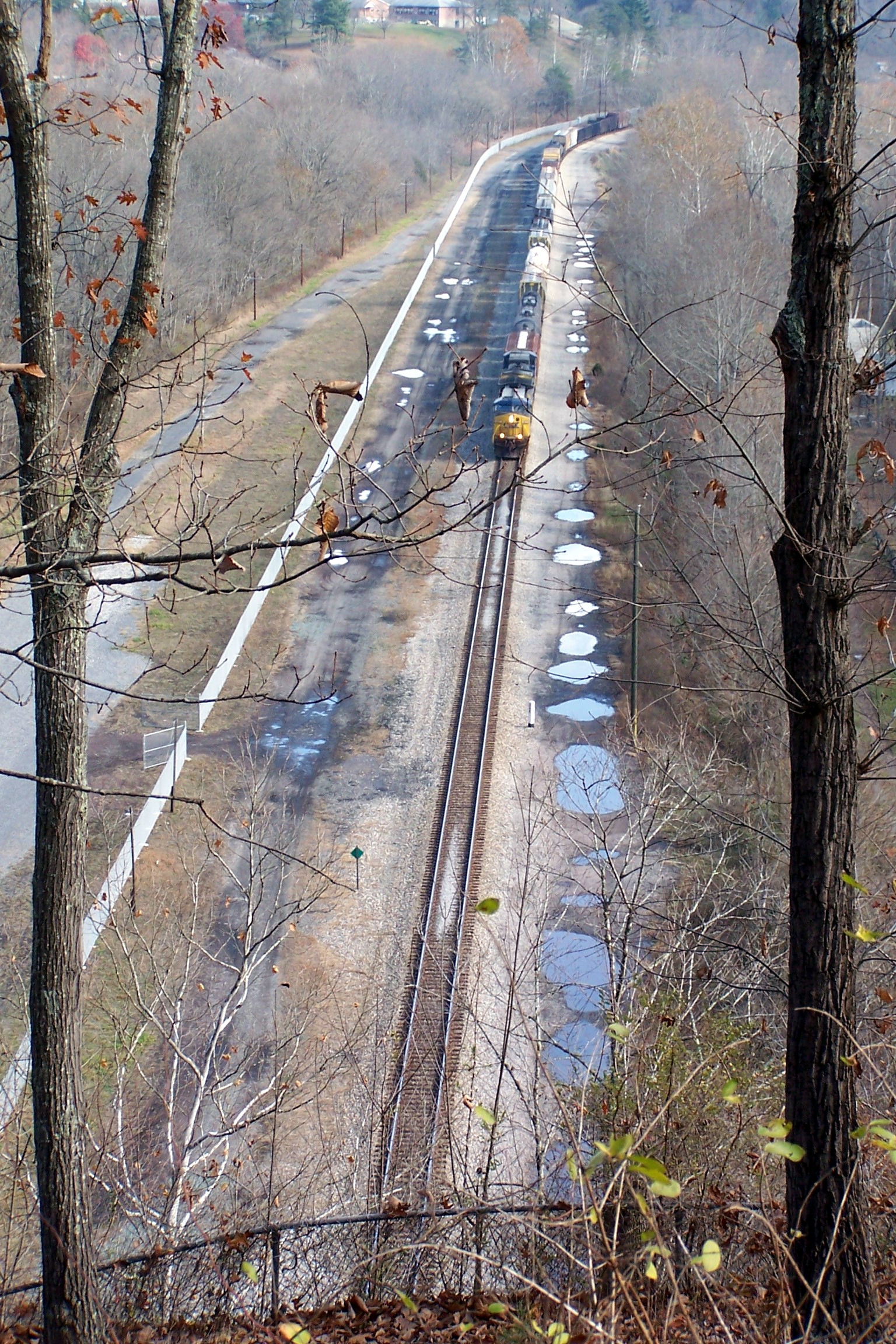
The standing point used here is on that park road about 90 m (300 ft) east-north-east of the portals. Looking west-south-west, two openings sit side by side at the foot of Big Bend Mountain: the 1932 bore that carries every train today, and the original 1872 bore, closed in 1974 and fenced across its mouth. The bronze John Henry statue stands in front of them. Trains appear with little warning: an eastbound emerges from the dark portal and passes the length of the park toward Talcott, while a westbound is visible for longer as it approaches along the straight from the east before disappearing into the mountain.
There is no timetable to plan around. The line carries CSX freight, much of it coal in heavy unit trains, and Amtrak's Cardinal also uses it between its Alderson and Hinton stops. A visit is mostly a matter of patience; the interpretive kiosks, the telegraph office site and the museum 1.3 km (0.8 mi) east give the waiting time a purpose. The park is open year round and admission is free, according to Summers County.
Landscape, Setting & Local Atmosphere
The park occupies the narrow floor of a valley between WV Route 3 and the railroad, at about 462 m (1,516 ft) above sea level on the USGS 10 m elevation model. To the west the ground rises steeply into Big Bend Mountain, whose crest above the tunnel line stands roughly 100 m (330 ft) higher than the portals. The tunnels cut straight under the mountain instead of following the long loop the Greenbrier River makes around it, which is why the place exists at all.
A historical marker placed in the park explains a detail that is easy to miss: before the 1932 tunnel, a north arm of the Greenbrier River ran along the base of the mountain. The C&O closed it off with fill excavated from the new bore, saving two trestles, and the river still seeps under that fill to form a wetland west of and below the park, now grown over with a mature stand of native lowland trees.
The park itself is small and kept for visitors: interpretive kiosks, walking trails, a picnic shelter and a stage, with the relocated statue as its focal point. The atmosphere is quiet and rural for most of the year: Talcott is an unincorporated village and WV Route 3 a two-lane country road. On the second weekend of July the calm gives way to John Henry Days, the free community festival with live music, fireworks, vendors and a car show that Summers County lists for the park.
Historical or Cultural Relevance
The Chesapeake and Ohio built its main line through this part of West Virginia between 1869 and 1872, and the tunnel under Big Bend Mountain was its largest single work. According to the park's own history, construction began in early 1870, the tracks were laid through between 9 and 12 September 1872 and final completion came in early 1873; the West Virginia Encyclopedia gives 12 September 1872 as the completion date. The bore is 6,450 feet (1,966 m) long, and the National Park Service calls it the longest on the C&O. The C&O resident engineer was Captain Richard H. Talcott and the contractor was Captain William R. Johnson, whose crews of 800 to 1,000 men were largely freedmen and Irish immigrants; the park's history names silicosis, accidental explosions and rock falls as the three main dangers they faced.
Traffic outgrew the single bore. The C&O began a parallel tunnel in 1930 and opened it in 1932; the two ran together until the original was closed in 1974. Naming is a trap: the park and several railfan sources call the 1872 bore the Great Bend Tunnel and the 1932 bore, still in use, the Big Bend Tunnel, while other sources use either name for the whole site.
The tunnel is where local tradition places John Henry's contest with a steam drill. In the 1920s Louis W. Chappell of West Virginia University and Guy B. Johnson of the University of North Carolina interviewed men who knew the story; the National Park Service states that research supports John Henry as a real worker who died here. Historian Scott Reynolds Nelson's 2006 book Steel Drivin' Man, and other researchers, have proposed other sites, including Lewis Tunnel in Virginia and tunnels near Leeds, Alabama. The contest itself remains a legend; the tunnel and its workforce are documented history.
The Hilldale-Talcott Ruritan Club, formed in 1968, raised the money for a bronze statue, modelled on local C&O porter Ross Evans, and opened a roadside park above the tunnel in 1972 for its centenary. The statue was restored and moved down to the portal in 2012, and the county park was dedicated in 2017.
What Makes This Spot Different
Few places let a railfan stand, legally and for free, in front of a working main-line tunnel portal with its abandoned predecessor right beside it. Here the 1932 bore that carries every CSX and Amtrak train and the fenced-off 1872 bore sit side by side at the foot of Big Bend Mountain, and the park road that brings visitors to them is itself the grade of the original line.
The second distinction is the story. This is the site that West Virginia's official historical marker, erected by West Virginia Archives and History, names as the tradition-held setting of the steel drivers' ballad of John Henry, and the park is built around it: the bronze statue of 1972, interpretive kiosks on the tunnel construction, the telegraph cabin and the local families, and a museum in a 1905 general store in the village. Scholars still dispute where the contest happened, and the park's panels present the local account; the tunnel, its workforce and its dangers are matters of record.
The third is the setting of the park on former railroad land between the highway and the track, which makes the visit calm and self-directed. There is no platform, no operator and no ticket: the county keeps the park open year round without charge, and the museum adds summer weekend opening hours.
Finally, the spot is distinct from Spotatrain's Hinton (New River Gorge) spot 11 km (7 mi) to the west: Hinton sits on the New River Subdivision at a railroad town, while this is the Alleghany Subdivision at a mountain tunnel, with its own light, sound and history.
Frequently Asked Questions
QCan you see trains from John Henry Historical Park?
Yes. The park road runs parallel to the active CSX Alleghany Subdivision, roughly 20 to 40 m (65 to 130 ft) away, and ends near the east portals of the Big Bend Tunnel, where trains enter and leave the mountain.
QIs John Henry Historical Park free?
Yes. Summers County states that admission to the park and to the John Henry Days festival is free. The park, created by the Hilldale-Talcott Ruritan Club on county land, is open year round.
QWhich of the two tunnels is still in use?
The 1932 bore carries all trains today. The original 1872 tunnel, which the park calls the Great Bend Tunnel, was closed in 1974 and is fenced across its mouth.
QWhat trains use the line through the Big Bend Tunnel?
CSX freight, described by CSX's tunnel contractor as heavy-tonnage coal and other freight, and Amtrak's Cardinal, which uses the Alleghany Subdivision between Alderson and Hinton. No official daily count was found.
QDid John Henry really race a steam drill here?
Local tradition and a state historical marker place the contest here, and the National Park Service says research supports John Henry as a real worker. Historian Scott Reynolds Nelson and others have proposed other sites, so the contest remains a legend.
QWhere do you park?
Turn off WV Route 3 onto the gravel entrance road at Talcott; the National Park Service directions place the parking area at the end of that road, near the tunnels.
Help improve this page
Spotted something out of date or incorrect? Let our community know.
Around Talcott
1 place on Spotatrain within 25 km of Talcott — 1 spot.
- Hinton (New River Gorge) 11 km
Spots Near Talcott
- Hinton (New River Gorge)Spot · Hinton, West Virginia11 km
- Thurmond (New River Gorge)Spot · Thurmond, West Virginia44 km
- Elkhorn (Pocahontas Coal)Spot · Landgraff, West Virginia66 km
- Roanoke (Railwalk)Spot · Roanoke, Virginia84 km
- Clifton Forge (CSX Yard)Spot · Clifton Forge, Virginia85 km
- Iaeger (N&W/VGN Junction)Spot · Iaeger, West Virginia95 km
More Spots in West Virginia
Related Experiences
Nearby attractions
- John Henry Museum & Gift Shop0.8 miles / 1.3 km
Run by the John Henry Historical Society in the former L.G. Rhodes General Store (1905) at 21 Pat Ball Road, with books, videos, transcripts and photographs donated by local residents; open Saturdays and Sundays 1:00-4:00 pm in summer.
- Great Bend Tunnel state historical marker and original statue site0.09 miles / 0.14 km
West Virginia Archives and History marker on WV Route 3 above the east portal, at the turnout where the John Henry statue stood from 1972 to 2012; its original plinth remains.
- Hinton Railroad Museum7 miles / 11.3 km
Museum at 206 Temple Street in Hinton with artifacts from the early Chesapeake and Ohio Railway, tools from the era of John Henry, uniforms, photographs and model train exhibits.
Hotels & places to stay near Talcott
Sources & official links
- John Henry Historical Park (official site)www.johnhenrypark.com
- Summers County Parks & Recreation: John Henry Historical Parkwww.summerscountywv.gov
- Great Bend Tunnel construction (John Henry Historical Park)www.johnhenrypark.com
- John Henry Park, Talcott, WV (National Park Service)www.nps.gov
- John Henry and the Coming of the Railroad (National Park Service)www.nps.gov
- Great Bend Tunnel (e-WV, West Virginia Encyclopedia)www.wvencyclopedia.org
- Big Bend Tunnel Rehabilitation (Keller)www.keller-na.com
- CSX Historic Talcott, Big Bend Tunnel and Avis Yard, 25 March 2017 (CSX Transportation Historical Society)csxthsociety.org