Updated
Length
18 km
Max speed
200 km/h
Tunnels
1
Bridges
3
Budget
DKK 8.2B
World's longest combined road-rail immersed tube tunnel under construction beneath the 18-km Fehmarn Belt, between Puttgarden (Germany) and Rødby (Denmark).
About This Project
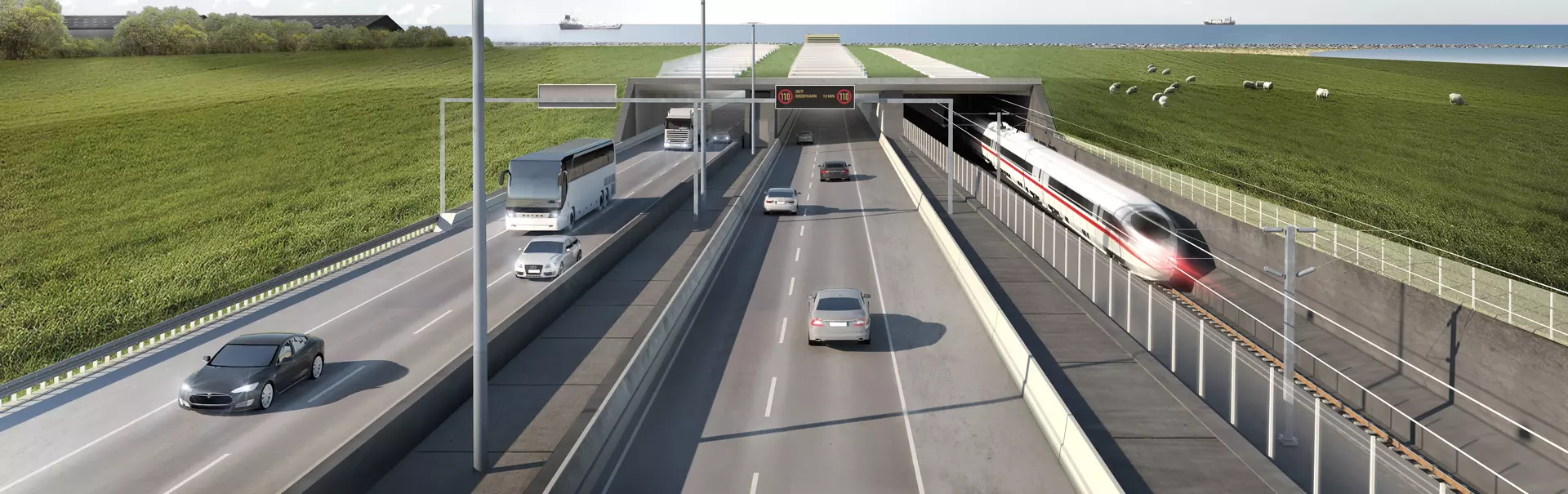
The Fehmarn Belt Fixed Link is a roughly 18-kilometre (11-mile) immersed tube tunnel being driven under the Fehmarn Belt in the Baltic Sea to connect Puttgarden on the German island of Fehmarn with Rødby on the Danish island of Lolland. When it opens — Femern A/S confirmed in January 2026 that this is no longer expected before 2031 — it will be the longest combined road-and-rail immersed tunnel in the world, carrying a four-lane motorway with continuous hard shoulders alongside two electrified railway tracks in separate tubes.
The project is the missing link in the Scandinavian-Mediterranean corridor of the Trans-European Transport Network, a 5,000-km axis the European Commission considers strategic enough to have made the Fehmarnbelt Fixed Link one of its five priority cross-border infrastructure schemes. Today, freight and passenger traffic between Germany and Sweden must detour roughly 160 km westwards through Jutland and over the Great Belt; the tunnel cuts that detour out entirely and shortens Hamburg-Copenhagen rail journeys from about 5 hours to 2½.
Construction is organised around an enormous purpose-built factory at Rødbyhavn that covers about 500,000 m² (124 acres) and is producing 79 standard concrete tunnel elements 217 m long, 42 m wide and 10 m high, plus 10 smaller "special" elements placed every 2 km to house the tunnel's electrical installations. Each standard element weighs approximately 73,000 tonnes — making them the largest series-produced tunnel components ever built. They are floated to a 40-metre-deep (131 ft) trench excavated across the strait and lowered into place by dedicated immersion pontoons IVY 1 and IVY 2 against an alignment tolerance of 15 mm.
The 2008 State Treaty makes Denmark solely responsible for the tunnel's construction, financing and operation; Germany handles its hinterland connections separately. Danish state-guaranteed loans cover the bulk of the cost, and they will be repaid out of motor vehicle tolls and railway charges once the link opens — meaning Danish taxpayers, in principle, do not contribute directly. The European Union has committed approximately €1.3 billion through the Connecting Europe Facility across multiple tranches.
As of May 2026 the project entered a long-awaited new phase: the first 217-metre element was successfully immersed on the seabed on 7 May 2026 after a three-day tow from the Rødbyhavn work harbour. Femern A/S has stated it will publish a revised overall schedule once the initial immersions are complete, replacing the now-superseded 2029 opening target.
Video
Why This Project Matters
The Fehmarn Belt has been a stubborn gap in northern Europe's rail and road network for more than a century. The "Vogelfluglinie" or bird-flight line, conceived in the 19th century to connect Hamburg to Copenhagen, has run since the 1960s via a train ferry between Puttgarden and Rødby — a 45-minute crossing that, combined with loading and waiting, makes the Hamburg-Copenhagen rail trip an almost 5-hour journey. Freight trains take even longer. Sweden, whose second-largest export market is Germany, pressed Denmark to close the gap during negotiations over the Øresund bridge in the 1990s.
The tunnel exists to do three things at once. First, it kills off a 160 km detour through the whole of Denmark, completing the Scandinavian-Mediterranean TEN-T corridor that the European Commission has identified as the central north-south axis of European transport, running from Malta in the Mediterranean to Finland's Arctic. Second, it offers Europe a credible climate alternative to short-haul flights and trucks on the Hamburg-Copenhagen relation: Hamburg-Copenhagen by rail drops from roughly 5 hours to 2½, electrified freight trains can move cargo from the Mediterranean to Scandinavia in a single overnight run, and Femern A/S has committed to powering tunnel construction and operations with 100 % renewable electricity. Third, for Denmark, the tunnel is a long-term toll-and-charges asset that — according to forecasts that produced a benefit-cost ratio of 6.7 in 2010 — should generate roughly USD 4 billion (DKK 26 billion) in profit over the first 50 years.
Technical Details
The Fehmarnbelt tunnel is a five-tube immersed concrete structure approximately 18 km (11 mi) long sitting in a 40 m (131 ft) deep trench dredged across the Fehmarn Belt. Two of its tubes carry an electrified double-track railway designed for cruising speeds of 200 km/h (124 mph); two further tubes carry a 4-lane motorway with a continuous hard shoulder rated for 110 km/h (68 mph) cruising; the fifth, central tube is a service and escape corridor.
Construction uses 79 standard precast elements 217 m × 42 m × 10 m (712 ft × 138 ft × 33 ft) and weighing approximately 73,000 tonnes (80,500 short tons) each, plus 10 smaller "special" elements placed every 2 km with a lower-level basement housing the tunnel's electrical equipment — 89 elements in total. Each standard element is built from nine 24-metre concrete segments cast sequentially in five production lines inside a climate-controlled, 500,000 m² (124-acre) factory at Rødbyhavn. Bulkheads are fitted to make the finished elements buoyant; a flood-able basin in front of the factory floats them out to the dedicated work harbour, where additional ballast concrete is added. They are then towed to position by Multi-Purpose Pontoon Maya and immersion pontoons IVY 1 and IVY 2 against an alignment tolerance of 15 mm, with the heavier road tubes balanced against temporary water chambers in the railway tube. Spreader Pontoon NP460 then locks each element with stone and gravel, and Protection Layer Pontoon Wismar caps it with a layer of stone. The first element was successfully immersed on 7 May 2026 after a 14-hour positioning operation.
Economic Impact
Femern A/S projects a 7-minute train crossing at 200 km/h, a 10-minute road crossing at 110 km/h, and Hamburg-Copenhagen rail journeys reduced from approximately 5 hours to 2½. For freight, the link removes the 160-km Jutland detour from northbound trips through the Scan-Med corridor, opening a direct electrified rail route between southern Europe and Scandinavia. The 2010 federal cost-benefit assessment in Germany produced a benefit-cost ratio of 6.7 — exceptional by infrastructure standards — and the tunnel is forecast to generate approximately USD 4 billion in toll-and-charge profits for Denmark over its first 50 years of operation.
Construction itself has become one of Northern Europe's largest single workplaces. As of 2026, around 2,000 people from more than 40 countries work at the Danish construction site, which occupies approximately 500 hectares (1,235 acres) — equivalent to about 700 football pitches — and another approximately 200 work on the German side. Two work harbours, two cement and aggregate supply chains, and dedicated immersion fleets have created sustained demand for steel, concrete, dredging, vessel construction and marine engineering capacity across the southern Baltic. The wider regional play, according to Femern A/S and the Schleswig-Holstein government, is that compressing Hamburg-Copenhagen into 2½ hours brings two booming metropolitan regions — Copenhagen-Malmö and Hamburg — into commuter and supply-chain range of each other for the first time.
Environmental Impact
The construction's most contested environmental impact is sedimentation. Dredging the 18-kilometre trench produced approximately 15 million m³ of soil, stone and sand, virtually all of which has been reused: roughly 300 hectares (740 acres) of new coastal nature and recreation areas are being created at Rødbyhavn from the spoil. Femern A/S deploys custom dredgers (the Hopper Dredger Vox Amalia, the Wire Grab Dredgers Manta and Magnor, and the world's largest Backhoe Dredger) and publishes turbidity, plankton and water-clouding monitoring data in real time on its Aegir portal in response to opposition concerns. Following the Leipzig court's 2020 verdict, Femern A/S is establishing 42 hectares (104 acres) of new rock reefs — 17 hectares more than originally agreed — to compensate for protected reefs found along the alignment during NABU's independent biotope survey.
On carbon, the project's footprint is dominated by the approximately 2 million tonnes of concrete required for the elements and portals. Femern A/S has committed to powering construction and operations entirely from renewable electricity (a Danish transformer station feeds the tunnel with green power from the grid) and argues the project's long-term emissions math works out positive once Hamburg-Copenhagen flights and trucks shift to electric rail and a 160-km road detour is removed. NABU and AGFF remain sceptical, particularly on porpoise habitat in the Belt and the long-run effect of the new dykes on Baltic Sea hydrology.
Challenges & Controversies
The project's environmental footprint has drawn organised opposition on both sides of the Belt for more than a decade. The German action alliance AGFF (Aktionsbündnis gegen eine feste Fehmarnbeltquerung) and Germany's largest conservation NGO NABU (Naturschutzbund Deutschland) led a campaign that ended with more than 4,000 pages of objections being filed at the Federal Administrative Court in Leipzig. Their core argument was that dredging would cloud Baltic waters, smother protected reefs and damage habitat for harbour porpoise populations the Federal Agency for Nature Conservation already considered to be in poor condition. NABU's own biotope mapping found protected reefs along the alignment where Femern A/S had documented only sand and silt. On 3 November 2020 the court dismissed every appeal, but only after Femern A/S agreed to establish 42 hectares (104 acres) of new rock reefs as compensation — 17 hectares more than originally proposed. NABU called the verdict "a black day for our seas."
The project's schedule and budget have also become flashpoints. The original 2008 plan targeted opening in 2018; that slipped to 2021, then 2024, then 2028, then 2029. In September 2025 Sund & Bælt acknowledged a further 18-month slip caused chiefly by late delivery of the special immersion vessels needed to lower the elements. In January 2026 Femern A/S confirmed that opening is no longer expected before 2031, and in February 2026 it cancelled the tenders for rail systems and tolling facilities, planning to retender once the new schedule firms up. New Civil Engineer reported in January 2026 on increasingly tense correspondence between Femern Link Contractors and the Danish transport minister over who carries blame for the delays. On the carbon side, B1M's reporting and Femern A/S itself acknowledge that producing the roughly 2 million tonnes of concrete required is a major emissions source — which Femern says is offset over time by the modal shift from trucks and short-haul flights the tunnel is designed to enable.
Project Timeline
State Treaty signed between Germany and Denmark
The Federal Republic of Germany and the Kingdom of Denmark sign the State Treaty on a Fixed Link across the Fehmarn Belt. The Treaty makes Denmark fully responsible for the tunnel's planning, construction and financing while Germany handles its own hinterland connections.
SourceImmersed tunnel chosen over bridge alternatives
The Danish Minister of Transport and the Danish Parliament decide to pursue an immersed tube tunnel as the preferred option for the crossing, after years of comparative study against cable-stayed bridge, suspension bridge and bored tunnel alternatives.
SourceDanish Building Act adopted
The Danish Parliament adopts the Act on the Construction and Operation of a Fixed Link across the Fehmarnbelt with Associated Landworks, authorising Femern A/S to build and operate the tunnel and serving as the project's environmental authorisation in Denmark.
SourceGerman plan approval granted
The Schleswig-Holstein Plan Approval Authority (APV-SH) issues the German plan approval decision for the tunnel structure between Puttgarden and Rødby, a 1,200-page document concluding several years of public participation and revisions.
SourceFederal Administrative Court dismisses all appeals
The Federal Administrative Court in Leipzig dismisses every appeal filed against the German plan approval decision by NABU, AGFF, three ferry operators, several municipalities and a landowner — over 4,000 pages of objections in total. The verdict gives the German section a final legal green light.
SourceDanish-side construction officially begins
Construction officially starts on 1 January 2021 on the Danish side at Rødby, focused on the tunnel element production site, gantry and ramps. The planned 4 January groundbreaking ceremony is held virtually because of COVID-19, with the Danish Ministry of Transport publishing a video featuring the EU corridor coordinator and the Danish, German and Schleswig-Holstein transport ministers.
SourceGerman-side groundbreaking at Puttgarden
The ground-breaking ceremony for the work harbour and tunnel portals at Puttgarden is held with Danish Transport Minister Benny Engelbrecht and Schleswig-Holstein Transport Minister Bernd Buchholz in attendance. The German construction site has been fully prepared throughout 2021.
Source18-km tunnel trench fully excavated
Excavation works for the 18-kilometre tunnel trench, which started in July 2021 off the Lolland coast and reached German territory in September 2021, are completed. Approximately 15 million m³ of dredged material is being reused for around 300 hectares of new coastal nature and recreation areas at Rødbyhavn.
SourceSund & Bælt confirms 18-month schedule slip
Sund & Bælt Holding A/S, the parent of Femern A/S, acknowledges in September 2025 that the project has slipped by around 18 months from the previously communicated 2029 opening. The slip is blamed primarily on delayed delivery of the special vessels designed to immerse the precast tunnel elements.
SourceTenders for rail systems and tolling cancelled
Femern A/S cancels the tenders for the rail systems and the tolling facilities for the tunnel amid ongoing delays. Both contracts are expected to be retendered later, after the revised overall project schedule is finalised. The decision reflects tensions between client and contractor as completion targets shift.
SourceFirst tunnel element successfully immersed
After leaving Rødbyhavn work harbour at 9 pm on 4 May 2026 carried by specialised immersion pontoon IVY, the first 217-metre, 73,500-tonne tunnel element is successfully positioned in the seabed trench in front of the Danish portal after a 14-hour immersion operation. It is the first of 89 elements to be installed and the first time series-produced tunnel components of this size have ever been used.
SourceVideos
Photos
External Resources
Official resources
Learn more
Frequently Asked Questions
When will the Fehmarnbelt tunnel open?▾
How long will the crossing take?▾
Who is paying for the tunnel?▾
Why an immersed tunnel rather than a bridge?▾
What environmental concerns have been raised?▾
What happens to the existing Puttgarden-Rødby ferry?▾
How big are the tunnel elements?▾
How is the tunnel connected to the existing rail network?▾
Help improve this page
Spotted something out of date or incorrect? Let our community know.
Related on Spotatrain
More Freight Rail Mega-Projects
More Mega-Projects Worldwide
HS2
Britain's most ambitious post-war railway, halved in scope and being rebuilt under a 2026 programme reset.

Brightline West
America's first true high-speed rail: Las Vegas to greater Los Angeles at 200 mph
Explore around this project
1 place on Spotatrain within 100 km of this project — 1 experience.
- Miniatur Wonderland 84 km