

Updated
Length
350.8 km
Max speed
320 km/h
Stations
4
Budget
USD 21.5B
America's first true high-speed rail line — a 350 km (218 mi) all-electric route from Las Vegas to greater Los Angeles, planned for 200 mph (320 km/h) service in late 2029.
About This Project
Why it matters. Brightline West is widely described — by its own developers, by the Federal Railroad Administration, and by trade press from Railway Gazette to Railway Age — as the United States'' first true high-speed rail line. Existing US "high-speed" services such as Amtrak''s Acela top out around 240 km/h (150 mph) on short stretches of the Northeast Corridor; Brightline West is being built to a sustained 320 km/h (200 mph) standard on a dedicated, fully grade-separated right-of-way. If completed as designed, it will be the first commercial deployment in North America of equipment derived from the Siemens Velaro Novo platform, a 200 mph electric multiple unit family already in service in Europe.
Scope and route. The line runs roughly 350 kilometres (218 miles) along the median of Interstate 15 between a flagship Las Vegas station near Harry Reid International Airport and the Cucamonga Metrolink station in Rancho Cucamonga, just over 65 km / 40 mi east of downtown Los Angeles. Intermediate stops are planned at Apple Valley / Victor Valley and Hesperia, both in California''s High Desert. End-to-end trip time is targeted at approximately two hours, against five to seven hours by car on a congested I-15.
Status as of April 2026. Groundbreaking took place on 22 April 2024 in Las Vegas. Heavy civil construction is well under way in Nevada — embankment grading, drainage works, bridge piers, and the first elevated deck panels — while California construction is ramping up through 2026 with utility relocations, geotechnical borings, and bridge potholing along the I-15 corridor. Revenue service, originally targeted for the 2028 Los Angeles Olympic Games, is now expected in late 2029, and total project cost has climbed from an initial $12 billion estimate to approximately $21.5 billion. Brightline West is awaiting a $6 billion RRIF Direct Loan from the US Department of Transportation; a decision is not expected until 2027.
Video
Why This Project Matters
A corridor too short to fly, too far to drive. Brightline''s thesis — first applied to its Florida service between Miami and Orlando — is that the United States has dozens of city-pair markets where intercity rail can outcompete both flying and driving on cost, time and reliability. Las Vegas to Los Angeles is the textbook case: roughly 430 km (270 mi) by road, four to six hours of often-congested driving on a notoriously bottlenecked I-15, and a short flight whose effective door-to-door time is dragged out by airport access on both ends. Tens of millions of single-purpose leisure trips a year between Southern California and Las Vegas make this one of the densest unserved intercity-rail markets in the world.
Federal industrial-policy bet. From the federal perspective, Brightline West is also a deliberate test case: a privately developed, US-built high-speed rail line that the Federal-State Partnership for Intercity Passenger Rail Grant Program could underwrite without taking on the political and procurement complexity of California''s state-led project. The $3 billion grant signed in 2024 is one of the largest single rail awards in US history and was explicitly framed by the FRA as kickstarting a domestic high-speed rail industry, including a new Siemens assembly plant in Horseheads, New York.
Climate and congestion arguments. Brightline forecasts 8–9 million passengers annually at maturity and projects an emissions reduction on the order of 400,000 tonnes of CO₂ per year by removing several million car trips from the I-15 corridor. The trains themselves will be powered from the Southern California Edison grid, which is decarbonising rapidly, with a stated long-term goal of 100% emissions-free traction power.
Technical Details
Rolling stock. Ten seven-car Siemens "American Pioneer 220" (AP 220) electric multiple units, an Americanised derivative of the Velaro Novo platform, with a capacity of 434–450 passengers per trainset and a top operating speed of 200 mph (320 km/h). Final assembly takes place at Siemens Mobility''s new Horseheads, New York plant, which opened in late 2024 as the company''s North American high-speed rail hub. The FRA issued a Buy America non-availability waiver covering specific high-speed subsystems not yet domestically produced.
Electrification and signalling. The line will be a 100% all-electric, fully grade-separated double-track railway built mostly within the median of Interstate 15. The system architecture under consideration places ETCS Level 2 with GSM-R as the leading candidate for automatic train control and radio — a deliberate choice of a globally proven European standard rather than retrofitted conventional US wayside signalling. The signalling supplier had not been publicly confirmed as of April 2026.
Civil engineering scope. Construction includes grading and drainage; structural works including new bridges and retaining walls; modifications to I-15 lanes and ramps where the alignment leaves the median; and installation of track and communications systems. Two signature elevated structures are the approximately 5.6 km (3.5 mi) viaduct on the Rancho Cucamonga approach (paralleling I-15 southbound) and the 1.16 km / 3,800 ft Barstow Viaduct in the California Middle segment. At least seven major bridges cross Bell Mountain Wash, the Mojave River, Brush Creek, Debris Cone Creek, Cleghorn Creek, Cajon Wash and Lytle Creek. The most demanding gradient is approximately 6% (60 ‰) through Cajon Pass, with sustained 4.5% grades between Victorville and Las Vegas — both well beyond European HSR norms and a key driver of the AP 220 trainset specification.
Economic Impact
Construction phase. Brightline West is forecast to support approximately 35,000 construction jobs across Nevada and California through buildout, with project labour agreements covering Southern Nevada Building Trades and California craft unions. The Siemens contract adds permanent manufacturing jobs at the Horseheads, New York plant, where the AP 220 trainsets are assembled and tested.
Operational phase. Brightline projects roughly 1,000 permanent direct jobs once the line is operational — train crews, station staff, dispatchers, vehicle maintenance facility technicians and corporate roles. Senator Jacky Rosen has cited a projected $10 billion economic-impact figure for the State of Nevada alone, primarily driven by induced tourism, business travel, and reduced congestion costs on I-15.
Modal shift. With a target of 8–9 million annual passengers at maturity, the line is expected to capture a meaningful share of leisure and business trips currently made by private car or short-haul flights between Southern California and Las Vegas. Beyond ticket revenue, supporters argue the freed I-15 capacity and avoided airport congestion at LAX, Ontario and Harry Reid will compound the project''s benefit-cost case, although these wider effects are notoriously difficult to quantify ex ante.
Environmental Impact
Operational emissions. Brightline West forecasts a reduction of roughly 400,000 tonnes of CO₂ per year (cited by some sources as approximately 325,000 tons) once the line is fully operational, by displacing several million car and short-haul flight trips along the I-15 corridor. The trains will draw traction power from Southern California Edison, which is on a trajectory to a substantially decarbonised grid; the company has stated a long-term goal of 100% emissions-free traction power.
Construction emissions and mitigation. Brightline has pledged to offset construction-related emissions through pilot programmes including battery-electric construction equipment and solar-powered site offices. Specific quantified targets and verification protocols had not been publicly published as of April 2026.
Habitat and wildlife. Because most of the alignment sits within the existing I-15 right-of-way, ecological impacts are concentrated in three areas: desert tortoise and Mojave habitat in the Nevada and California desert segments; bighorn sheep movements near Soda, Cady and Clark mountains, where dedicated wildlife crossings spanning both the freeway and the rail line are being designed in coordination with Caltrans; and the Cajon Pass alignment, which was the subject of the multi-year FRA Cajon Pass High-Speed Rail Project EIS and a coordinated permitting review.
Challenges & Controversies
Cost overruns. The headline figure has roughly doubled from early estimates. The XpressWest-era project was repeatedly described as a $5–8 billion build; the Brightline West relaunch budget hovered around $12 billion at groundbreaking in 2024; by mid-2025 internal documents shared with bondholders pegged the figure at $16.1 billion; and a leaked filing reported by the Las Vegas Review-Journal and Railway Age in early 2026 put the all-in number at approximately $21.5 billion — a cost overrun of roughly 121% versus the early Brightline-era estimate. Critics including the Cato Institute–affiliated Antiplanner have argued the trajectory mirrors public HSR projects Brightline's private model was meant to outperform; the company counters that it has absorbed scope additions, inflation and supply-chain shocks while keeping construction moving.
Missed Olympics deadline and revised opening. Service was originally pitched as opening in time for the Los Angeles 2028 Olympic Games — a target Brightline executives, federal officials and Senator Jacky Rosen all referenced repeatedly through 2024. By April 2025 the company conceded the line would not be operational until late 2029, several months after the Games. Independent observers including Trains and Fox5 Vegas have characterised this as a credibility setback even though Olympic-window opening was always tight.
Financing strain. Through 2025 and into 2026 Brightline West restructured $2.5 billion of Series 2025A private-activity bonds under a transaction-support agreement that obliged the company to raise at least $400 million of fresh equity by 31 March 2026. That deadline was not met; bondholders granted successive extensions, the last a 40-day grace period running to 10 September 2026 and conditioned on management presenting an updated business plan. Total project cost has risen from roughly $12 billion at groundbreaking to at least $21 billion. The $6 billion federal RRIF loan has meanwhile not yet reached the formal application stage: Brightline West entered the Build America Bureau's credit pipeline in September 2025, and in a securities filing on 10 September 2026 the company said it expected an "invitation to apply" once the Bureau completes its diligence review, "no later than October of this year." That invitation would open a statutory 90-day decision window, potentially pushing a decision into January 2027. In August 2026 president Sarah Watterson stepped down, staying on as a special adviser.
Parent-company distress — a separate entity. Brightline West's difficulties are routinely conflated with the far deeper crisis at Brightline Florida, the operating Miami–Orlando service. These are distinct companies carrying distinct debt, and the Florida coverage does not describe the Las Vegas project. Brightline Florida deferred $117 million of interest payments into mid-June 2026; Fitch and S&P pushed its bonds further into speculative grade across late 2025 and January 2026, Fitch citing "substantial credit risk and very low margin of safety"; and its Ernst & Young–audited 2025 financial statements stated that the company "does not currently have the liquid funds necessary to service its debt." S&P has forecast a default in January 2027. In late August 2026 the company reached a restructuring support agreement with bond insurer Assured Guaranty for at least $350 million of debtor-in-possession financing should it enter Chapter 11, which Bloomberg described as "typically a precursor" to such a filing, against roughly $5.5 billion of obligations. No bankruptcy petition had been filed as of 11 September 2026. Brightline West itself remained under construction, with revenue service still targeted for late 2029.
Local opposition is comparatively muted. Unlike California's state-led high-speed rail project, Brightline West has avoided large-scale eminent-domain disputes by using the I-15 median; the most active environmental concerns are around desert tortoise habitat, bighorn sheep crossings near Soda, Cady and Clark Mountains, and the Cajon Pass alignment, which the FRA addressed through a multi-year EIS and the Cajon Pass High-Speed Rail Project environmental review.
Watch this project live
A railway webcam covers this project — see what is running right now.
- Watch live
Barstow, California — PTZ Camera
PTZ camera on the BNSF Needles Subdivision, hosted at Barstow Station
Project Timeline
DesertXpress Enterprises formed
Las Vegas-based developers incorporated DesertXpress Enterprises, LLC to build a privately financed high-speed rail line connecting Las Vegas to Southern California — the first formal corporate vehicle behind what would eventually become Brightline West.
SourceFortress Investment Group acquires XpressWest
Fortress Investment Group, owner of Brightline''s Florida service, acquired the federally approved XpressWest project (the renamed DesertXpress) and signalled intent to begin construction of the rail line in late 2020.
SourceProject rebranded as Brightline West
Fortress rebranded the line as Brightline West, formally aligning it with the Brightline brand and extending the planned western terminus from Victor Valley to the Cucamonga Metrolink station in Rancho Cucamonga.
Source$3 billion FRA grant announced by President Biden
President Joe Biden travelled to Las Vegas to formally announce a $3 billion award to the Nevada Department of Transportation under the Federal-State Partnership for Intercity Passenger Rail Grant Program — one of the largest single federal rail awards in US history.
SourceGroundbreaking ceremony in Las Vegas
Brightline broke ground at the planned Las Vegas station site in front of approximately 600 attendees including US Transportation Secretary Pete Buttigieg, Brightline founder Wes Edens, Nevada Governor Joe Lombardo and Senators Catherine Cortez Masto and Jacky Rosen.
SourceSiemens selected as rolling stock supplier
Brightline West announced Siemens Mobility as the manufacturer of ten seven-car American Pioneer 220 (AP 220) trainsets — an Americanised Velaro Novo derivative — to be assembled at Siemens'' new Horseheads, New York high-speed rail factory.
Source$3 billion FRA grant agreement formally signed
The Federal Railroad Administration officially signed the $3 billion grant agreement with the Nevada Department of Transportation, locking in the largest federal commitment to the project to date.
SourceService date pushed from 2028 Olympics to late 2029
Brightline conceded that revenue service would not be ready in time for the Los Angeles 2028 Olympic Games, citing California permitting and construction sequencing; the new target became late 2029.
Source$6 billion RRIF Direct Loan application filed
Brightline West filed its application for a $6 billion RRIF Direct Loan with the US Department of Transportation''s Build America Bureau; DOT''s April 2026 pipeline lists the expected decision date as 2027.
SourceSeries 2025A bond restructuring agreement
Brightline West announced a transaction-support agreement covering a private exchange of $2.5 billion of Series 2025A private-activity bonds, including additional security liens and a commitment to raise at least $400 million in equity by 31 March 2026.
SourceLate-2029 opening reaffirmed
Local Las Vegas reporting reaffirmed the late-2029 revenue-service target as Brightline West entered the heavy-construction phase in Nevada, with the first elevated decks now being placed.
SourceTwo-month bondholder payment reprieve
Bondholders granted Brightline a roughly two-month reprieve on a Florida commuter-bond payment as negotiations on the broader Brightline West financing package — including the pending $6 billion RRIF loan — continued.
SourceProject still awaiting $6B federal RRIF loan
Las Vegas media reported that Brightline West remained without a final answer on its $6 billion federal RRIF loan, even as Nevada civil construction continued — a credibility test for the project''s revised financing plan.
SourceVideos
The B1M — The $140BN Race to Build America's First High-Speed Railway
Photos
West Palm Beach Brightline Station
External Resources
Official resources
Frequently Asked Questions
When will Brightline West open?▾
How fast will the trains go?▾
How much does the project cost and who is paying?▾
Why does the line stop in Rancho Cucamonga and not in downtown Los Angeles?▾
Why is there no tunnel through Cajon Pass?▾
What trains will Brightline West use?▾
Will Brightline West really be America's first true high-speed rail line?▾
Help improve this page
Spotted something out of date or incorrect? Let our community know.
Related on Spotatrain
More Mega-Projects Worldwide
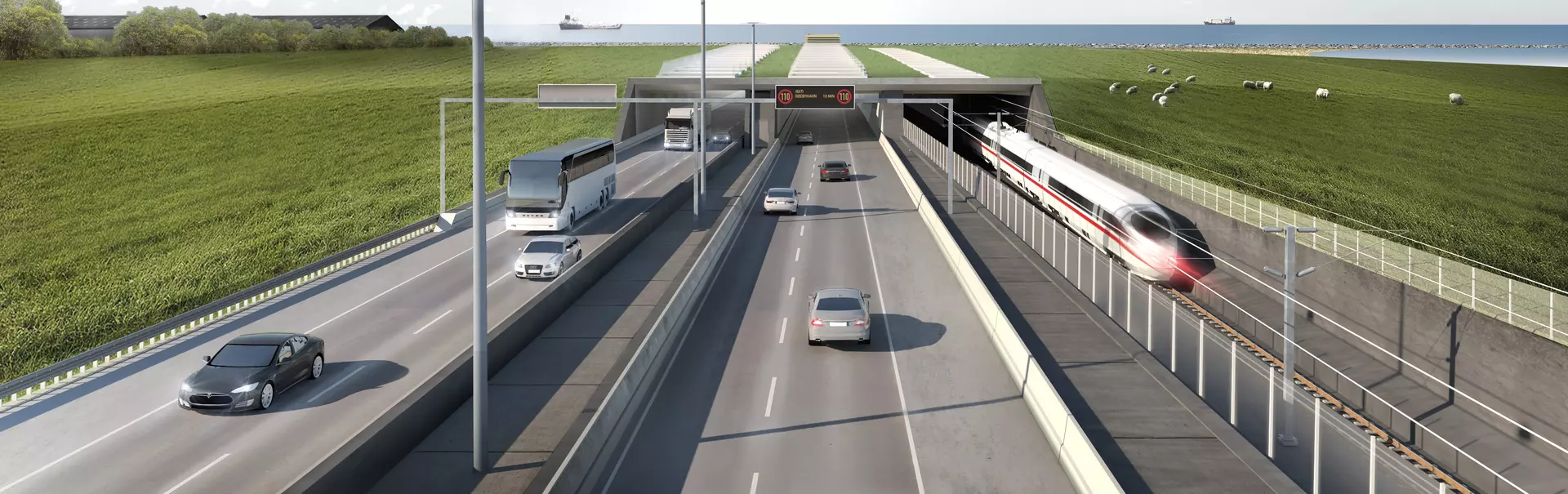
Fehmarnbelt Fixed Link
World's longest combined road-rail immersed tube tunnel, threading the missing link of the Scan-Med corridor.
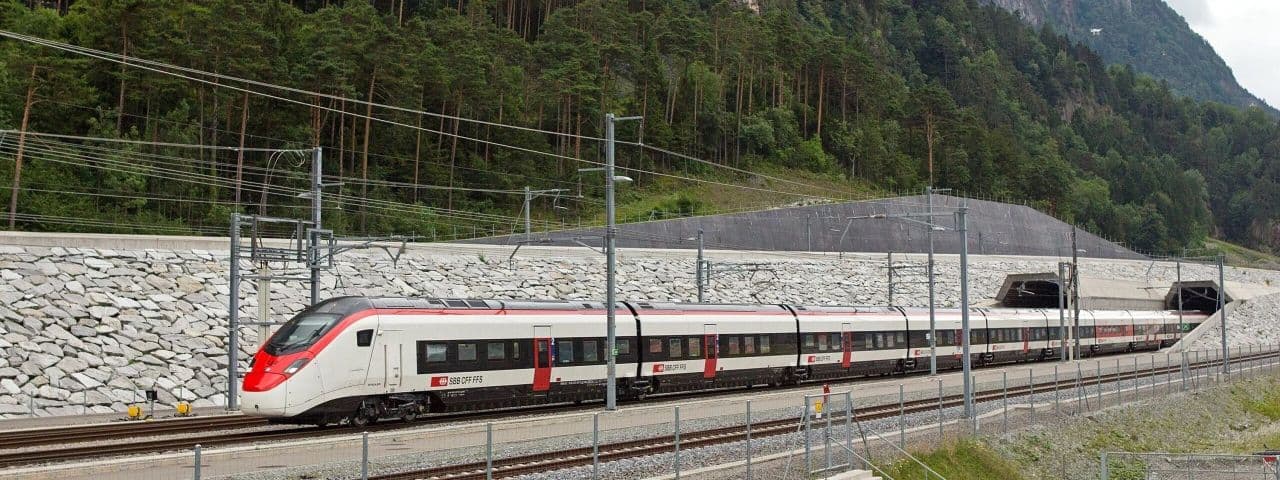
Gotthard Base Tunnel
The world's longest railway tunnel, slicing 57 km flat through the Swiss Alps.
HS2
Britain's most ambitious post-war railway, halved in scope and being rebuilt under a 2026 programme reset.
Spots in This Corridor
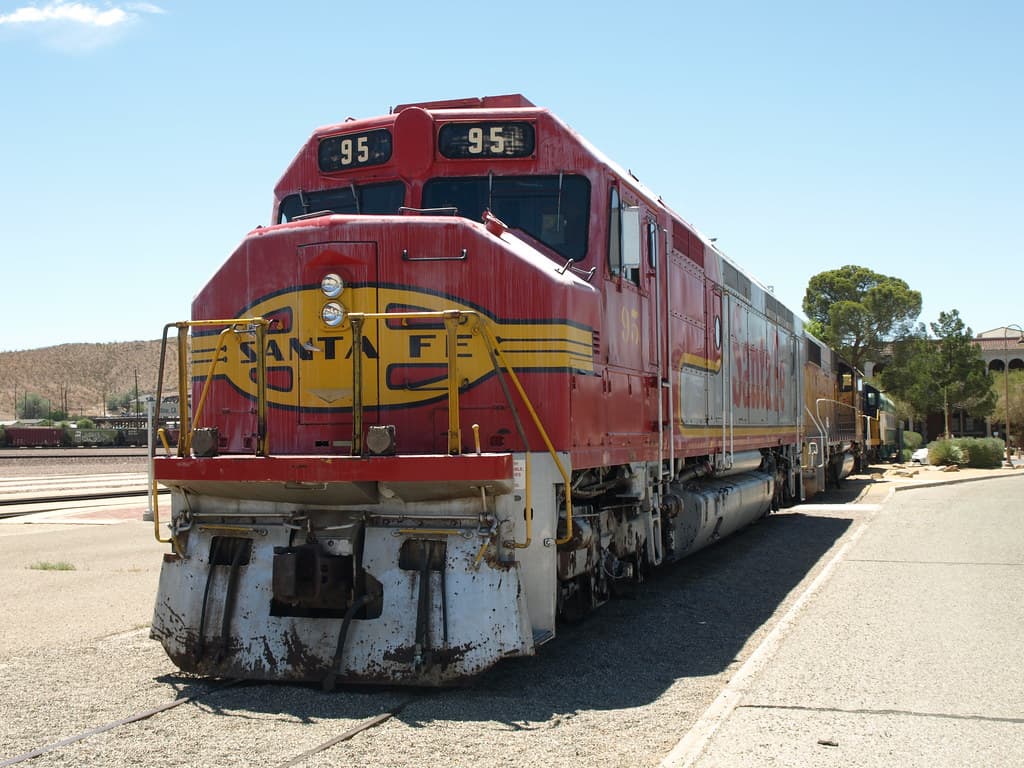

Barstow (Harvey House)
A major BNSF crew change and classification yard in the Mojave Desert, housed at the historic 1911 Casa del Desierto Harvey House — one of the busiest rail junctions in California.
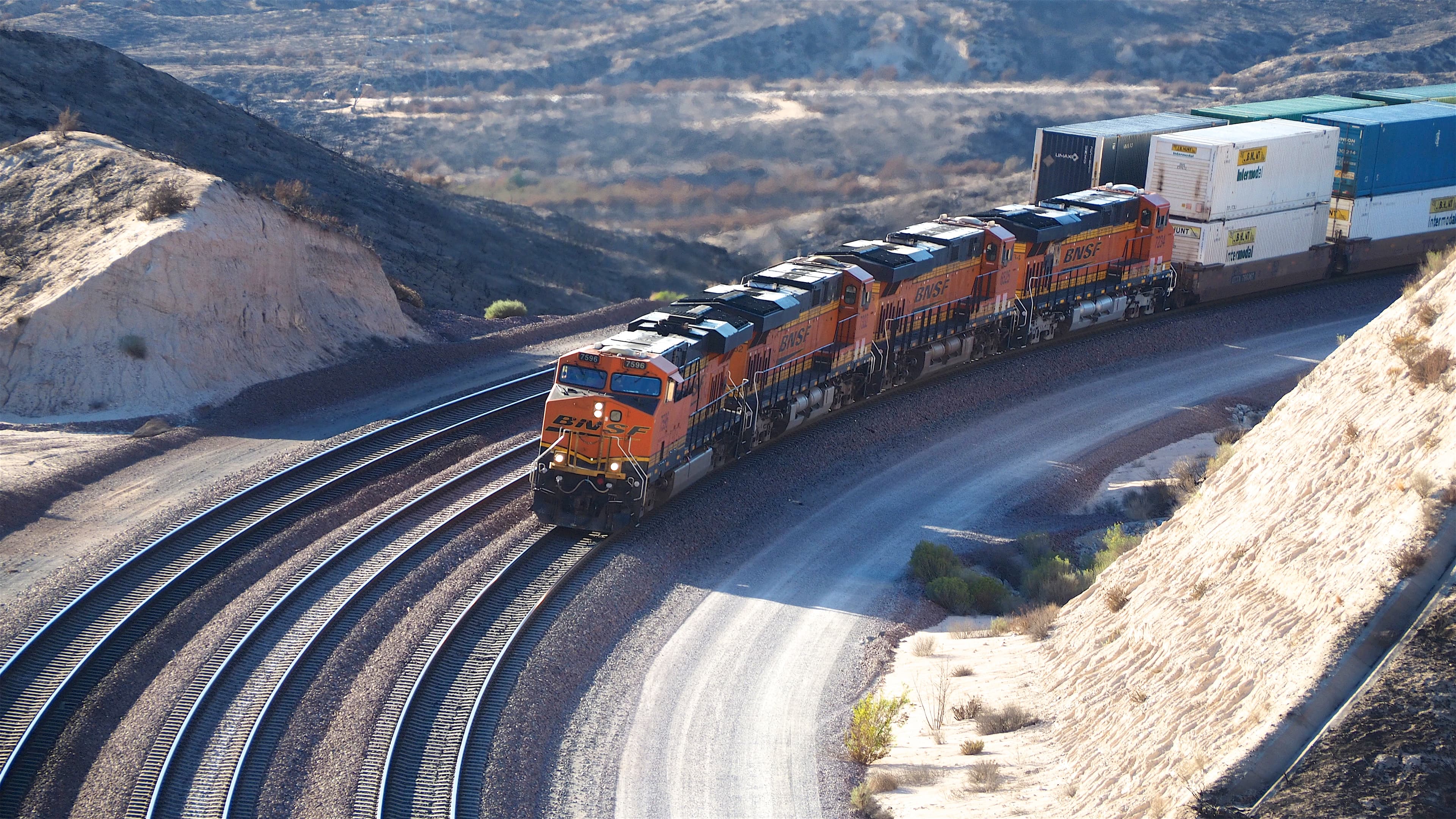
Cajon Pass (Summit)
The busiest mountain railroad crossing in the United States, where BNSF's triple-track Cajon Subdivision and Union Pacific's Palmdale Cutoff funnel roughly 90 trains per day through a dramatic desert canyon between the San Bernardino and San Gabriel Mountains.
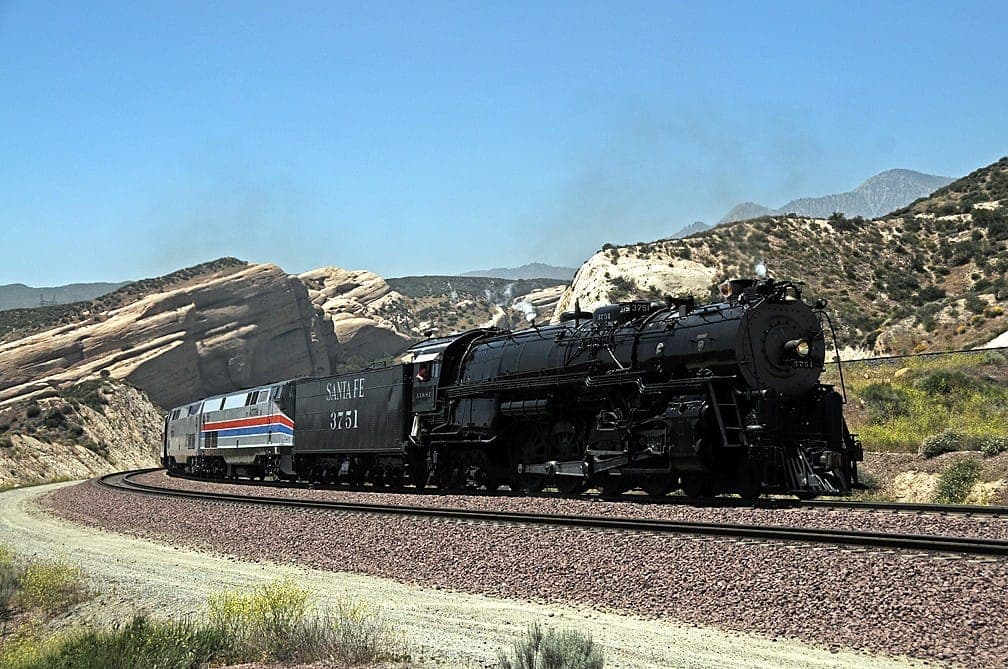
Sullivan's Curve
One of the most iconic railfan locations on BNSF's Southern Transcon. Sullivan's Curve offers close-up views of 90+ daily BNSF and UP trains climbing Cajon Pass at the 2.2% grade, with the dramatic Mormon Rocks as backdrop.
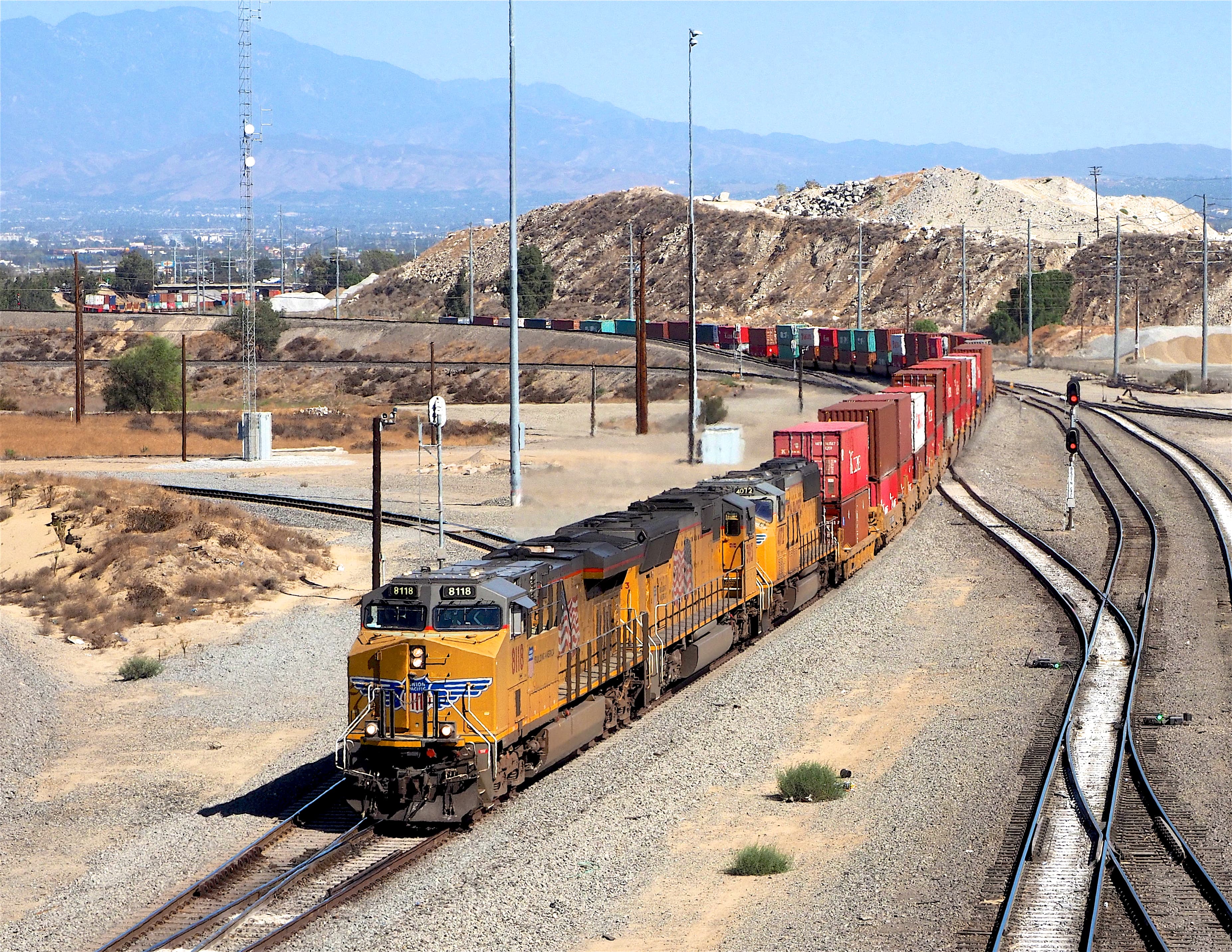
Colton (Colton Crossing)
Historic junction where Union Pacific's Sunset Route crosses BNSF's Southern Transcon in Colton, California. Built in 1883, the crossing saw over 110 trains daily before a $93-million flyover was completed in August 2013, lifting UP tracks 35 feet above BNSF.
Related Experiences & Journeys
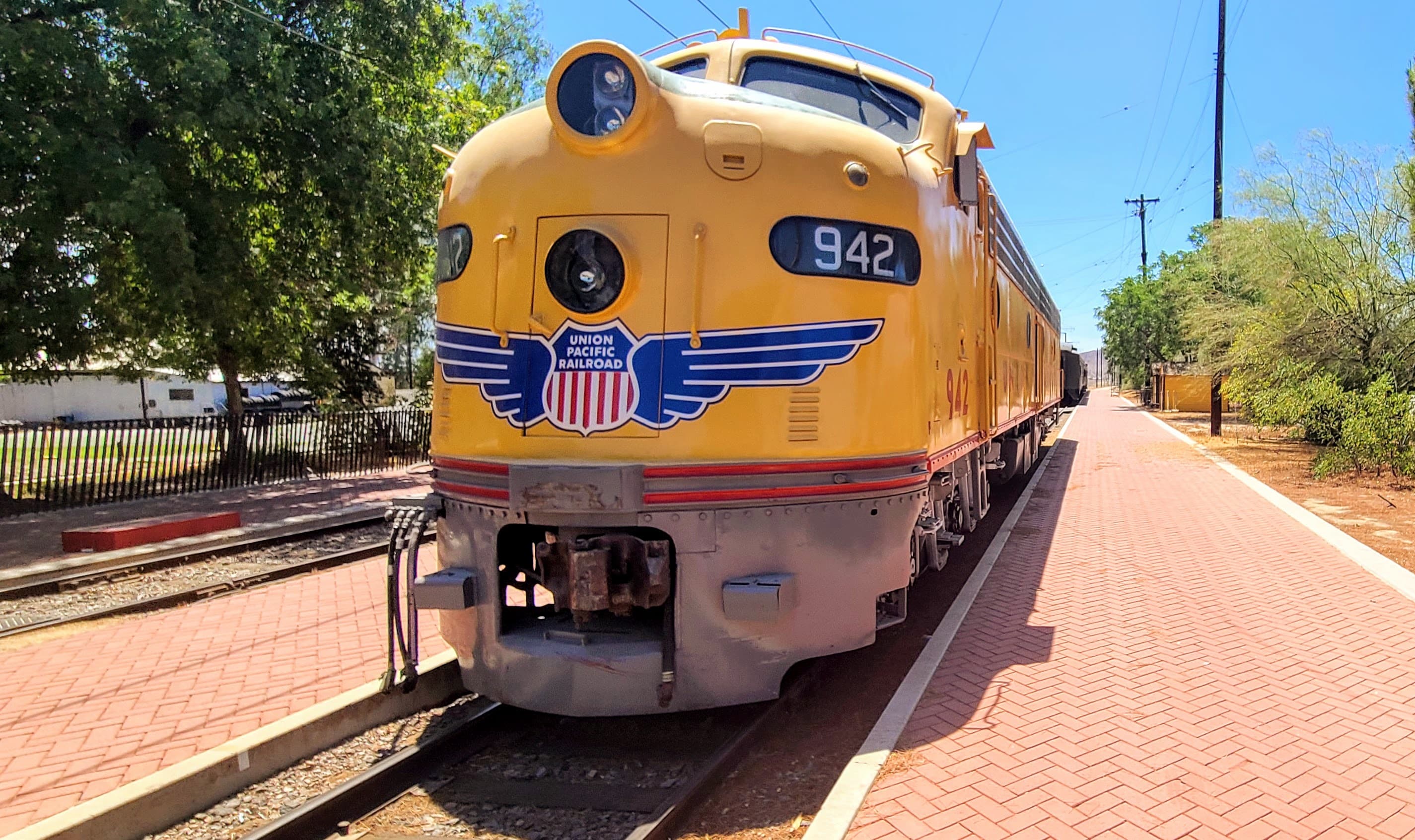
Southern California Railway Museum
Perris museum with 200+ historic trains and trolleys, weekend rides, and the world's largest Pacific Electric Railway collection.
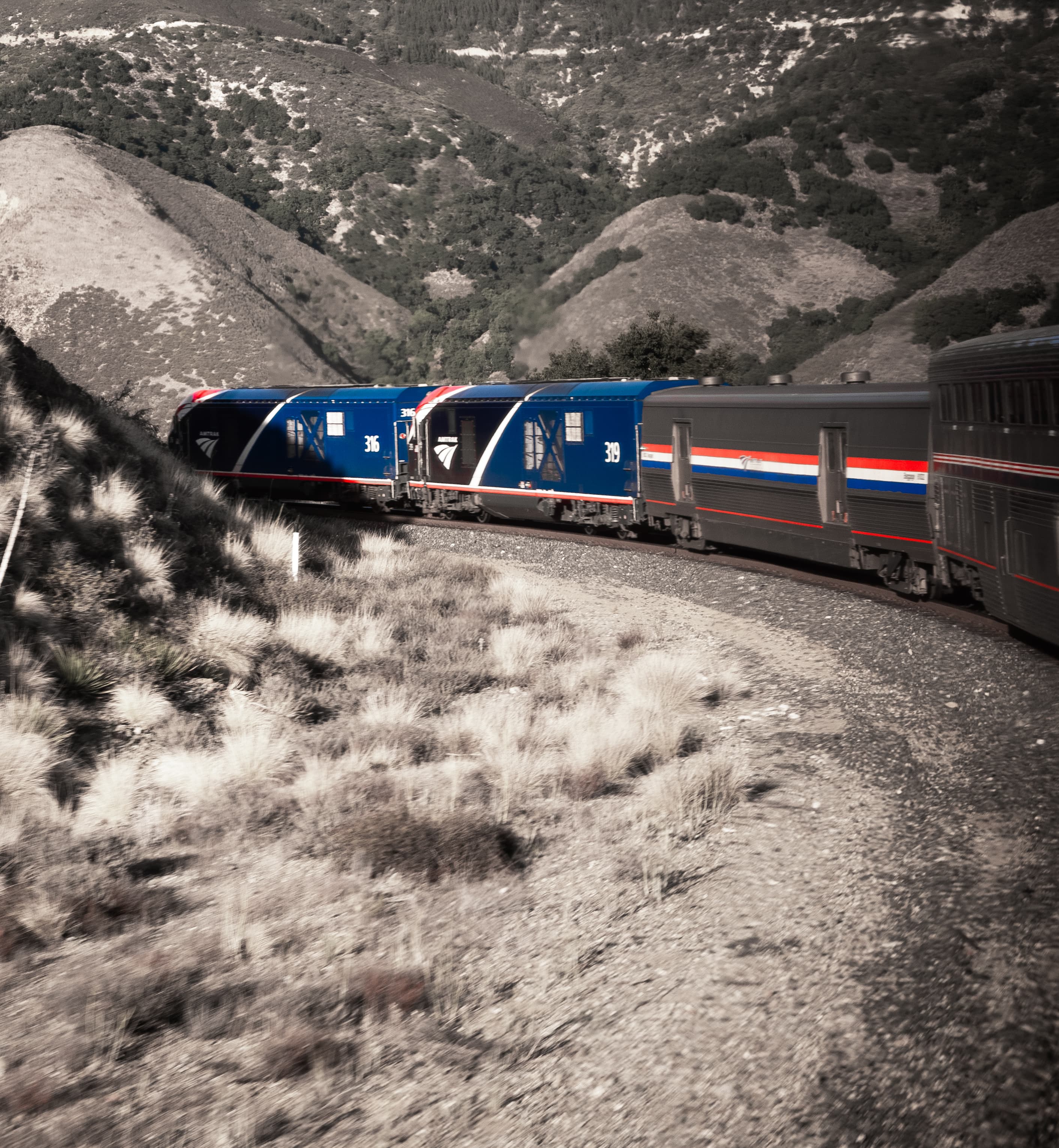
Coast Starlight
Seattle to Los Angeles in 35 hours: Cascade summits, Mount Shasta and 104 miles of Pacific shoreline
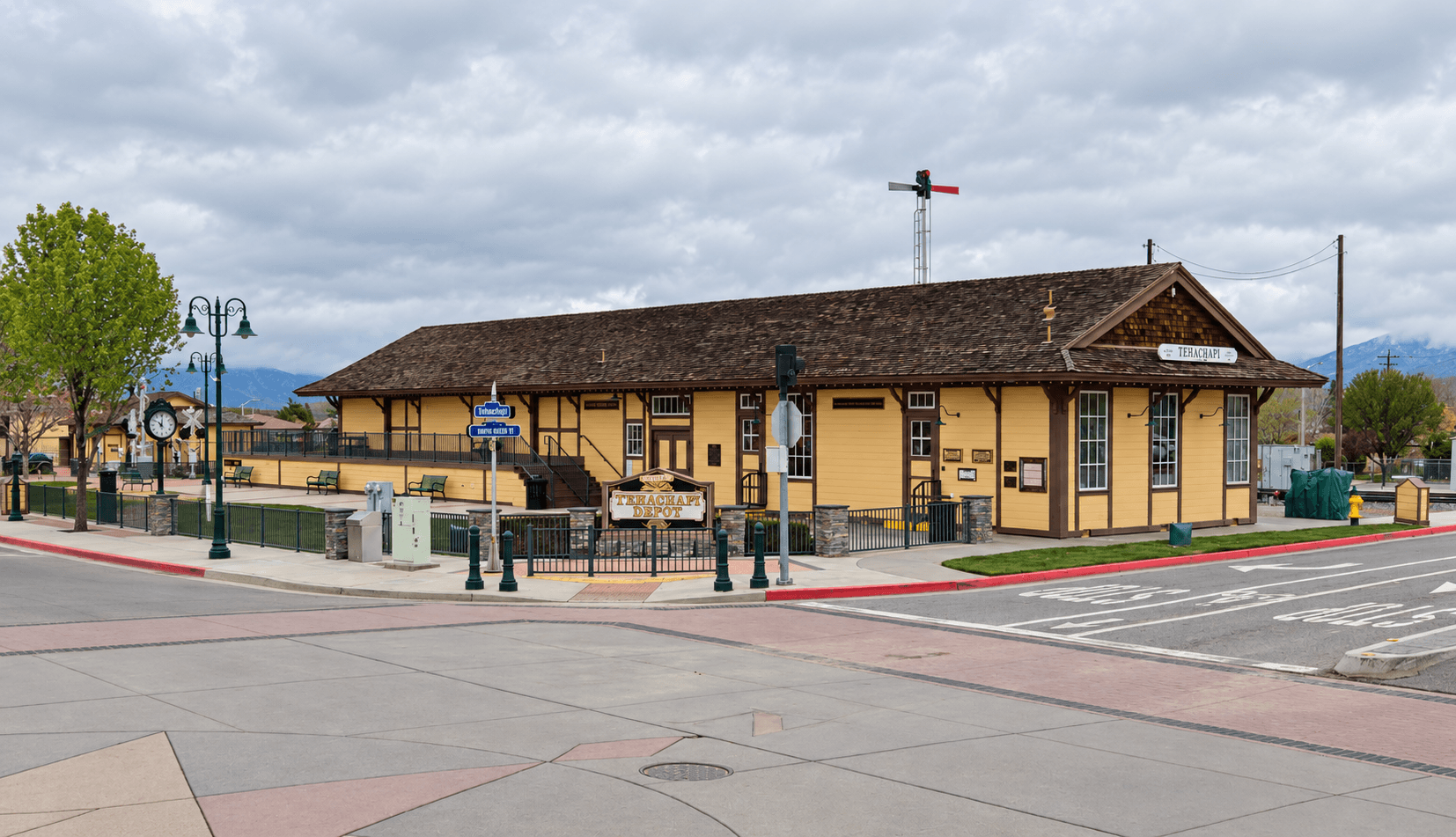
Tehachapi Depot Railroad Museum
A faithfully rebuilt 1904 Southern Pacific depot at the top of the Tehachapi Pass, run entirely by volunteers and free to enter, with the Union Pacific main line crossing the street a few steps from the door.
Explore around this project
9 places on Spotatrain within 25 km of this project — 4 spots and 5 live cams.
- Barstow (California) 1.2 km
- Barstow (Harvey House) 1.2 km
- Barstow, California — PTZ Camera 1.8 km
- Cajon Pass (Summit) 3.1 km
- Cajon Pass, California — Summit and Silverwood 3.3 km
- Sullivan's Curve 6.1 km
- Victorville, California — Trackside Camera 9.5 km
- Daggett, California — BNSF Needles Subdivision 12 km
- Colton (Colton Crossing) 23 km