Spotting Location
Duplainville (CP/CN)
Duplainville is one of the Midwest's most celebrated railfan destinations, where the CPKC double-track Watertown Subdivision crosses the CN single-track Waukesha Subdivision at an at-grade diamond. Located in Pewaukee, Wisconsin, about 15 miles west of Milwaukee, the crossing sees approximately 53 trains per day from two Class I Canadian railroads plus Amtrak's Empire Builder.
Pewaukee, Wisconsin, United States
Verified on October 8, 2026
See everything in Wisconsin7 spots · 24 live cams · 3 experiences · 9 eventsPlan your visit
Coordinates: 43.073571, -88.196832
- Parking
- Free
- Shelter
- None
- Restrooms
- None
Parking: Free — park on Marjean Lane west of Duplainville Road or on Duplainville Road south of the CP tracks. Do not park near the diamond.
- Best times
- Trains run around the clock, but daytime hours offer the best visibility. Morning (7-10 AM) and late afternoon (3-6 PM) typically see concentrated freight movements. The westbound Empire Builder (Train 7) usually passes mid-morning; the eastbound (Train 8) in late afternoon.
- Duration
- 1-3 hours
- Cost
- Free
Where to stand, park and take a break
Before you go — access is not guaranteed
Photo positions show where photographers have stood, not places we have visited. Some may be on private or railway property. Stay on public land and never cross fences, tracks or “No Trespassing” signs: being on railroad property is illegal and dangerous. Parking and restrooms come from official and map sources.
Read our trainspotting safety, law & etiquette guide →Tap a symbol on the map for details.
Take this spot with you — every point in your GPS app, even without signal.
Weather & light
Sun times calculated for this spot’s coordinates.
Seasons
Duplainville is an all-seasons destination. Spring (April-May) brings unpredictable weather but lighter crowds. Summer (June-August) offers the longest daylight hours — essential given the 24-hour train schedule — but expect warm, humid conditions and thick vegetation near the tracks. Autumn (September-October) is the sweet spot: cool temperatures, excellent low-angle light for photography, and occasional fall color along the CN corridor. Winter (November-March) delivers dramatic snow-on-rail photos but can be bitterly cold with windchill; dress in layers and bring hand warmers.
Safety
Stay on public roadways and road shoulders at all times. Do not walk on or near the tracks — trains approach quickly and quietly from both directions at this crossing. CP Police actively patrol the area and will cite trespassers. All nearby industrial lots are posted No Trespassing. When photographing from the Duplainville Road grade crossing, stay behind the gates and warning signals. Be aware that this is a double-track CP main with additional CN traffic — trains can approach from any of three directions simultaneously.
Trains here
Through trains per day
24reported to the FRA — Waukesha Subdivision only
More than one line meets here. This count covers the Waukesha Subdivision alone — each other line is counted separately below.
Daytime
12
6 AM – 6 PM
≈ 1 every 60 min
Nighttime
12
6 PM – 6 AM
≈ 1 every 60 min
Other lines here
- Watertown Subdivision21 trains/day (FRA 390524K, 150 m)
Reported by the railroad for FRA grade crossing 692236B, 140 m from this spot (FRA inventory, July 2026). An estimate, not a schedule.
- Track at the crossing
- 1 main track · 40 mph timetable speed
Train types
What runs here
Two Class I railroads share this diamond, producing a combined total of roughly 53 trains per day:
CPKC (Watertown Subdivision): About 25 trains daily on the east-west double main. Traffic consists of double-stack intermodal, grain and ethanol unit trains, potash hoppers, and mixed manifest freight. Amtrak's Empire Builder (Trains 7 westbound and 8 eastbound) traverses this line twice daily. A local patrol train, CP G64, switches industrial spurs along the subdivision between Portage and Milwaukee.
CN (Waukesha Subdivision): About 28 trains daily on the north-south single main. This corridor handles heavy intermodal traffic, crude oil tank trains, lumber, frac sand unit trains from Wisconsin mines, and general manifest. Locomotive consists frequently feature CN, IC (Illinois Central heritage "Death Star" paint), BCOL, and occasional leased units. The Waukesha Sub runs 148 miles from Fond du Lac, WI south to Chicago, also hosting Metra North Central Service commuter trains on its southern segment.
The diamond was completely rebuilt in the summer of 2020 by CP and CN crews working jointly, with the old interchange track between the two railroads removed in August 2019 to create a staging area.
Passenger trains on this line
- Train 1333, to St. PaulDaily≈ 1:06 PMestimated from Milwaukee, 26 km
- Train 1340, to ChicagoDaily≈ 5:18 PMestimated from Milwaukee, 26 km
- Train 28, to ChicagoDaily≈ 2:39 PMestimated from Milwaukee, 26 km
- Train 8, to ChicagoDaily≈ 2:39 PMestimated from Milwaukee, 26 km
- Train 27, to PortlandDaily≈ 5:03 PMestimated from Milwaukee, 26 km
- Train 7, to SeattleDaily≈ 5:03 PMestimated from Milwaukee, 26 km
Scheduled times from Amtrak’s official timetable, updated October 15, 2026 — trains often run late. Estimated times are worked out along the line from the nearest scheduled stop.
On the line here
FRA / NTAD — crossing inventory Jul 21, 2026 · bridge inventory Oct 14, 2022 · rail yards (FRA / NTAD)
Photos & videos

 Milwaukee beerNut
5

Milwaukee beerNut
5

Milwaukee beerNut
5

Milwaukee beerNut
5

Cr4410
CC BY-SA 4.0

Cr4410
CC BY-SA 4.0

Cr4410
CC BY-SA 4.0
Milwaukee beerNut
5
Swipe to see all 8 photos
Best angles for photos
Vegetation near the diamond has grown significantly in recent years, limiting some formerly open sight lines. The best current vantage points:
From Duplainville Road grade crossing: The closest public viewpoint to the diamond. You can photograph trains on both the CP and CN mains from the roadside. Morning light favors eastbound CP trains (shooting west-to-east). A 70-200mm lens captures locomotive details and diamond action from here.
From Marjean Lane area: Slightly west and south, offering three-quarter views of westbound CP trains. Afternoon light works well here. Use 200-400mm lenses for tight shots of locomotive consists.
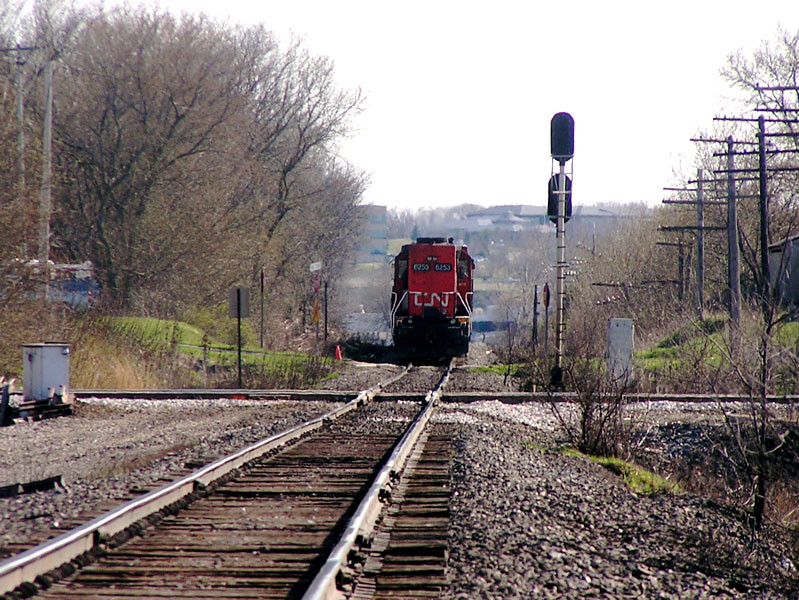
CN corridor from Green Road: Cross the CP double main on Duplainville Road and head east on Green Road to reach the CN main. This angle provides head-on or three-quarter views of northbound/southbound CN trains. Best in morning and midday light.
Be aware that all industrial parking lots near the tracks are posted No Trespassing. Stick to public roadways and road shoulders. A scanner tuned to CP Road (161.100 MHz) and CN Road frequencies is essential for predicting meets at the diamond — the real prize is capturing two trains from different railroads crossing simultaneously.
The full guide
Trainspotting Experience
Duplainville is the only place in Wisconsin where Canadian Pacific Kansas City and Canadian National cross at grade, making it a bucket-list stop for Midwest railfans. The double diamond — CP's two main tracks crossing CN's single main — sits at approximately Milepost 102.2 on the CPKC Watertown Subdivision and Milepost 102.6 on the CN Waukesha Subdivision. With roughly 53 trains per day funneling through this intersection, waits between trains are often short.
To reach the crossing, take Interstate I-94 west from Milwaukee to State Highway F (exit at Waukesha). Head north on Highway F to the third stoplight, just past a Ready Mix plant, then bear right onto Duplainville Road. The CP tracks are about three-quarters of a mile north. Park on Marjean Lane, west of Duplainville Road — do not park near the diamond itself, as CP Police actively patrol and will issue citations. To reach the CN main, continue north on Duplainville Road across the CP double main to Green Road, then head east to the tracks.
The experience is defined by the diamond: the distinctive clatter of wheel flanges hitting the frog, horns blasting at the grade crossing, and the rumble of 12,000-foot intermodals shaking the ground. Trains often slow or stop awaiting clearance, giving you extended time to study locomotive consists. It is common to see trains from both railroads converge on the crossing within minutes of each other.
Landscape, Setting & Local Atmosphere
Duplainville sits on flat to gently rolling terrain in Waukesha County, about 15 miles west of Milwaukee and 3 miles north of Waukesha. The immediate crossing area is a mix of light industrial buildings, scattered residential properties, and open lots along Duplainville Road. There are no dramatic elevation changes — the land is typical southeastern Wisconsin glacial outwash, sitting around 870 feet above sea level.
The surroundings feel semi-rural despite the proximity to Milwaukee's western suburbs. Pewaukee Lake, the largest lake in Waukesha County, lies about 2 miles to the northeast. In winter, the crossing area can be bitterly cold with lake-effect gusts, but snow on the ballast and frosted rail creates stark photographic contrasts. Summer brings warm, humid conditions with long daylight hours. Autumn is arguably the best season: cool temperatures, low-angle golden light, and muted foliage along the CN corridor to the north provide a classic Midwest railroad backdrop.
Historical or Cultural Relevance
The east-west line through Duplainville was constructed in 1855 by the Chicago, Milwaukee, St. Paul and Pacific Railroad (the Milwaukee Road), running from Brookfield to Watertown and eventually extending to Portage. In 1885, the Wisconsin Central Railroad built a line south from Rugby Junction to Chicago, and the two railroads' tracks crossed at what became known as Duplainville.
In 1890, an interlocking tower was erected in the northwest quadrant of the diamond to manage the crossing. That original wooden tower burned down on January 1, 1929, and was replaced by a brick building that served the same function. When CTC (Centralized Traffic Control) was installed and the diamond began being controlled remotely from Milwaukee, the brick tower was finally demolished in 1987. An interchange connection track linking the two railroads was built in the northeastern quadrant of the diamond.
The Milwaukee Road was absorbed by the Soo Line Railroad (a CP subsidiary) in 1985, bringing the east-west line under Canadian Pacific control — now CPKC following the 2023 merger with Kansas City Southern. The Wisconsin Central went through several ownership changes, including a period under Soo Line, before CN acquired it in 2001, bringing the north-south line under Canadian National control.
On May 7, 1956, a serious passenger train accident occurred at Duplainville, one of several incidents at this busy crossing over the decades. The diamond has also been the site of numerous highway-rail crossing accidents, contributing to the installation of modern warning systems.
In the summer of 2020, CP and CN jointly rebuilt the entire diamond crossing — a major engineering undertaking that briefly shut down both main lines.
What Makes This Spot Different
Duplainville stands out as one of the few locations in the United States where two Canadian Class I railroads cross at an at-grade diamond with public access. The CPKC-CN combination means motive power variety that you won't find on Union Pacific or BNSF territory: expect CN's black-and-red "noodle" scheme, IC heritage "Death Star" units, BCOL green, CPKC tuscan red, and frequent run-through foreign power.
The sheer volume — roughly 53 trains per day — means short waits and constant action. The double diamond configuration (CP's two mains crossing CN's single main) adds complexity: dispatchers coordinate meets, occasionally creating the spectacle of trains from both railroads crossing the diamond within moments of each other.
Unlike many urban junctions fenced off or blocked by buildings, Duplainville offers multiple public viewing angles from Duplainville Road and surrounding streets. The location also benefits from Amtrak Empire Builder service, giving passenger train fans two daily opportunities alongside the heavy freight traffic. The 2020 diamond reconstruction attracted railfan attention nationwide and was extensively documented in Trains Magazine.
Frequently Asked Questions
QHow many trains pass through Duplainville per day?
Approximately 53 trains daily: about 25 CPKC trains plus Amtrak 7 & 8 (Empire Builder) on the east-west line, and about 28 CN trains on the north-south line.
QWhere should I park at Duplainville?
Park on Marjean Lane west of Duplainville Road, or on Duplainville Road south of the CP tracks. Do not park near the diamond itself — CP Police patrol the area and issue citations.
QHow do I get to Duplainville?
Take I-94 west from Milwaukee to State Highway F at Waukesha. Go north on Hwy F to the 3rd stoplight (past a Ready Mix plant), bear right onto Duplainville Road, and continue about 3/4 mile north to the CP tracks.
QIs there an admission fee to watch trains at Duplainville?
No. Duplainville is a public road crossing with free access. There are no facilities, restrooms, or shelters — bring your own supplies.
QWhat scanner frequencies should I monitor?
Monitor CP Road frequency (161.100 MHz) and CN Road frequencies for the Waukesha Subdivision. A scanner helps predict meets at the diamond and identify approaching trains.
Help improve this page
Spotted something out of date or incorrect? Let our community know.
Around Pewaukee
6 places on Spotatrain within 25 km of Pewaukee — 1 spot, 4 live cams and 1 event.
Spots Near Pewaukee
More Spots in Wisconsin
Related Experiences
Related Journeys & Mega-Projects
Nearby attractions
- East Troy Railroad Museum30 miles / 48 km
Heritage railroad operating 14-mile round-trip rides on historic electric trolleys and interurban cars on the last remaining segment of the Milwaukee Electric Railway system. Runs weekends May-October with dinner and special event trains.
- Pewaukee Lake2 miles / 3.2 km
The largest lake in Waukesha County, about 2 miles northeast of the crossing. Popular for fishing (known for trophy muskies), boating, kayaking, and lakeside dining. Two public boat launches available.
- Mid-Continent Railway Museum90 miles / 145 km
Living railroad museum in North Freedom, WI operating 50-minute excursion trains on former Chicago & North Western trackage. Features vintage steam and diesel locomotives recreating the Golden Age of railroading.
- National Railroad Museum (Green Bay)118 miles / 190 km
One of the oldest and largest rail museums in the US with over 70 pieces of vintage rolling stock including Eisenhower's WWII command train and Union Pacific Big Boy 4017.
- Old World Wisconsin20 miles / 32 km
Outdoor living history museum in Eagle, WI showcasing 19th-century immigrant life with historic buildings and farmsteads set in the Kettle Moraine landscape of southeastern Wisconsin.
Hotels & places to stay near Pewaukee
Sources & official links
- Duplainville Wisconsin Railfan Homepage (dupyrail.com)www.dupyrail.com
- Duplainville, Wisconsin - Wikipediaen.wikipedia.org
- Reconstructing a Railroad Diamond Crossing - Trains Magazinewww.trains.com
- Watertown Subdivision - Wikipediaen.wikipedia.org
- Waukesha Subdivision - Wikipediaen.wikipedia.org
- Duplainville Photos on Flickrwww.flickr.com
- Duplainville Railfan Guide (railfanguides.us)www.railfanguides.us
- Duplainville on RailPictures.netwww.railpictures.net