
Spotting Location
High Bridge (Kentucky R.)
America's first cantilever bridge, standing 275 feet above the Kentucky River. Norfolk Southern freight trains cross this 1877 landmark 25-30 times daily on the historic CNO&TP Rathole Division.
Wilmore, Kentucky, United States
Plan your visit
Coordinates: 37.817294, -84.720083
- Parking
- Free
- Shelter
- Yes
- Restrooms
- Yes
- Best times
- Freight traffic runs around the clock with no fixed schedule. Weekday mornings and late afternoons tend to see clusters of movements. Allow 1-2 hours for a reasonable chance of seeing multiple crossings.
- Duration
- 1-2 hours
- Cost
- Free — no admission fee or parking charges
Weather & light
Sun times calculated for this spot’s coordinates.
Seasons
Spring (April-May) brings redbud and dogwood blooms along the Palisades with mild temperatures. Summer offers long daylight but can be hot and humid, with breezes from the river valley. Fall (October-November) is prime season — vivid hardwood foliage contrasts dramatically with the bridge's dark steel. Winter reveals the gorge's full geology with bare trees but can be cold on the exposed bluff.
Safety
High Bridge Park provides a safe viewing environment behind railings at the overlook. Stay behind all posted barriers — the 275-foot drop to the river is sheer and unforgiving. The bridge itself is an active Norfolk Southern rail line with no pedestrian access; trespassing on the bridge or tracks is illegal and extremely dangerous. Keep children supervised near the overlook railing. Cell service can be spotty in the gorge.
Trains here
- Railroad
Norfolk Southern — Rathole Division
- Frequency
- 25-30 trains per day
Train types
What runs here
High Bridge carries Norfolk Southern's CNO&TP (Cincinnati, New Orleans & Texas Pacific) line, historically known as the Rathole Division — a nickname earned from the 23 tunnels that once lined the route between Danville, Kentucky, and Oakdale, Tennessee. The 1st District of the CNO&TP, running from Cincinnati south through Lexington and across the bridge toward Danville, sees approximately 25-30 trains per 24-hour period.
Traffic is overwhelmingly freight. The consist mix includes intermodal double-stacks, manifest freight, unit grain trains, and coal loads bound for power plants in the Southeast. Norfolk Southern runs standard road power on this corridor with distributed power units (DPU) common on longer and heavier consists.
There is no passenger service on this line. The last regularly scheduled passenger train was withdrawn from the CNO&TP in 1970. Amtrak's Cardinal takes a different route through Kentucky, so any passenger equipment on this bridge — such as business car specials or office car trains — is a rare event that draws regional railfans.
Traffic is distributed around the clock, with weekday mornings and late afternoons tending to see clusters of movements. Sunday volumes are typically lighter than weekday averages. The Rathole Division was extensively modernized in 1961-1963 at a cost of $32 million, with 25 miles of new rail laid and nine tunnels bypassed, ensuring the corridor remains a vital north-south freight artery.
On the line here
FRA / NTAD — crossing inventory Jul 21, 2026 · bridge inventory Oct 14, 2022 · rail yards (FRA / NTAD)
Photos & videos

 Rsfinlayson
CC BY-SA 4.0
Christopher Wayne Hensley
CC BY-SA 3.0

TheLexingtonTimes
CC BY-SA 4.0
https://www.loc.gov/pictures/item/ky0374.photos.374607p
Public domain
Swipe to see all 4 photos
Best angles for photos
The primary vantage point is the park overlook on the Jessamine County (east) bluff, which provides an elevated, south-facing perspective across the full length of the bridge. From here, a 70-200mm zoom captures the entire 1,125-foot span with river and sky context, while a 200-400mm range isolates individual locomotives on the bridge deck against the Palisades backdrop.
Morning light (8-11 AM) illuminates the east-facing side of northbound trains and catches the bridge's truss details with warm, angular light. Late afternoon (4 PM to sunset) provides dramatic backlighting for southbound movements, with golden reflections off the steel structure and the river below.
The overlook railing is low enough that tripod use is straightforward, and panning shots along the bridge are unobstructed. Video shooters benefit from the 275-foot vertical drop — the scale of trains crossing this gorge translates powerfully on screen, especially with a wide establishing shot followed by telephoto detail of motive power.
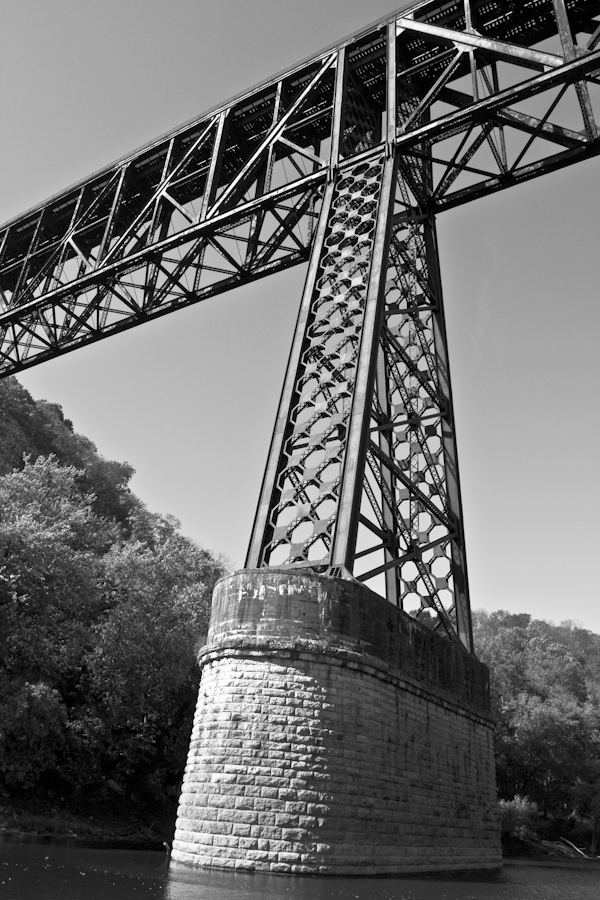
For a lower angle emphasizing the bridge's towering height, trails descend from the park toward the river below. From the riverbank, looking up at the underside of the bridge with a wide-angle lens (16-35mm) creates dramatic perspective shots of the truss structure silhouetted against the sky. Note that these trails are steeper and less maintained than the main overlook path.
The full guide
Trainspotting Experience
High Bridge Park in Wilmore provides direct, legal access to one of the most storied railroad bridges in North America. The park's dedicated overlook, reached via a short paved path from the free parking lot off Old Park Road (KY-29), places visitors just yards from the Norfolk Southern main line as it crosses the Kentucky River gorge. Trains emerge from the tree-lined approach on the Jessamine County side, roll onto the 1,125-foot steel span, and traverse the gorge at moderate speed — the bridge's curvature and grade keep speeds well below main-line maximums, giving observers ample time to watch entire consists pass.
The park is open year-round with no admission fee. Amenities include a restored Victorian pavilion with picnic tables, portable restrooms, a playground, and a small museum with historical exhibits about the bridge. The overlook is wheelchair accessible, with a railing that allows clear sightlines without obstructing cameras or binoculars. On weekends, it's common to find other railfans set up with scanners tuned to Norfolk Southern frequencies, tracking approaching trains along the CNO&TP corridor.
A visit of 1-2 hours will typically yield at least one or two train crossings, given the 25-30 daily movements on this line. The sound is remarkable — the open-deck bridge amplifies the rumble of wheelsets against steel, echoing off the limestone walls of the gorge 275 feet below.
Landscape, Setting & Local Atmosphere
The bridge spans the Kentucky River Palisades, a rugged limestone canyon that cuts through the otherwise gentle rolling terrain of central Kentucky's Bluegrass region. The gorge walls rise roughly 275 feet from the river surface, exposing weathered gray limestone cliffs streaked with moss and draped in Virginia creeper. The river below winds through tight bends where the Kentucky and Dix rivers converge just northwest of the bridge, creating a dramatic natural amphitheater.
From the overlook, the view extends both upstream and downstream along the Palisades. In spring, redbud and dogwood blossoms punctuate the dense canopy of oak, hickory, and sycamore that cloaks the gorge walls. Autumn brings vivid hardwood color — reds, oranges, and golds — that contrasts dramatically with the dark steel truss work. Winter strips the trees bare and reveals the full scale of the gorge's geology, including exposed rock strata visible from the bluff.
The park sits on the Jessamine County bluff with open sky to the south and west. Late afternoon light warms the bridge's steel and illuminates northbound train faces. A steady breeze often rises from the river valley, providing welcome relief on humid summer days and carrying the sound of approaching trains well before they become visible.
Historical or Cultural Relevance
High Bridge holds a distinguished place in American engineering history. The project began in the 1850s when the Lexington and Danville Railroad commissioned John A. Roebling — later famous for the Brooklyn Bridge — to design a suspension bridge across the Kentucky River gorge. Financial difficulties halted construction after only the stone towers were completed.
Two decades later, the Cincinnati Southern Railway revived the crossing in 1873, commissioning C. Shaler Smith to design a new bridge using Roebling's existing stone towers as anchors. Smith's innovative solution was a three-span continuous under-deck truss built using the cantilever method — making High Bridge the first cantilever bridge constructed in the United States. The Baltimore Bridge Company erected the 3,654,280-pound iron superstructure in just four months and four days during the winter of 1876-77, at a total cost of $404,373.
The bridge opened for rail traffic in 1877. Its formal dedication in 1879 was attended by President Rutherford B. Hayes and General William Tecumseh Sherman. At 275 feet above the river and 1,125 feet long, it was the tallest bridge above a navigable waterway in North America and the tallest railroad bridge in the world until the early 20th century.
In 1911, Gustav Lindenthal oversaw a complete reconstruction, reinforcing the foundations and rebuilding the bridge around the original structure. To keep rail traffic flowing during construction, the track deck was temporarily raised 30 feet on a trestle. The American Society of Civil Engineers (ASCE) has designated High Bridge a National Historic Civil Engineering Landmark. The small community of High Bridge grew around the rail line, with a station known as "The Towers" operating from 1877 into the early 20th century.
What Makes This Spot Different
High Bridge occupies a rare intersection of engineering heritage and active railroad operations. While many historic 19th-century bridges have been decommissioned or converted to rail-trails, High Bridge remains a working piece of Norfolk Southern's freight network, carrying 25-30 trains daily across the same gorge that challenged engineers 150 years ago. The combination of first-in-America cantilever construction, a presidential dedication, and continuous rail service since 1877 gives this bridge a historical pedigree that few active railroad structures can match.
The viewing conditions are exceptionally favorable. High Bridge Park provides a safe, elevated, publicly accessible overlook directly adjacent to the tracks — no trespassing required, no precarious positions along the right-of-way. The 275-foot vertical drop to the river delivers an immediate sense of scale, and the gorge acts as a natural amphitheater that amplifies train sounds.
The CNO&TP Rathole Division context adds operational interest for railfans exploring the corridor. The route's history of tunnels, Appalachian grades, and heavy freight traffic between Cincinnati and Chattanooga makes it a compelling multi-day railfanning destination, with High Bridge as the signature photo location.
Frequently Asked Questions
QIs there an admission fee to visit High Bridge Park?
No. The park is free to visit with free parking available at the lot off Old Park Road (KY-29).
QHow many trains cross High Bridge per day?
Approximately 25-30 Norfolk Southern freight trains cross the bridge in a 24-hour period, with a mix of intermodal, manifest, grain, and coal consists.
QCan you walk across High Bridge?
No. High Bridge is an active Norfolk Southern freight rail line with no pedestrian access. Trespassing on the bridge is illegal and dangerous.
QIs the park wheelchair accessible?
Yes, the main overlook and park facilities are wheelchair accessible via paved paths from the parking lot.
QWhen was High Bridge built?
The original bridge was designed by C. Shaler Smith and opened in 1877 as the first cantilever bridge in the United States. It was completely rebuilt by Gustav Lindenthal in 1911.
Help improve this page
Spotted something out of date or incorrect? Let our community know.
Around Wilmore
3 places on Spotatrain within 50 km of Wilmore — 1 live cam and 2 events.
Spots Near Wilmore
More Spots in Kentucky
Nearby attractions
- Rail Explorers Bluegrass Division18.6 miles / 30 km
Pedal-powered railbike tours along the Bluegrass Scenic Railroad in Versailles, with views of Young's High Bridge (a different historic bridge) and the Kentucky River valley. 10-mile round trip, about 2 hours.
- Shaker Village of Pleasant Hill12.4 miles / 20 km
National Historic Landmark with 34 original 19th-century buildings on 3,000 acres in Harrodsburg. One of the largest restored Shaker communities in America, with lodging, dining, and river excursions.
- Jim Beam Nature Preserve9.3 miles / 15 km
Kentucky River Palisades hiking trails with towering limestone cliffs and dramatic views of the gorge. Managed by the Nature Conservancy.
- Valley View Ferry15.5 miles / 25 km
The oldest continuously operating year-round ferry in the United States, crossing the Kentucky River since 1785. Free passage for vehicles and pedestrians.
- Palisades Adventures — Kayaking & Canoeing1.2 miles / 2 km
Canoe and kayak rentals based near High Bridge for paddling the Kentucky River through the Palisades, including a scenic trip up the Dix River to Herrington Lake.
Hotels & places to stay near Wilmore
Sources & official links
- High Bridge — Bridges and Tunnelsbridgestunnels.com
- Kentucky River High Bridge — Structure Magazinewww.structuremag.org
- NS CNO&TP First District — Jim Pearson Photographywww.jimpearsonphotography.com
- High Bridge of Kentucky — Wikipediaen.wikipedia.org
- High Bridge — ASCE National Historic Civil Engineering Landmarkwww.asce.org
- High Bridge Park and Historic Bridge — Kentucky Tourismwww.kentuckytourism.com
- High Bridge — HistoricBridges.orghistoricbridges.org
- Southern's Rathole Division — American Railswww.american-rails.com