
Plan your visit
Coordinates: 45.418817, -73.659468
- Parking
- Free
- Shelter
- None
- Restrooms
- Yes
Parking: Free parking at Parc des Rapides
- Best times
- Weekday mornings (6–9 AM) and afternoons (4–7 PM) for Exo Candiac commuter trains. CPKC freight passes at irregular intervals throughout the day.
- Duration
- 1–2 hours
- Cost
- Free
Weather & light
Sun times calculated for this spot’s coordinates.
Seasons
Summer: 20–30°C, long daylight hours, lush vegetation along the shoreline. Fall: cooling temperatures, foliage colour, ideal photography conditions. Winter: river ice, temperatures below -20°C possible, very short daylight windows—dress in layers. Spring: high water levels and strong currents from snowmelt; migratory waterfowl frequent Parc des Rapides.
Safety
Stay on public riverbank trails at all times. Do not approach or attempt to access the bridge structure, which is active CPKC railway property. The St. Lawrence River has strong currents—keep a safe distance from the water's edge. Listen for locomotive horns signalling approaching trains.
Trains here
- Railroad
CPKC, Exo — Montréal Subdivision
- Frequency
- Exo Candiac line: 9 round trips Monday to Friday (weekday peak service). CPKC freight trains operate on this corridor throughout the day and night.
Train types
What runs here
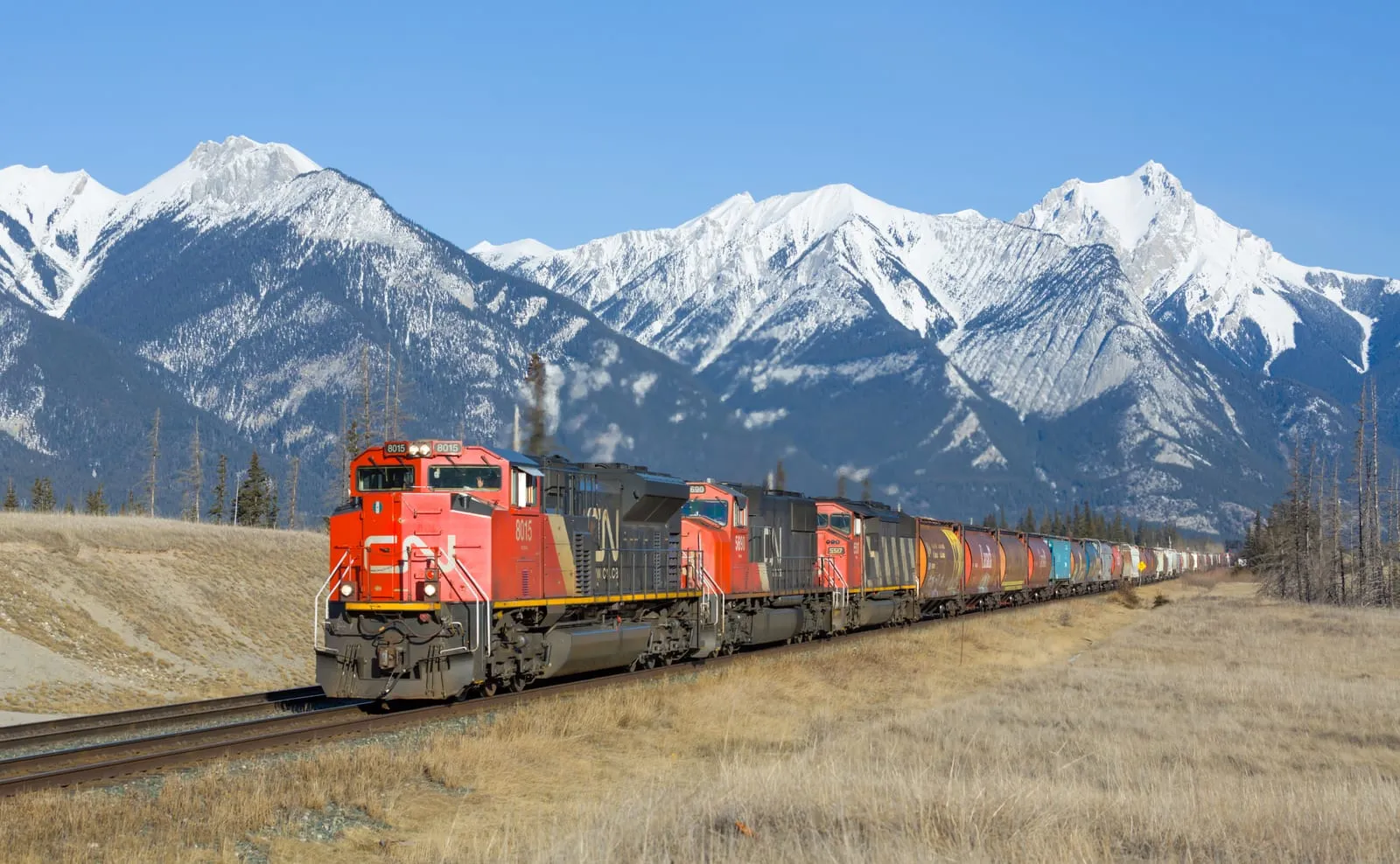
The bridge carries CPKC (Canadian Pacific Kansas City) on its Montréal Subdivision, with regular freight movements including intermodal, grain, and mixed manifest trains. CPKC power on this corridor typically features AC4400CW or SD70 series locomotives. The Exo Candiac commuter line (Ligne 14) also crosses the bridge, operating nine round trips Monday to Friday using either a Bombardier ALP-45DP or a GMDD F59PHI locomotive hauling three to four Bombardier MultiLevel double-deck coaches. Service is weekday-only; weekends see freight traffic only. VIA Rail and Amtrak do not operate via this bridge—their Montréal routes use CN trackage via the Victoria Bridge downstream.
Photos & videos
 Roger Nelson
Attribution-ShareAlike License
Swipe to see all 2 photos
Best angles for photos
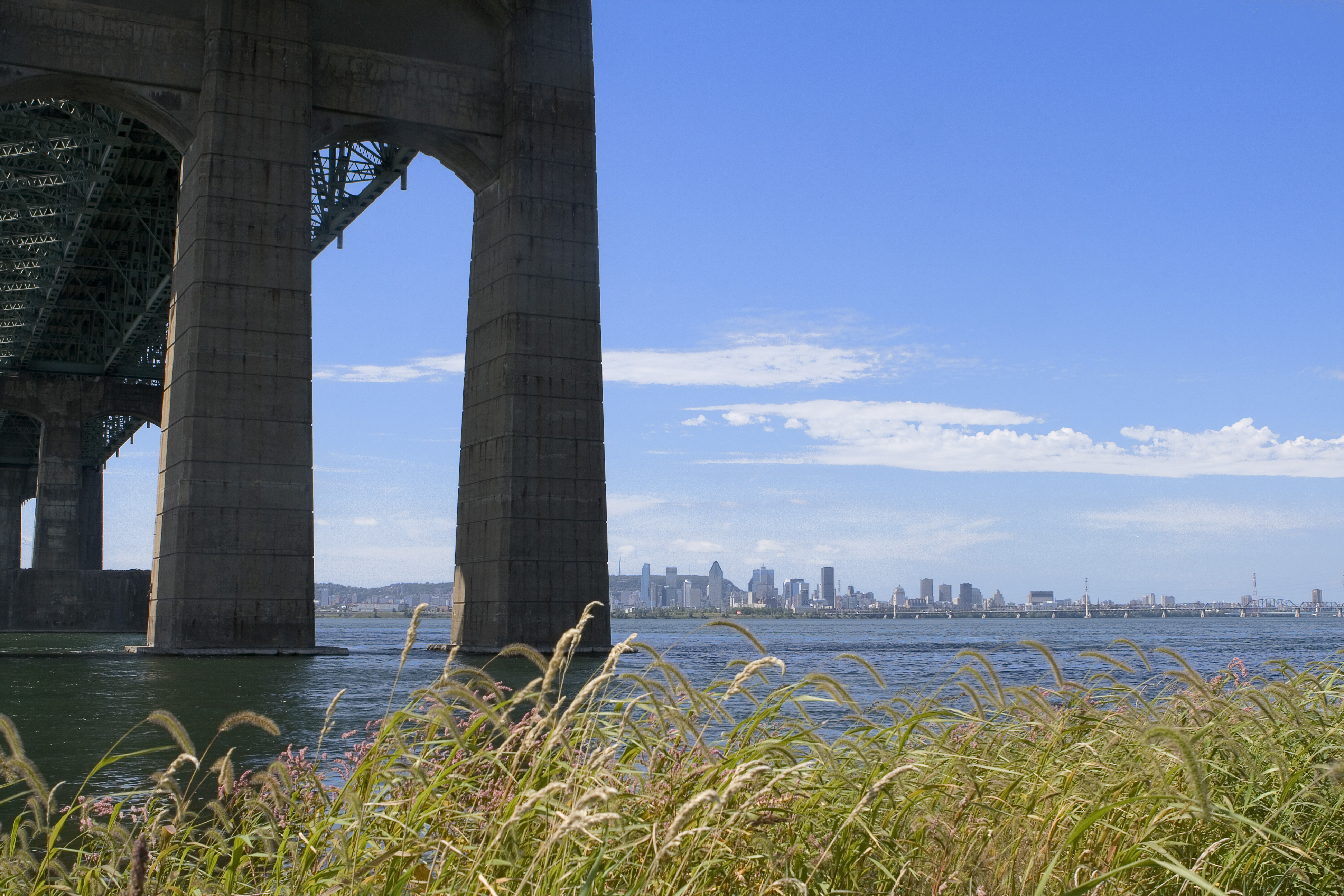
From the LaSalle riverbank in Parc des Rapides, the most productive angle looks southwest toward the bridge portals, where the through-truss framing creates a strong geometric frame around approaching trains. Morning light from the east illuminates northbound consists heading toward LaSalle; afternoon and golden-hour light works better for southbound trains heading toward Kahnawake. A 70–200mm zoom covers the full range from compressed bridge-and-train shots to tight locomotive portraits. The twin vertical lift Seaway bridges, visible roughly 400 m to the south, can be included in wide-angle establishing shots showing the full CPKC corridor. Including the adjacent Honoré Mercier Bridge in the background adds useful scale context.
The full guide
Trainspotting Experience
The best public viewing position is from the LaSalle (north) bank of the St. Lawrence River, accessible via the waterfront trail in Parc des Rapides. From the shoreline path, the two-track Pennsylvania through-truss main spans are clearly visible as trains exit the island. Freight consists are long and heavy, often with multiple CPKC locomotives at the head end. Exo Candiac commuter trains are compact—three to four Bombardier MultiLevel coaches behind a single diesel locomotive—and run on a predictable weekday schedule, making them easy to plan for. The adjacent Honoré Mercier road bridge provides useful orientation; the rail bridge is just upstream (west) of it. On busy weekdays, railfans can expect both freight and passenger movements without long waits. Approximately 400 metres south of the main bridge, a pair of twin vertical lift bridges carries the same rail line over the St. Lawrence Seaway navigation channel—both structures are often visible from the same shoreline vantage point.
Landscape, Setting & Local Atmosphere
The LaSalle waterfront here is an open, green corridor shaped by Parc des Rapides and the broad sweep of the St. Lawrence River. The Lachine Rapids lie just upstream, and the steel truss spans of the railway bridge rise above a shoreline of wild grass, cottonwoods, and rocky riverbank. The Honoré Mercier road bridge runs parallel just to the east, adding a layered industrial skyline against the water. Great blue herons are a common presence in the park—the area hosts over 225 bird species—so birding and railfanning coexist naturally here. Summer is lush and warm; winter brings drifting ice floes under the bridge piers. The sound environment is dominated by river current, distant traffic, and the metallic echo of train wheels on the through-truss spans.
Historical or Cultural Relevance
The CPR built the first Saint-Laurent Railway Bridge between 1885 and 1887, designed by engineer C. Shaler Smith using a flying cantilever design to span the main navigation channel on a single track. The bridge opened for passenger service in July 1887, giving Canadian Pacific an independent St. Lawrence crossing and ending the Grand Trunk Railway's monopoly over river crossings via the Victoria Bridge. Growing axle loads made the original structure obsolete, and the Dominion Bridge Company of Montréal constructed a replacement between 1910 and 1913, completing on November 13, 1913. The new double-track Pennsylvania through-truss structure was erected alongside the still-operational 1887 bridge, eliminating any service interruption. The current bridge has a main span of 408.5 feet (124.5 m) and a total length of 3,660 feet (1,115.6 m). When the St. Lawrence Seaway opened in 1959, a pair of twin vertical lift bridges was added approximately 400 metres south of the main truss spans to carry the rail line over the new navigation channel—a separate structure still in service today.
What Makes This Spot Different
Two distinct railway bridge structures on the same CPKC corridor are visible from the same LaSalle shoreline: the 1913 Pennsylvania through-truss main spans and the twin vertical-lift Seaway bridges built in 1959. Both remain in active service and are rarely seen in combination at other Montréal crossings. The mix of heavy CPKC freight and Exo commuter movements on a double-track line provides varied roster variety from a single fixed viewpoint—long multi-locomotive grain trains alongside compact rush-hour passenger sets—without any need to relocate.
Frequently Asked Questions
QWhat railway companies use Pont Saint-Laurent?
CPKC (Canadian Pacific Kansas City) operates freight trains over the bridge on its Montréal Subdivision. The Exo Candiac commuter line (Ligne 14) also uses the bridge, running nine round trips Monday to Friday.
QWhen was the bridge built?
The current structure was built between 1910 and 1913 by the Dominion Bridge Company of Montréal, completing on November 13, 1913. It replaced an 1887 bridge designed by C. Shaler Smith for the Canadian Pacific Railway.
QWhere can I watch trains from?
Parc des Rapides on Boulevard LaSalle provides waterfront trail access on the north (LaSalle) side of the bridge. The park is free and open year-round with parking available.
QDoes VIA Rail or Amtrak pass over this bridge?
No. VIA Rail and Amtrak use CN trackage via the Victoria Bridge downstream. Pont Saint-Laurent carries CPKC freight and Exo Candiac commuter trains only.
QAre there two bridges on this rail line?
Yes. In addition to the 1913 through-truss main bridge, a pair of twin vertical lift bridges built in 1959 crosses the St. Lawrence Seaway approximately 400 metres to the south. Both are visible from the LaSalle shoreline.
Help improve this page
Spotted something out of date or incorrect? Let our community know.
Around Montréal
5 places on Spotatrain within 25 km of Montréal — 2 spots, 1 experience and 2 events.
Spots Near Montréal
More Spots in Canada
Nearby attractions
- Parc des Rapides0.2 miles / 0.3 km
A 30-hectare urban park along the LaSalle shoreline adjacent to the Lachine Rapids, home to over 225 bird species including great blue herons. The park offers waterfront trails that provide the primary public viewing access for the railway bridge.
- Honoré Mercier Bridge0.1 miles / 0.2 km
An iconic road bridge immediately east of the railway bridge, spanning the St. Lawrence River between LaSalle and Kahnawake. Its presence alongside the rail bridge creates a layered industrial river-crossing panorama popular with photographers.
- Lachine Canal National Historic Site4.3 miles / 7 km
A 14.5-kilometre historic canal and linear park ideal for cycling and walking, stretching from the Old Port of Montréal to Lachine. The canal was built in 1825 to bypass the Lachine Rapids and played a central role in Canada's industrial development.
- Musée de Lachine5 miles / 8 km
A local history museum set in a 17th-century fur trading post, with an outdoor sculpture garden featuring 12 contemporary works. The museum covers Lachine's history as a key node on the St. Lawrence trade route.
- Kahnawake Mohawk Territory1.2 miles / 2 km
The south shore Mohawk community directly across the river from the rail bridge. Kahnawake has a rich heritage connected to the ironworkers (Mohawk skywalkers) who helped build bridges and skyscrapers across North America, including structures in Montréal.
Hotels & places to stay near Montréal
Sources & official links
- Saint-Laurent Railway Bridge – Wikipediaen.wikipedia.org
- Pont Ferroviaire Saint-Laurent – HistoricBridges.orghistoricbridges.org
- Parc des Rapides – Ville de Montréalmontreal.ca
- Exo Line 14 Candiac – CPTDB Wikicptdb.ca
- Saint-Laurent Railway Bridge – Wikimedia Commons Photoscommons.wikimedia.org
- Pont Ferroviaire Saint-Laurent – Wikipédia (fr)fr.wikipedia.org