
Spotting Location
Selma (Rail Junction)
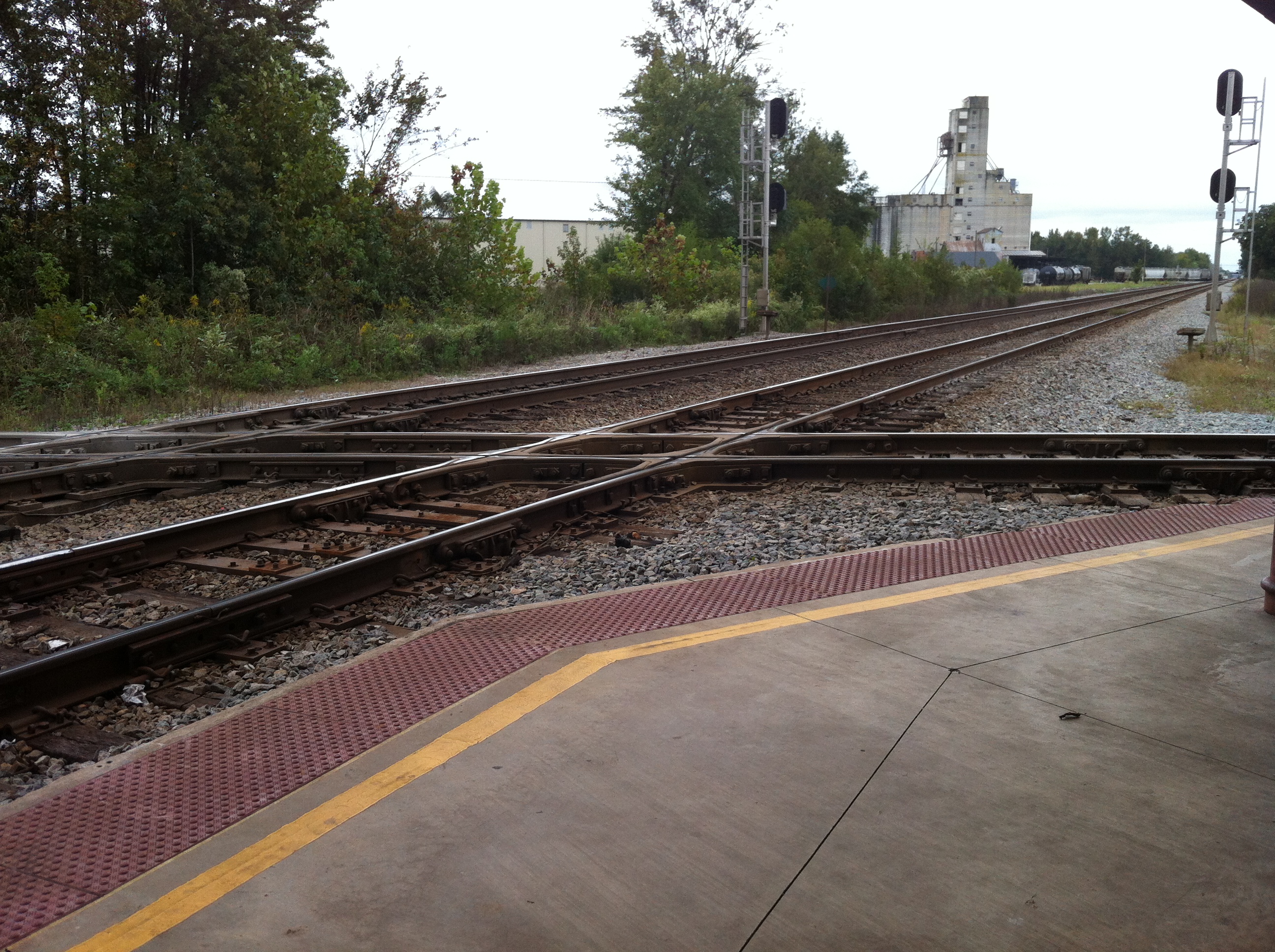
Selma Union Depot occupies the diamond crossing of CSX's A-Line and Norfolk Southern's H-Line. One of five US stations with both N/S and E/W rails, it logs 30–35 trains daily and has served passengers since 1924.
Selma, North Carolina, United States
Verified on October 9, 2026
See everything in North Carolina8 spots · 7 live cams · 2 experiences · 7 eventsPlan your visit
Coordinates: 35.532507, -78.280066
- Parking
- Yes
- Shelter
- Yes
- Restrooms
- Yes
- Best times
- Afternoon (noon to sunset) offers the best light for eastbound and northbound movements. The NS afternoon freight build typically occurs between 2pm and 5pm, generating extra diamond crossings. Amtrak's Carolinian southbound typically passes mid-morning; the Palmetto southbound runs in the afternoon. Early morning fog can create atmospheric shots; sunrise is ideal for backlit northbound CSX approaches.
- Duration
- 1–3 hours
- Cost
- Free. No admission to the station or platform. Parking is free.
Where to stand, park and take a break
Before you go — access is not guaranteed
Photo positions show where photographers have stood, not places we have visited. Some may be on private or railway property. Stay on public land and never cross fences, tracks or “No Trespassing” signs: being on railroad property is illegal and dangerous. Parking and restrooms come from official and map sources.
Read our trainspotting safety, law & etiquette guide →Tap a symbol on the map for details.
Take this spot with you — every point in your GPS app, even without signal.
Weather & light
Sun times calculated for this spot’s coordinates.
Seasons
Spring (March–May): Mild temperatures (60–75°F) and lengthening daylight make this the most comfortable season for extended platform stays. Morning fog occasionally adds drama to early shots.
Summer (June–August): Long daylight extends photography windows past 8pm. Temperatures frequently exceed 90°F — the covered platform provides critical shade, but bring water for repositioning sessions. The downtown Rockin' on Raiford concert series (April–September) adds evening activity nearby.
Fall (September–November): The prime season. Lower humidity, golden afternoon light, and the annual Selma Railroad Days Festival (first full weekend of October) — running since 1975, with model train layouts, classic car show, and local vendors within walking distance of the station — make this the most rewarding time to visit.
Winter (December–February): Mild winters (rarely below freezing) keep the spot accessible year-round. Morning fog is more frequent, creating dramatic backlit conditions on northbound trains at sunrise.
Safety
Remain on the station platform or public sidewalks at all times. The diamond crossing is an active interlocking — never step onto the tracks outside designated grade crossings. CSX trains travel at up to 79 mph through the station zone; approach horns are the primary warning on straight track. Keep children away from platform edges and active track lanes. The parking lot sees vehicle traffic — watch for cars when repositioning for shots. Night photography is feasible from the lit platform but use caution at unlit grade crossings. Trespassing on railroad property is illegal.
Trains here
Through trains per day
17reported to the FRA — A-Line only
More than one line meets here. This count covers the A-Line alone — trains on the H-Line are not included.
Daytime
8
6 AM – 6 PM
≈ 1 every 1.5 h
Nighttime
9
6 PM – 6 AM
≈ 1 every 80 min
Reported by the railroad for FRA grade crossing 633909B, 50 m from this spot (FRA inventory, July 2026). An estimate, not a schedule — crossings on this line within 5 km report 12 to 18.
- Railroad
CSX, Norfolk Southern, Amtrak — A-Line (South End Subdivision) / H-Line (Piedmont Division)
≈ MP 161.1 on the A-Line (South End Subdivision) — derived from FRA grade crossing 633909B, 50 m away
- Track at the crossing
- 1 main track · 25 mph timetable speed
Train types
What runs here
CSX Transportation operates the primary corridor at Selma on the A-Line (South End Subdivision), with approximately 20–25 through freights per day. Observed train symbols include manifest Q438 and Q439 (Rocky Mount–Savannah corridor), priority intermodal Q410 and Q409, expedited merchandise Q141 and Q140, and dedicated UPS trains. Norfolk Southern's H-Line (Piedmont Division) sees two scheduled through freights — trains 349 and 350 running between Linwood and Selma — plus the E50 local, totaling roughly 4–6 NS movements per day; motive power is typically older EMD variants including SD40-2 and GP38-2.
Amtrak provides two round trips daily on CSX tracks: the Carolinian (New York–Charlotte, trains 79 northbound / 80 southbound) and the Palmetto (New York–Savannah, trains 89 northbound / 90 southbound). Combined daily traffic averages 30–35 trains in 24 hours. The NS afternoon build-up at the diamond — when westbound trains stage for the H-Line — regularly generates additional crossing movements beyond the published schedule.
Passenger trains on this line
- Train 52, to LortonDaily3 – 4 AMrough estimate: no stop within 50 km
- Train 53, to SanfordDaily9 – 10 PMrough estimate: no stop within 50 km
- Train 80, to New YorkDaily · changed Oct 17–2210:48 AMdeparts Selma
- Train 1180, to AlexandriaMon, Tue, Wed, Thu, Sat and Sun11:35 AMdeparts Selma
- Train 1179, to RaleighMon, Tue, Wed, Thu, Sat and Sun6:09 PMarrives Selma
- Train 79, to CharlotteDaily · changed Oct 17–226:27 PMarrives Selma
- Train 40, to ChicagoMon, Tue, Wed, Thu, Fri and Sat · changed Oct 16–17 and 19–22≈ 9:48 AMestimated from Raleigh Union Station, 46 km
- Train 41, to MiamiMon, Tue, Wed, Thu, Fri and Sat · changed Oct 16–17 and 19–22≈ 7:05 PMestimated from Raleigh Union Station, 46 km
- Train 90, to New YorkDaily · changed Oct 16–221:09 PMarrives Selma
- Train 89, to SavannahDaily · changed Oct 16–226:03 PMdeparts Selma
- Train 97, to MiamiDaily · changed Oct 16–2212 – 1 AMrough estimate: no stop within 50 km
- Train 98, to New YorkDaily · changed Oct 16–2212 – 1 AMrough estimate: no stop within 50 km
Tap a train for its times.
Scheduled times from Amtrak’s official timetable, updated October 16, 2026 — trains often run late. Estimated times are worked out along the line from the nearest scheduled stop.
On the line here
FRA / NTAD — crossing inventory Jul 21, 2026 · rail yards (FRA / NTAD)
Watch this spot live
A railway webcam covers this location — see what is running right now.
- Watch live
Selma (North)
The north end of Selma’s historic rail junction
Photos & videos

 PLeia2
4

Antony-22
CC BY-SA 4.0

Antony-22
CC BY-SA 4.0

Antony-22
CC BY-SA 4.0

Antony-22
CC BY-SA 4.0
Mikeiamunion21
CC BY-SA 3.0

Mikeiamunion21
CC BY-SA 3.0

Antony-22
CC BY-SA 4.0

Mikeiamunion21
CC BY-SA 3.0
Swipe to see all 9 photos
Best angles for photos
The covered platform is the primary shooting position, offering a clear view of the diamond crossing and both approaches along the CSX A-Line. Morning light (before 10am) favors northbound CSX movements heading toward Rocky Mount; afternoon sun illuminates westbound NS power pulling out of the diamond onto the H-Line. Positioning near the eastern end of the platform provides a broadside angle on NS trains clearing the crossing.
For three-quarter nose shots of southbound CSX trains, stand on the north side of East Railroad Street where the A-Line approaches from the south. A 70–200mm lens handles most platform-to-train distances; a 300mm or longer compresses the background for approaching consists. The station's night lighting supports slow-rolling NS locals; Amtrak consists at speed require a tripod or a fast prime (f/2.8 or wider at ISO 3200+). Grade crossings flanking the station on both sides allow repositioning without crossing active tracks.
The full guide
Trainspotting Experience
Selma Union Depot at 500 East Railroad Street is one of the most accessible railfan spots in the Southeastern United States. The covered station platform runs alongside both the CSX mainline and the Norfolk Southern connection, letting you monitor traffic at the diamond crossing without exposure to sun or rain. Free parking in the adjacent lot provides a direct sightline to the crossing, allowing you to watch from your vehicle between trains.
The diamond junction sits just south of the station building, visible from the platform and the surrounding public sidewalks. NS crews assembling their westbound train in the late afternoon regularly request headroom over the CSX-controlled crossing, producing additional switching moves beyond the scheduled consist. Grade crossings on both sides of the station allow quick repositioning to intercept an approaching train from either direction. The waiting room is open daily 10am–5pm with a station attendant on duty one hour before each Amtrak arrival; restrooms are accessible during open hours. The station is lit at night, making slow-rolling NS locals workable for photographers with a tripod.
Landscape, Setting & Local Atmosphere
Selma sits on the flat, sandy coastal plain of central North Carolina at roughly 165 feet above sea level. The terrain provides unobstructed sightlines along the CSX A-Line — a half-mile of open track is visible from the platform in each direction. The V-shaped 1924 masonry depot, with its two wings meeting at a central two-story signal tower, frames northbound CSX movements on one leg and NS power on the east-west branch. Summers are hot and humid, with afternoon temperatures commonly reaching 90°F; the covered platform provides essential shade. Morning fog periodically settles over the low ground around the junction — particularly in fall and early winter — creating atmospheric conditions when headlights pierce the haze at sunrise. Mature oaks and crepe myrtles line the streets of downtown Selma, but the trackside right-of-way remains open and clear year-round.
Historical or Cultural Relevance
Rail service arrived in Selma with the Mitchner Station in 1855 — still standing a few blocks from the current depot and believed to be the oldest surviving train station in North Carolina. A wood-frame replacement was built at the present East Railroad Street site in 1897 to accommodate growing traffic on both the Atlantic Coast Line's north–south main and the Southern Railway's east–west connection.
The current masonry depot was designed by architect A.M. Griffin and completed in 1924. Its distinctive V-shape — two long wings angled toward each other — was dictated by the diamond crossing of the ACL and SR lines, with a two-story signal tower at the apex where the wings meet. Threatened with demolition in 1975, the city's opposition saved the building; it was added to the National Register of Historic Places on June 24, 1982. Amtrak passenger service resumed on October 31, 1982, when the Palmetto became the first modern-era train to stop at the reopened station. A $3.4 million restoration was completed in 2002, with additional upgrades finished in February 2024.
What Makes This Spot Different
Selma Union Depot is one of only five active Amtrak stations in the United States where a north–south and an east–west main line physically intersect at a diamond — and this diamond is visible from the station platform. Unlike most junction watches requiring trackside access or private property, the entire crossing is observable from public areas: the covered platform, the adjacent free parking lot, and the surrounding downtown streets.
The V-shaped 1924 station building functions simultaneously as an active Amtrak stop and a railroad museum, letting railfans examine historical artifacts inside the waiting room between trains. Motive power variety at a single location is unusual: GE Tier 4 AC units on CSX through freights, older EMD SD40-2 on NS H-Line freights, and Amtrak P42DC or ACS-64 on passenger consists — all within the same afternoon. The quiet small-town setting means approach horns carry clearly from a distance, giving photographers ample preparation time.
Frequently Asked Questions
QWhich trains stop at Selma Union Depot?
Two Amtrak trains serve Selma: the Carolinian (New York–Charlotte, trains 79/80) and the Palmetto (New York–Savannah, trains 89/90). Both run once daily in each direction on CSX tracks.
QHow many trains pass through per day?
Approximately 30–35 trains in 24 hours, including 20–25 CSX freights on the A-Line, 4–6 Norfolk Southern movements on the H-Line, and 4 Amtrak passenger trains.
QIs there parking at the station?
Yes, free parking is available in the station lot and along adjacent streets. The lot provides a direct view of the diamond crossing.
QIs the station open for visitors?
The passenger waiting room is open daily 10am–5pm. A station attendant is on duty one hour before each Amtrak arrival until 30 minutes after the train departs. Restrooms are accessible during open hours.
QWhat makes Selma's junction unusual?
Selma is one of only five active Amtrak stations in the US where a north–south and an east–west main line cross at a diamond. Both intersecting railroads and their trains are visible from the public station platform.
QWhen is the best time of year to visit?
Fall is widely considered the best season — comfortable temperatures, lower humidity, and the annual Railroad Days Festival (first weekend of October), celebrating the town's rail heritage since 1975.
Help improve this page
Spotted something out of date or incorrect? Let our community know.
Around Selma
1 place on Spotatrain within 25 km of Selma — 1 live cam.
- Selma (North) 1 m
Spots Near Selma
More Spots in North Carolina
Nearby attractions
- Selma Railroad Days Festival0.1 miles / 0.2 km
Annual festival held the first full weekend of October, celebrating Selma's railroad heritage since 1975. Features model train exhibits, a classic car show, live music, local vendors, and a festive parade — all within walking distance of Union Depot.
- Mitchner Station (1855)0.25 miles / 0.4 km
Believed to be the oldest surviving train station in North Carolina, this original 1855 wood-frame depot stands a few blocks from Union Depot. A remarkable piece of railroad heritage predating the Civil War, still intact in downtown Selma.
- Downtown Selma Antiques District0.2 miles / 0.3 km
Selma's historic downtown is packed with antique shops including Trackside Antiques, Treasury Antiques, and Barn Shelter Antiques, all within a short walk of Union Depot. Trackside Antiques also sells homemade fudge alongside railroad collectibles and memorabilia.
- The Rudy Theatre0.25 miles / 0.4 km
Historic downtown venue offering four unique family-friendly live shows per year, plus the Rockin' on Raiford outdoor concert series (April–September). A cultural centerpiece of downtown Selma, steps from the station.
- Carolina Premium Outlets9.9 miles / 16 km
Large outlet shopping center in nearby Smithfield with over 80 stores. Convenient for combining a railfanning day trip with shopping; about 10 minutes from Selma Union Depot via US-70.
Hotels & places to stay near Selma
Sources & official links
- Selma Union Depot – Wikipediaen.wikipedia.org
- Amtrak – Selma-Smithfield Station (SSM)www.amtrak.com
- Great American Stations – Selma-Smithfieldwww.greatamericanstations.com
- NC by Train – Selma Station Schedulewww.ncbytrain.org
- Railstream – Selma NC Live Camerarailstream.net
- Johnston County NC – Selma Historic Union Stationwww.johnstoncountync.org
- Selma Railroad Days Festivalwww.johnstoncountync.org
- RailfanLocations – Selma, NCrailfanlocations.weebly.com