

Spotting Location
Dragoon (Texas Canyon)
Dragoon sits at 4,557 feet on Union Pacific's double-track Sunset Route through Arizona's Texas Canyon, where long intermodal trains thread between towering granite boulders at a rate of one to two per hour.
Dragoon, Arizona, United States
Plan your visit
Coordinates: 31.999004, -110.076714
- Parking
- Free
- Shelter
- Yes
- Restrooms
- Yes
Parking: Free parking at Texas Canyon Rest Area and Dragoon Road pullouts
- Best times
- Sunrise through mid-morning for westbound shots with front lighting. Late afternoon golden hour for eastbounds lit against the granite. Midday light is harsh but train frequency remains steady. The Dragoon General Store railcam can help you gauge current traffic before driving out.
- Duration
- 2-4 hours (half day if combining with Amerind Museum trails)
- Cost
- Free (Texas Canyon Rest Area and roadside viewing). Amerind Museum admission $12 adults if visiting trails.
Weather & light
Sun times calculated for this spot’s coordinates.
Seasons
Spring (March-May) offers mild temperatures (60-85°F), blooming desert plants among the boulders, and clear skies — the best overall season. Summer (June-September) brings intense heat above 100°F and dramatic monsoon thunderstorms in July-August that create spectacular cloud backdrops but can make outdoor shooting uncomfortable and briefly flood washes. Fall (October-November) provides the clearest air, comfortable temperatures, and excellent long-range visibility for telephoto work. Winter (December-February) is cool (40-65°F daytime) with occasional overnight frost; rare snowfall on the granite boulders creates extraordinary but fleeting photo opportunities.
Safety
Stay well clear of the double-track main line — trains approach from both directions simultaneously and can be masked by the granite formations until they are very close. The Texas Canyon Rest Area provides safe, fenced viewing. If shooting from Dragoon Road pullouts, never stand between the tracks and the road. Rattlesnakes are present in the boulder fields, especially in warm months — watch where you step and sit. Summer temperatures routinely exceed 100°F; carry at least two liters of water per person even for short visits. Cell service is spotty in the canyon.
Trains here
- Railroad
Union Pacific, Amtrak — Lordsburg Subdivision (MP 1055)
- Frequency
- 1-2 trains per hour, approximately 25-45 per day
Train types
What runs here
Union Pacific operates the Lordsburg Subdivision as a double-track main line from Tucson (MP 987.7) to El Paso (MP 1298.5), with Dragoon Summit near milepost 1055. This is one of the busiest freight corridors in the American Southwest, funneling container traffic from the ports of Los Angeles and Long Beach toward eastern destinations.
The dominant traffic is intermodal — double-stack container trains (often called Z-trains for the premium service or S-trains for standard) that routinely stretch beyond three miles. Mixed manifest freights carrying everything from lumber to chemicals to auto parts make up a significant portion of the remaining traffic. Unit trains of grain, potash, and rock also appear regularly. Total traffic typically runs 25 to 45 trains per day depending on conditions, with the Dragoon General Store railcam showing a fairly steady rhythm of one to two trains per hour during daylight.
Amtrak's Sunset Limited, operating tri-weekly between New Orleans and Los Angeles, passes through without stopping (the nearest station stops are Benson to the west and Tucson farther west). The Sunset Limited typically runs as a single P42 locomotive with Superliner coaches and sleepers — a compact train that looks almost quaint compared to the mile-long freight consists.
Power is predominantly UP's own fleet of AC4400CW, ES44AC, and SD70ACe locomotives, though run-through power from other Class I railroads (BNSF, CSX, NS) occasionally appears on interline traffic.
Passenger trains on this line
- Train 2, to New OrleansFriday≈ 10:11 AMestimated from Benson Amtrak, 28 km
- Train 2, to New OrleansWednesday and Sunday · changed Oct 18 and 21≈ 11:02 AMestimated from Benson Amtrak, 28 km
- Train 1, to Los AngelesTuesday and Thursday · changed Oct 18, 20 and 22≈ 7:10 PMestimated from Benson Amtrak, 28 km
- Train 422, to ChicagoFriday≈ 10:11 AMestimated from Benson Amtrak, 28 km
- Train 422, to ChicagoWednesday and Sunday · changed Oct 18 and 21≈ 11:02 AMestimated from Benson Amtrak, 28 km
Scheduled times from Amtrak’s official timetable, updated October 16, 2026 — trains often run late. Estimated times are worked out along the line from the nearest scheduled stop.
Photos & videos
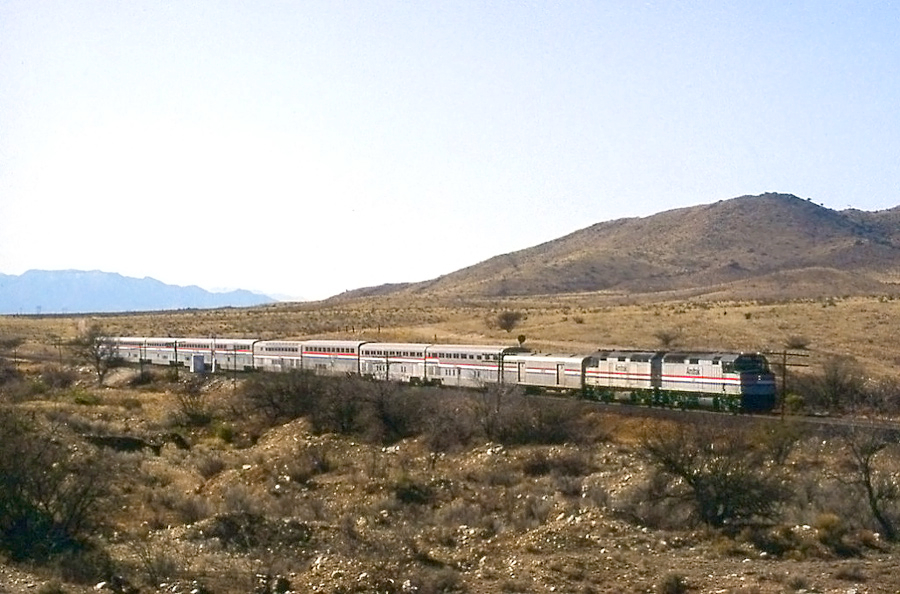
 Clay Gilliland
5
Best angles for photos
The Texas Canyon Rest Area on I-10 eastbound is the most accessible photo position. From the shaded ramadas, a 200-400mm telephoto compresses trains against the granite boulders rising behind the tracks. Morning light illuminates westbound trains head-on from this angle; afternoon light works better for eastbound consists with the boulders backlit in warm tones.
From Dragoon Road (Exit 318 northbound), several pullouts along the road offer elevated perspectives where you can frame trains curving through cuts in the rock. A wide-angle lens (24-70mm range) captures the full geological context — locomotive dwarfed by boulders stacked fifty feet high. The road crosses over or near the railroad alignment, providing both north-side and south-side shooting opportunities.
Near the Dragoon General Store, you can shoot at near-track level for dramatic low-angle compositions of locomotives cresting Dragoon Summit under load. The store area also gives clear sightlines in both directions, useful for catching approaching headlights and setting up before the train arrives.
Light direction: The tracks run roughly east-west through Texas Canyon. Morning sun (east) lights westbound trains; afternoon sun (west) lights eastbounds. The granite formations create interesting shadow play throughout the day, but the harshest midday light (11am-2pm) flattens the boulder textures. Golden hour — roughly the first and last 90 minutes of sunlight — is when the granite glows warmest and photographs best.
The full guide
Trainspotting Experience
Dragoon sits at the summit of Union Pacific's Lordsburg Subdivision through Arizona's Texas Canyon — the second-highest point on the entire Sunset Route at 4,557 feet. The line here is double-track CTC, part of a major east-west artery connecting Southern California ports with New Orleans, Houston, and Chicago via interchange. Expect one to two Union Pacific trains per hour on a typical day, with stack trains often exceeding three miles in length.
The best access is from I-10 Exit 318 (Dragoon Road). The Texas Canyon Rest Area on the eastbound side of I-10 provides paved parking, shade ramadas, restrooms, and a direct sightline to the railroad roughly 200 yards north. From the rest area, you can watch trains emerge from between the massive granite formations that define this corridor. The westbound rest area offers a similar perspective from the opposite side.
For closer access, take Dragoon Road north from Exit 318 toward the hamlet of Dragoon itself. The Dragoon General Store, which operates a live railcam, sits adjacent to the tracks and provides a front-row vantage point. The grades approaching Dragoon Summit steepen to 1.36%, so eastbound trains work their locomotives hard — the deep rumble of GE and EMD prime movers echoing off canyon walls is one of the spot's defining features. Westbound trains descending from the summit often rely on dynamic braking, producing a distinctive high-pitched whine that carries through the rock formations.
Landscape, Setting & Local Atmosphere
Texas Canyon is a geological showcase unlike anything else along the Sunset Route. Massive granite boulders — some balanced improbably atop one another — rise from the desert floor on both sides of the railroad and I-10. These formations have been weathered over millions of years by wind and freeze-thaw cycles, rounding their edges into spheroidal shapes. Several have earned fanciful names: Whale Rock, Sleeping Child, Chinese Idol, and Sheep Rock among them.
The canyon sits in a transition zone between the Chihuahuan Desert to the east and the Sonoran Desert influence to the west, at an elevation where creosote bush, mesquite, ocotillo, and alligator juniper share the slopes. The Dragoon Mountains rise to the southeast (Mount Glenn reaching 7,512 feet), while the Little Dragoon Mountains flank the canyon to the northwest. Spring brings blooming ocotillo and yucca among the boulders; summer monsoon storms create dramatic cloud formations and occasional lightning behind passing trains; fall delivers the clearest air for long-lens photography; and winter can dust the granite tops with a rare frosting of snow.
The atmosphere is one of stark contrast — the industrial scale of modern double-stack trains threading through a landscape that looks like it belongs in a Western film set. Light pollution is minimal, and the canyon acoustics amplify rail sounds in surprising ways.
Historical or Cultural Relevance
The Southern Pacific Railroad pushed its Sunset Route through this stretch of southeastern Arizona around 1880, reaching Tucson on March 20 of that year and continuing east toward New Mexico as part of the nation's second transcontinental link. The route through Texas Canyon was chosen despite the challenging grades because the pass between the Dragoon Mountains and Little Dragoon Mountains offered the most practical crossing of this mountain barrier.
Texas Canyon itself takes its name from a family from Texas who purchased and ranched the land in the 1880s — as more family members followed, the canyon adopted the name. The dramatic granite formations quickly became famous among early railroad passengers; the Southern Pacific marketed the Sunset Route partly on the scenic appeal of passages like this one.
The Amerind Foundation, established in 1937 by amateur archaeologist William Shirley Fulton, occupies 1,900 acres at the mouth of Texas Canyon just one mile south of I-10 at Exit 318. Originally a private research center focused on Native American archaeology, it now operates as a museum, art gallery, research library, and nature preserve. The Texas Canyon Nature Preserve, opened by the Amerind Foundation, offers over 6 miles of hiking trails with trilingual signage (O'odham, English, and Spanish) through the same boulder formations that frame the railroad.
Union Pacific absorbed the Southern Pacific in 1996, inheriting the Sunset Route and investing heavily in capacity improvements. The double-tracking of the Lordsburg Subdivision transformed what had been a congested single-track bottleneck into one of the most fluid freight corridors in the West.
What Makes This Spot Different
What sets Dragoon apart from other desert railfan locations is the geology. Most Southwestern train-watching spots offer open desert vistas — long, flat sightlines where you can see trains approaching for miles. Dragoon offers the opposite: an intimate canyon where massive granite boulders crowd the right-of-way, creating natural frames and scale references that make even 20,000-ton trains look small. The canyon acoustics amplify locomotive sounds, so you hear the train echoing off stone walls in a way that flat desert never provides.
Dragoon Summit is the second-highest point on the entire Sunset Route, meaning eastbound trains are working hard uphill and westbounds are dynamically braking downhill — both producing more sound and visual drama than trains on level track. The Dragoon General Store's live railcam lets you scout conditions remotely before committing to the drive, a practical advantage few railfan locations offer. And the Amerind Museum's Texas Canyon Nature Preserve means you can combine serious railfanning with hiking among the very same boulder formations that backdrop your train photos — making Dragoon a worthwhile full-day destination rather than a quick trackside stop.
Frequently Asked Questions
QHow many trains pass through Dragoon per day?
Union Pacific runs approximately 25-45 trains per day on the Lordsburg Subdivision through Dragoon, typically at a rate of 1-2 per hour. The Dragoon General Store operates a live railcam that can help you gauge current traffic levels.
QIs Dragoon on a single or double track?
The Lordsburg Subdivision through Dragoon is a double-track CTC main line, one of Union Pacific's busiest east-west freight corridors.
QDoes Amtrak stop at Dragoon?
No. Amtrak's tri-weekly Sunset Limited passes through Texas Canyon without stopping. The nearest Amtrak station is Benson, approximately 20 miles west.
QWhere is the best place to watch trains at Dragoon?
The Texas Canyon Rest Area on eastbound I-10 offers the easiest access with parking, restrooms, and shade. For closer views, take Exit 318 north on Dragoon Road toward the Dragoon General Store, which sits adjacent to the tracks.
QWhat is the elevation at Dragoon?
Dragoon Summit sits at 4,557 feet (1,389 m) above sea level, making it the second-highest point on Union Pacific's Sunset Route.
Help improve this page
Spotted something out of date or incorrect? Let our community know.
Around Dragoon
3 places on Spotatrain within 25 km of Dragoon — 3 live cams.
Spots Near Dragoon
More Spots in Arizona
Nearby attractions
- Amerind Museum & Texas Canyon Nature Preserve1 miles / 1.6 km
Founded in 1937, this 1,900-acre museum, research center, and art gallery features Native American archaeology exhibits and over 6 miles of hiking trails through the same granite boulder formations that frame the railroad. Trilingual signage in O'odham, English, and Spanish.
- Kartchner Caverns State Park25 miles / 40 km
A spectacular living limestone cave system with guided tours through formations of stalactites, stalagmites, and other speleothems. Located 9 miles south of Benson. Park admission $10-20/vehicle; cave tours extra.
- Cochise Stronghold15 miles / 24 km
Historic Apache stronghold in the Dragoon Mountains with hiking trails ranging from the easy half-mile Stronghold Nature Trail to the moderate 6-mile Cochise Trail. Popular for camping, birding, and rock climbing.
- Tombstone Historic District40 miles / 64 km
The legendary Wild West town featuring the O.K. Corral, Bird Cage Theatre, Boothill Graveyard, and Courthouse State Park. Daily reenactments and walking tours bring 1880s Arizona to life.
- Dragoon Springs Stage Station Ruins5 miles / 8 km
Ruins of an 1858 Butterfield-Overland stage route station, a 10-15 minute drive from Dragoon. Historic gravesites and remnants of the station walls remain at this little-visited site.
Hotels & places to stay near Dragoon
Sources & official links
- Dragoon General Store Railcamwww.dragoonstore.com
- Dragoon, Arizona - Wikipediaen.wikipedia.org
- Texas Canyon - Wikipediaen.wikipedia.org
- Amerind Museum Official Sitewww.amerind.org
- Dragoon Arizona Community Websitewww.dragoonarizona.com
- Union Pacific Lordsburg Subdivision DVD - 7idea Productionswww.7ideaproductions.com
- Sunset Route - Wikipediaen.wikipedia.org
- Texas Canyon Rest Area - Yelp Reviewswww.yelp.com