Spotting Location
White Rock (Waterfront BNSF)
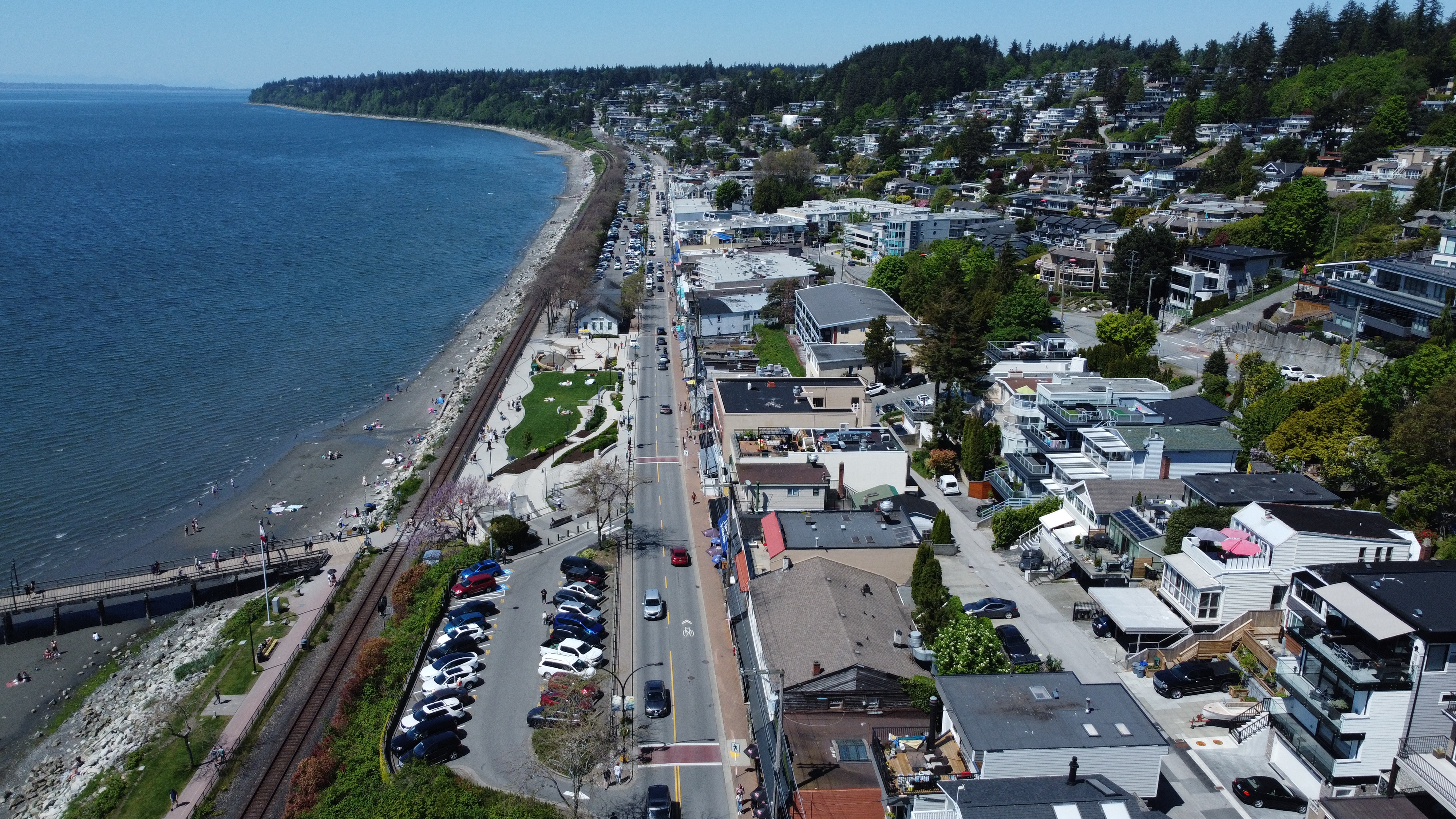
A 2.19-km paved promenade on Semiahmoo Bay puts you within metres of the BNSF Bellingham Subdivision single main — carrying approximately 28 trains daily including Amtrak Cascades and heavy BNSF freight — with Mount Baker rising to the south-east as a backdrop.
White Rock, British Columbia, Canada
Verified on October 8, 2026
See everything in British Columbia9 spots · 2 live cams · 4 experiences · 10 eventsPlan your visit
Coordinates: 49.020993, -122.805701
- Parking
- Yes
- Shelter
- None
- Restrooms
- Yes
- Best times
- Mornings (7–10 AM) for front-lit northbound trains and the first Amtrak Cascades departures of the day. Mid-afternoon (2–5 PM) for southbound trains with sun behind the camera from east-end promenade positions. The promenade is open 24 hours; freight trains run at all hours with no published schedule.
- Duration
- 1–3 hours
- Cost
- Free entry to promenade; paid parking on Marine Drive via PayByPhone (free Nov 1–Jan 31).
Weather & light
Sun times calculated for this spot’s coordinates.
Seasons
Spring/summer (April–September): Peak season for both railfanning and tourism. Long daylight hours — sunset after 9 PM in June — allow extended evening photography sessions. Mount Baker and the San Juan Islands are most visible in clear June and July weather. The promenade is busiest on summer weekends; arrive before 9 AM or use transit (bus connections from Surrey Central SkyTrain station) to avoid parking competition. Wildflower growth along the foreshore adds colour to foreground compositions in May.
Fall (October–November): Reduced crowds, dramatic cloud formations, and storm light. The misty, overcast conditions common in October suit moody, high-contrast compositions. Rain gear is practical but most days remain walkable. Train frequency is unaffected by season.
Winter (December–March): The quietest season for visitors and occasionally the most dramatic for photography. Storm surf, sea mist, and flat grey water provide strong contrast to brightly painted locomotives. Free waterfront parking is available from November 1 to January 31, significantly reducing costs. Snow is rare in White Rock (maritime climate) but possible. The 1913 Great Northern station / White Rock Museum is typically open year-round.
Safety
The BNSF Bellingham Subdivision is a high-traffic, CTC-dispatched main line operating 24 hours a day. Always stay on the promenade side of the 16 safety gates; do not cross the gates or approach the track. Trains on a single-track main can come from either direction — do not assume a gap means no train is coming. Amtrak Cascades trains pass through at line speed without stopping; they are quieter than freight trains and can approach quickly. Keep children supervised near all gate openings. At night, the promenade is lit but train sightlines may be shorter — maintain awareness from both directions.
Trains here
- Railroad
BNSF, Amtrak — Bellingham Subdivision
- Frequency
- ~28 trains per day (4 Amtrak Cascades + ~24 BNSF freight)
Train types
What runs here
The BNSF Bellingham Subdivision — a single-track main line running approximately 191 km (119 miles) from Everett, Washington to Blaine, Washington — carries an estimated 28 trains daily through White Rock. Traffic includes: four Amtrak Cascades trains per day (two northbound toward Vancouver Pacific Central Station, two southbound toward Seattle and Portland), operated with Siemens Charger locomotives; BNSF manifest freight hauling Canadian softwood lumber, paper products, and general merchandise; intermodal stack trains serving Port of Vancouver container traffic; and occasional unit trains of coal and petroleum coke heading north to Roberts Bank export terminal near Delta, BC. The subdivision has been reported at near-capacity utilization since the mid-2000s, so gaps between trains tend to be shorter than railfans accustomed to lower-density lines might expect. Freight trains frequently stretch 8,000–10,000 feet and take two to three minutes to pass a fixed vantage point. All traffic operates under CTC on this territory; no passenger stop exists at White Rock — Amtrak Cascades trains pass through at line speed without stopping.
Passenger trains on this line
- Train 517, to PortlandFriday and Saturday≈ 8:22 AMestimated from Bellingham Amtrak Station, 45 km
- Train 517, to PortlandMon, Tue, Wed, Thu and Sun · changed Oct 18–22≈ 8:50 AMestimated from Bellingham Amtrak Station, 45 km
- Train 516, to VancouverFriday and Saturday≈ 11:29 AMestimated from Bellingham Amtrak Station, 45 km
- Train 516, to VancouverMon, Tue, Wed, Thu and Sun · changed Oct 18–22≈ 11:57 AMestimated from Bellingham Amtrak Station, 45 km
- Train 519, to SeattleFriday and Saturday≈ 5:52 PMestimated from Bellingham Amtrak Station, 45 km
- Train 519, to SeattleMon, Tue, Wed, Thu and Sun · changed Oct 18–22≈ 6:20 PMestimated from Bellingham Amtrak Station, 45 km
- Train 518, to VancouverFriday and Saturday≈ 8:59 PMestimated from Bellingham Amtrak Station, 45 km
- Train 518, to VancouverMon, Tue, Wed, Thu and Sun · changed Oct 18–22≈ 9:27 PMestimated from Bellingham Amtrak Station, 45 km
Scheduled times from Amtrak’s official timetable, updated October 16, 2026 — trains often run late. Estimated times are worked out along the line from the nearest scheduled stop.
Watch this spot live
A railway webcam covers this location — see what is running right now.
- Watch live
White Rock, British Columbia — East Beach Promenade and BNSF Tracks
The seawall promenade at East Beach with the BNSF line running beside it
Photos & videos

 IainCameron
4

IainCameron
4
Northwest
CC BY-SA 4.0

Somar501
CC BY-SA 3.0

Kenny Louie from Vancouver, Canada
CC BY 2.0

R. Sieben
CC BY 3.0
Swipe to see all 6 photos
Best angles for photos
The 2.19-km promenade gives continuous access to the track, but three positions stand out:
Pier base and Museum area: The 1913 Great Northern station (now White Rock Museum & Archives) sits immediately at the foot of the pier, and the track curves gently through this zone. Shooting south-west from near the pier entrance at low tide gives both open water and rail in the same frame, with Mount Baker on clear days. A 24–70 mm lens covers the curve comfortably. Best for northbound trains in the morning.
1,001 Steps Park (foot of 15A Avenue): Descending from Marine Drive gives a slight elevation advantage over passing trains — useful for showing roof detail and context between train and shoreline. The White Rock boulder is occasionally visible in the background. A 70–200 mm lens suits this position well. Access via transit is straightforward from this point.
East promenade (foot of 24th Avenue): The track runs straighter here, enabling telephoto compression — 300–400 mm — with trains set against open water on one side and the seawall on the other. Southbound trains are front-lit in the mid-to-late afternoon.
Fog from Semiahmoo Bay occasionally lingers on early-morning freight moves, creating an atmospheric diffusion layer. The promenade surface is paved and level throughout, making handheld panning viable. For video, the smooth surface allows steady walks alongside passing trains.
The full guide
Trainspotting Experience
The BNSF Bellingham Subdivision runs a single track directly along the Semiahmoo Bay waterfront in White Rock, separated from the 2.19-kilometre paved promenade by a low concrete retaining wall. The City of White Rock and BNSF have installed 16 safety gates at eight promenade entry points — these form the only barrier between the public walkway and the active main line. The track is operated under CTC (Centralized Traffic Control), and railfans watching the signals at each end of town can anticipate approaching traffic from either direction. With approximately 28 daily movements on a single track, gaps between trains are rarely longer than 30–45 minutes, and often much shorter during peak freight windows. Both northbound and southbound trains navigate a gentle curve as they enter the White Rock waterfront section, allowing clean broadside and three-quarter views from most promenade positions. The closest formal access points are the 1,001 Steps Park at the foot of 15A Avenue (with nearby transit) and stairways at the foot of 24th Avenue. The 470-metre White Rock Pier — Canada's longest pier, opened 1914 — provides an elevated lateral vantage point looking back toward the shoreline for trains passing beneath.
Landscape, Setting & Local Atmosphere
The track hugs the shoreline of Semiahmoo Bay — not the open Pacific — placing trains against open salt water for most of the promenade's length. On clear days, snow-capped Mount Baker (3,286 m / 10,781 ft) rises prominently to the south-east, while the San Juan Islands form a layered silhouette to the south-west. The foreground shifts with the tides: at low water, tidal flats extend toward the international border and wet sand reflects locomotive paint; at high tide, water reaches close to the retaining wall, compressing the scene into a dramatic rail-and-sea composition. Marine Drive runs above and parallel to the promenade, lined with cafés, restaurants, and shops. The 470-metre White Rock Pier juts into the bay near the centre of the waterfront, providing a secondary vantage point with oblique views of passing trains from above. Lighting is best in the morning for northbound (south-east-facing) moves and in late afternoon for southbound trains viewed from the east end. Winter brings dramatic cloud formations and low, diffused light suited to moody colour or black-and-white work; June and July evenings deliver golden-hour windows extending well past 9 PM.
Historical or Cultural Relevance
The railway at White Rock traces its origins to James J. Hill's expansion into British Columbia. Hill's first BC line, the New Westminster & Southern Railway, opened 14 February 1891 — the first international rail line west of Winnipeg — connecting the south shore of the Fraser River to the American border at Blaine, Washington. In 1909, the Great Northern Railway rerouted its main line to follow the Semiahmoo Bay shoreline, opening the scenic "sealine route" through White Rock and Crescent Beach to New Westminster. This waterfront alignment directly triggered White Rock's development as a seaside resort. A dedicated station building opened New Year's Day 1913, and by that same year the building also housed Canadian Customs — immigration officers were processing an estimated 15,000 to 18,000 travellers per month through the White Rock port of entry. In White Rock's peak passenger era, four trains a day served the town; the three-car Campers Special ran between Vancouver and Blaine from 1911 to 1925. Passenger service to White Rock ceased in 1975. The 1913 Great Northern station building survives today as the White Rock Museum & Archives, situated directly beside the pier — making it one of the few places in western Canada where railfans can examine a railway's founding infrastructure while simultaneously watching its freight descendants roll past outside.
What Makes This Spot Different
White Rock's 2.19-kilometre promenade offers one of the longest stretches of publicly accessible, unobstructed waterfront rail corridor in western Canada. The entire length places visitors within 10–20 metres of the active BNSF Bellingham Subdivision main, with clear sightlines in both directions. The combination of Amtrak Cascades passenger service and heavy BNSF freight — all framed against open Semiahmoo Bay with Mount Baker visible to the south-east — is rarely matched at a location with this level of pedestrian amenity and transit accessibility. The 1913 Great Northern station at the pier head (now White Rock Museum & Archives) adds a direct historical layer: the building that once processed tens of thousands of cross-border rail travellers per month now stands as a museum while modern BNSF freight rolls past its windows. The White Rock boulder — a 480-tonne glacial erratic on the foreshore — and the 470-metre pier (Canada's longest) complete a setting that rewards both railfans and general visitors, making it one of the most accessible and scenically distinctive railfanning locations in the Lower Mainland.
Frequently Asked Questions
QCan I walk the entire promenade alongside the BNSF tracks?
Yes. The 2.19-km White Rock promenade runs parallel to the BNSF Bellingham Subdivision for its full length, separated by a low concrete retaining wall. The City of White Rock and BNSF have installed 16 safety gates at 8 promenade entry points. The promenade is open 24 hours and paved throughout.
QHow many trains pass through White Rock per day?
Approximately 28 trains daily: four Amtrak Cascades trains (two northbound toward Vancouver, two southbound toward Seattle/Portland) plus an estimated 24 BNSF freight trains including manifest freights, intermodal stack trains, and occasional coal/petroleum coke unit trains heading to Roberts Bank.
QDoes Amtrak stop at White Rock?
No. Amtrak Cascades does not stop at White Rock. The nearest Amtrak stops are Bellingham, WA (Fairhaven Station) to the south and Vancouver, BC (Pacific Central Station) to the north. Trains pass through White Rock at line speed without stopping.
QIs there parking at the White Rock waterfront?
Yes. Pay parking is available along Marine Drive via the PayByPhone app, in effect 24 hours a day. Free parking is available from November 1 to January 31. The promenade is also reachable by transit — White Rock has bus connections from Surrey Central Station on the SkyTrain network.
QWhat is the White Rock Museum, and is it worth visiting for railfans?
The White Rock Museum & Archives is housed in the original 1913 Great Northern Railway station, located right beside the pier. It documents the history of White Rock from its Indigenous heritage through its railway-driven development as a resort town, and holds photographs and artifacts from the Great Northern era. For railfans it is a direct link to the corridor's passenger service history.
QWhat freight does BNSF haul through White Rock?
BNSF freight through White Rock includes Canadian softwood lumber, paper products, and general merchandise (manifest trains); intermodal containers destined for Port of Vancouver; and occasional unit trains of coal and petroleum coke bound for Roberts Bank export terminal near Delta, BC.
Help improve this page
Spotted something out of date or incorrect? Let our community know.
Around White Rock
6 places on Spotatrain within 25 km of White Rock — 1 spot, 1 live cam and 4 events.
- White Rock, British Columbia — East Beach Promenade and BNSF Tracks 1.1 km
- Blackie Spit Park 6.3 km
- Monster Express — Fraser Valley Heritage Railway Society 11 km
- Electric Express — Fraser Valley Heritage Railway Society 11 km
- Pumpkin Train — Bear Creek Park Train 15 km
- Scream Train — Bear Creek Park Train 15 km
Spots Near White Rock
More Spots in British Columbia
- Cisco BridgesSpot · Siska, British Columbia
- Ashcroft (Black Canyon)Spot · Ashcroft, British Columbia
- Kamloops (Junction)Spot · Kamloops, British Columbia
- Revelstoke (CP Main)Spot · Revelstoke, British Columbia
- Field Village (CPR Telegraph Building)Spot · Field, British Columbia
- Spiral Tunnels (Kicking Horse)Spot · Field, British Columbia
Related Experiences
Related Journeys & Mega-Projects
Nearby attractions
- White Rock Museum & Archives0.1 miles / 0.1 km
Housed in the original 1913 Great Northern Railway station beside the pier, this museum documents White Rock's history from Indigenous heritage through its railway-driven resort-era development. Essential context for railfans visiting the corridor.
- White Rock Pier0.1 miles / 0.1 km
At 470 metres (1,542 ft), Canada's longest pier juts into Semiahmoo Bay from the foot of the promenade, providing elevated lateral views of passing BNSF trains from above. Originally built in 1914, it is open 24 hours.
- The White Rock Boulder0.1 miles / 0.2 km
The giant glacial erratic that gave the city its name — a 480-tonne white-painted granite boulder on the foreshore, visible from the promenade near the pier. A historic landmark with Indigenous cultural significance.
- Peace Arch Provincial Park3.1 miles / 5 km
Straddles the BC–Washington border approximately 5 km west of the White Rock waterfront. The park offers views of BNSF trains approaching the international boundary crossing and is a recognized railfan photography location on the Bellingham Subdivision.
- Centennial Park0.6 miles / 1 km
City park approximately 1 km from the waterfront offering panoramic views of Semiahmoo Bay. Sports fields, tennis courts, and walking trails with open sightlines toward the same bay backdrop seen from the promenade.
Hotels & places to stay near White Rock
Sources & official links
- Rail in White Rock – City of White Rockwww.whiterockcity.ca
- History of Rail – City of White Rockwww.whiterockcity.ca
- White Rock Museum & Archiveswww.whiterockmuseum.ca
- Amtrak Cascades Schedule & Statusamtrakcascades.com
- BNSF Railway – Official Sitewww.bnsf.com
- White Rock BC Railfanning – Railroad.net Forumrailroad.net
- Bellingham Subdivision – Wikipediaen.wikipedia.org
- White Rock Pier & Promenade – City of White Rockwww.whiterockcity.ca