

Railway Experience
The Railway Museum (Omiya)
JR East's flagship railway museum in Omiya, Saitama, with 36 historic trains, driving simulators and a steam-locomotive turntable.
Updated
About This Experience
The Railway Museum (鉄道博物館, Tetsudō Hakubutsukan), known affectionately as "Teppaku", opened on 14 October 2007 — Japan's Railway Day — in Omiya, Saitama City, as the centerpiece of the JR East 20th Anniversary Memorial Project. It is built and operated by the East Japan Railway Culture Foundation, a non-profit subsidiary of the East Japan Railway Company (JR East). The museum is the direct successor to the Transportation Museum (Kōtsū Hakubutsukan) in Chiyoda, Tokyo, which itself traced its origins to a Railway Museum opened near Tokyo Station in 1921; that Tokyo facility closed in May 2006 ahead of the move to Saitama.
The complex occupies a 19,800 m² (213,000 sq ft) building on a 42,500 m² (457,000 sq ft) site, with roughly 9,500 m² (102,000 sq ft) of display space. A four-storey South Building opened in July 2018 alongside a full renovation of the Main Building, reorganising the museum into five themed "Stations": the Rolling Stock Station, Science Station, Job Station, History Station and Future Station. The Rolling Stock Station is the largest hall, displaying 36 pieces of full-size rolling stock arranged around a working turntable.
Omiya itself is one of Japan's historic railway towns, a junction where the JR Takasaki and Tohoku main lines meet and where the Tohoku, Joetsu and Hokuriku Shinkansen run past the museum's rooftop. The collection traces nearly 150 years of Japanese railway history, from Locomotive No. 1 — the British-built Class 150 engine that ran when Japan opened its first railway between Shimbashi and Yokohama in 1872 — to the 0 Series and later Shinkansen that defined high-speed rail.
Photo Opportunities
Best vantage points: The rooftop "Panorama Deck" garden overlooks real Shinkansen and New Shuttle services passing the museum — bring a zoom lens for moving trains. Inside the Rolling Stock Station, the gallery balcony gives an elevated view over the whole hall and the turntable; the turntable rotation of C57 135 is the signature photo moment. Locomotive No. 1 and the cut-away Mallet are strong detail subjects. Personal photography is generally permitted indoors; tripods and commercial shoots may be restricted — check on arrival.
Featured Video
The Railway Museum in Omiya | 鉄道博物館
Why Visit
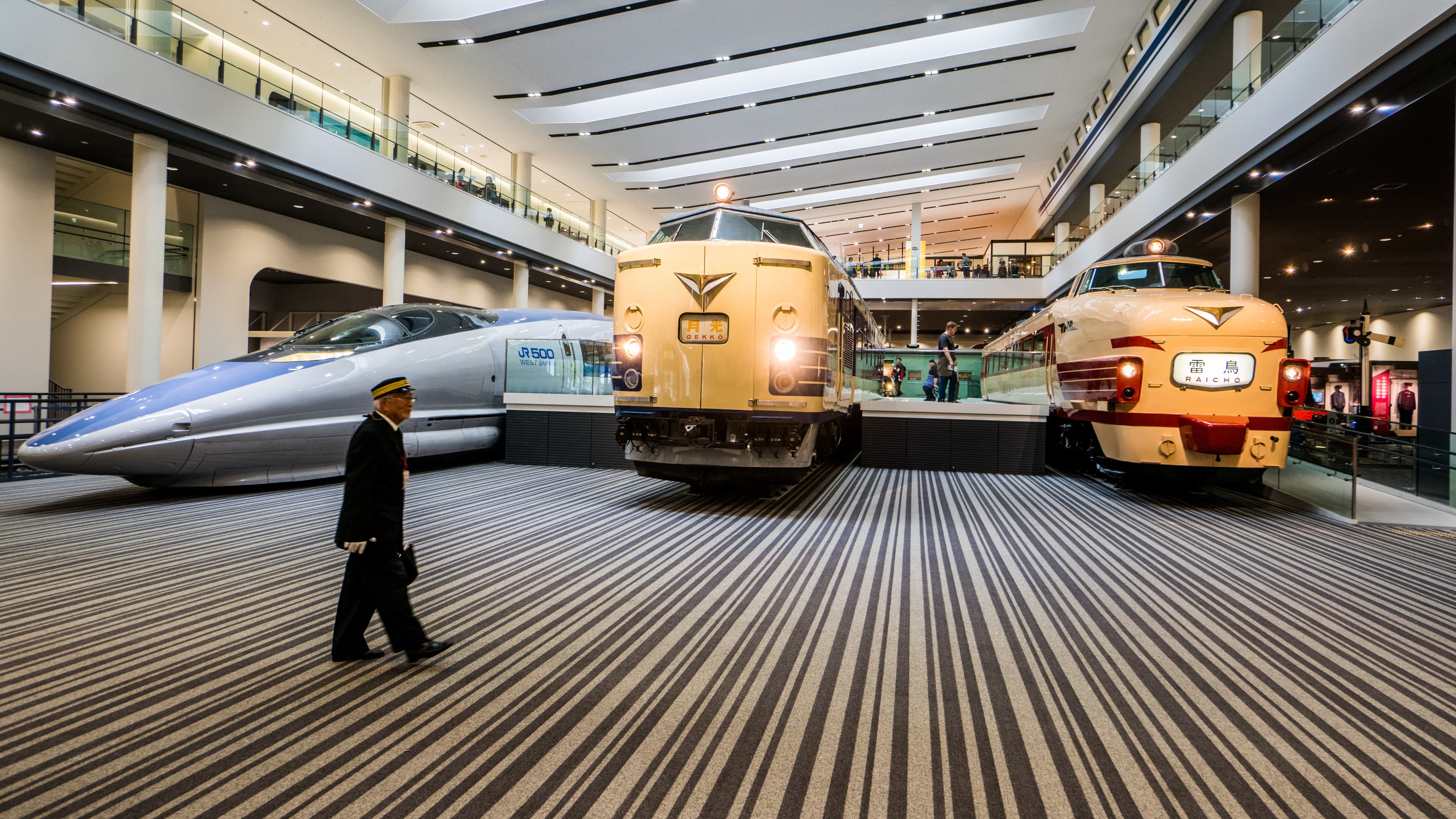
For railfans, the draw is the rolling stock and the simulators. The Rolling Stock Station gathers 36 full-size vehicles spanning steam, electric, diesel and Shinkansen eras. Highlights include the 1872 Class 150 Locomotive No. 1, the JNR Class 7100 No. 7101 "Benkei", a sectioned JNR Class 9850 Mallet locomotive (cut away to show its internal workings), Class C51 No. C51 5 and Class C57 No. C57 135 — the engine that hauled Japan's last scheduled steam service in 1975. Among the electrics are Class EF55 No. EF55 1, the streamlined "Moomin", and Class ED40 No. ED40 10.
The Shinkansen line-up is exceptional: a 0 Series car (No. 21-2), a 200 Series, a 400 Series, an E1 Series double-decker and an E5 Series car, charting the evolution of the bullet train. Rare survivors include several Imperial Carriages (Nos. 1, 2, 7, 9, 10 and 12) once reserved for the Imperial family.
Hands-on driving simulators let visitors operate a D51 steam locomotive, an E5 Series Shinkansen, and commuter trains on the Tokaido, Keihin-Tohoku and Yamanote Lines. The simulators require a same-day reservation (made via in-museum terminals or the museum app) and carry an extra fee; the D51 simulator is suited to junior-high-school age and older.
What to Expect
Plan for roughly two hours minimum, and a half to full day with the interactive exhibits. The museum is busiest on weekends, school holidays and during special exhibitions, so a weekday morning is the calmest time to arrive. The five Stations mix authentic hardware with ICT-driven displays — video, audio and lighting recreate the dynamism of trains in service.
A working turntable in the Rolling Stock Station carries the C57 135 steam locomotive; on a scheduled rotation demonstration the engine is turned and its whistle is sounded, drawing a crowd. (Confirm the daily demonstration time on the official site or museum app, as it can change.) Families gravitate to the miniature train circuit — where visitors can ride and operate small trains — and to a mini-Shinkansen ride.
The rooftop garden and the museum's eateries look directly onto the live tracks: the JR Takasaki Line below and the Tohoku, Joetsu and Hokuriku Shinkansen sweeping past, making the museum itself an excellent active trainspotting vantage point.
Best Time to Visit
Weekday mornings are the least crowded. Avoid Japanese school holidays, Golden Week (late April–early May) and weekends if you want quiet halls and shorter simulator queues. Mid-October coincides with Japan's Railway Day (the museum's founding anniversary on 14 October), often marked by special programming.
Frequently Asked Questions
QHow do I get to the Railway Museum from Tokyo?
Take a JR train to Omiya Station (about 30 minutes from central Tokyo), then transfer to the New Shuttle and ride one stop to Tetsudo-Hakubutsukan (The Railway Museum) Station. The museum is about a 1-minute walk from there. The New Shuttle ride is roughly 3 minutes and about ¥190 one way, and is not covered by most JR passes.
QHow much does admission cost?
Same-day admission is ¥1,600 for adults, ¥600 for elementary/junior-high/high-school students, and ¥300 for children aged 3 and older. Advance online tickets for adults are typically ¥1,500. Driving simulators and some hands-on attractions cost extra.
QWhen is the museum open and closed?
It is open 10:00–17:00 with last admission at 16:30. It is closed every Tuesday and during the New Year period (December 29–January 1).
QHow long should I plan for a visit?
Plan for at least two hours to see the rolling stock and main halls; families and enthusiasts who want to use the simulators and interactive exhibits often spend half a day to a full day.
QCan I drive a train simulator?
Yes. The museum offers driving simulators including a D51 steam locomotive and an E5 Series Shinkansen, plus commuter-line simulators. They require a same-day reservation made at in-museum terminals or via the museum app and carry an additional fee; the D51 simulator is for junior-high-school age and older.
QIs the museum suitable for children?
Very much so. There is a miniature train circuit visitors can ride and operate, a mini-Shinkansen ride, hands-on science exhibits and play areas, plus child-friendly facilities. It is designed as a hands-on museum for all ages.
QWhat are the must-see exhibits?
Don't miss Locomotive No. 1 (the 1872 Class 150), the C57 135 steam locomotive on the working turntable, the cut-away Class 9850 Mallet, the line-up of Shinkansen from the 0 Series to the E5, and the preserved Imperial Carriages.
How to Plan Your Visit
Season and Schedule
The Railway Museum in Omiya operates from 10:00 to 17:00, closing every Tuesday and during the New Year period, with potential extended hours on holidays. Visitors can enjoy rotating special exhibitions, seasonal events, and daily demonstrations, with peak attendance occurring on weekends, school holidays, and during Golden Week.
- Operating Hours
- 10:00–17:00, with last admission at 16:30.
- Closed
- Every Tuesday and the New Year period (December 29–January 1). Hours can be extended during some holiday periods — check the official calendar.
- Special Events
- Rotating special exhibitions are held in the South Building; the museum also runs seasonal and Railway Day (14 October) programming. The C57 135 turntable rotation and whistle demonstration runs on a set daily schedule.
- Peak Season
- Weekends, Japanese school holidays and Golden Week see the highest attendance.
Ticket Information
Admission to The Railway Museum in Omiya is priced for adults, students, and preschool children, with discounts available for groups and an annual passport for unlimited entry. Same-day and advance tickets can be purchased online, with advance reservations recommended, and some attractions may incur additional fees.
- Admission Prices
- Adults ¥1,600; Elementary, Junior High and High School students ¥600; children (preschool, age 3 and older) ¥300.
- Ticket Types
- Same-day tickets and advance tickets are sold; advance online tickets are typically ¥1,500 for adults (¥100 less than the same-day gate price).
- Booking
- Advance reservation is recommended, especially on busy days. Tickets can be purchased through the museum's official online ticketing partner.
- Discounts
- Group rates apply to parties of 20 or more, and an annual "Teppaku Annual Passport" allows unlimited entry for one year. Some hands-on attractions and the driving simulators carry an additional fee (typically around ¥500–600).
Accessibility Details
The Railway Museum in Omiya offers wheelchair access with elevators between floors and step-free routes to the main exhibition halls. Family-friendly amenities include baby and nursing rooms, stroller-friendly layouts, and children's play areas, while assistance dogs are generally allowed with prior confirmation.
- Wheelchair Access
- The museum is a modern, multi-storey facility with elevator access between floors.
- Mobility
- Step-free routes connect the main exhibition halls.
- Family Facilities
- Baby/nursing rooms, stroller-friendly layouts and dedicated children's play areas are provided.
- Service Animals
- Assistance dogs are generally permitted; confirm specifics with the museum in advance. (Verify current accessibility details with the museum before visiting.)
What to Bring
When visiting The Railway Museum in Omiya, wear comfortable walking shoes as the museum is large and multi-level. Bring a camera with a zoom lens for the rooftop deck and turntable, and consider having coins or an IC card for paid simulators and mini-train rides, along with the museum app for reservations and floor navigation; on-site dining options are available, but be mindful of outside food restrictions in certain areas.
- Clothing
- Comfortable walking shoes — the museum is large and spread over several floors.
- Camera Gear
- A zoom lens is useful for the rooftop deck and the turntable.
- Food & Water
- On-site restaurants and a café are available, including dining with track views; outside food rules apply in some areas.
- Family Items
- Coins/IC card for the paid simulators and mini-train rides, and the museum app for simulator reservations and the floor map.
Photography Tips
For great photography at The Railway Museum in Omiya, head to the rooftop garden for live train shots and the gallery balcony for views over the Rolling Stock Station. Optimal lighting is found in daylight on the rooftop, while indoor halls are well-lit for handheld shooting; consider using a fast lens for dim displays and a zoom lens for the rooftop. Utilize the turntable and curved rows of locomotives for depth in your compositions, but be aware that while personal photography is generally allowed indoors, tripods, flash near exhibits, and commercial photography may be restricted.
- Best Vantage Points
- Rooftop garden (live trains), gallery balcony over the Rolling Stock Station, and trackside around the C57 135 turntable.
- Optimal Lighting
- The rooftop is best in daylight; indoor halls are evenly lit for handheld shooting.
- Equipment
- A fast lens helps in the dimmer themed displays; a zoom for the rooftop.
- Composition
- Use the turntable and the curved rows of locomotives for depth.
- Restrictions
- Personal photography indoors is generally allowed; tripods, flash near exhibits and commercial photography may be restricted — confirm on arrival.
Traveling with Pets
Service animals only
Pets are firmly refused: "ペットなどの持ち込みは固くお断りしています" on the prohibited-items page, with assistance dogs — guide, hearing and mobility assistance — excepted throughout the museum. The museum goes beyond the legal minimum by providing a relief area for assistance dogs in the outdoor Teppaku Hiroba zone. No kennel or pet-sitting service is offered.
Verified — operator's pet policy
Travel Information
By Air
The Railway Museum in Omiya is approximately 50 km from Tokyo Haneda Airport, with Narita Airport located farther east. Travelers can reach Omiya Station via airport limousine bus or train from Haneda, with a total travel time of about 1.5 to 2 hours depending on connections.
- Nearest Airport
- Tokyo Haneda Airport (HND) is roughly 50 km (31 mi) away; Narita Airport (NRT) is farther east.
- Ground Transportation
- From Haneda, take the airport limousine bus or train to Omiya Station, then transfer to the New Shuttle.
- Travel Time
- Allow about 1.5–2 hours from either airport depending on connections.
By Train
The Railway Museum in Omiya is easily accessible via Tetsudo-Hakubutsukan Station on the New Shuttle line, just a short walk from the museum entrance. Visitors can transfer from Omiya Station, a major JR East hub, and enjoy scenic connections to various JR lines and Shinkansen services, although the New Shuttle is not included in most JR passes.
- Nearest Station
- Tetsudo-Hakubutsukan Station (The Railway Museum Station) on the New Shuttle (Saitama New Urban Transit) line, a roughly 1-minute walk from the museum entrance.
- Transfer Options
- The New Shuttle departs from Omiya Station, a major JR East hub; the ride is one stop (about 3 minutes, ~¥190 one way).
- Scenic Connections
- Omiya is served by JR lines and the Tohoku, Joetsu and Hokuriku Shinkansen, making it an easy add-on to a wider rail trip. Note: the New Shuttle is not covered by most JR passes (the JR Tokyo Wide Pass is an exception).
By Car
The Railway Museum is located in Omiya-ku, Saitama City, approximately 30 kilometers north of central Tokyo. While visitors can arrive by car, parking is limited, so taking the train is strongly recommended.
- Major Routes
- The museum is in Omiya-ku, Saitama City, north of central Tokyo.
- From Major Cities
- Roughly 30 km (19 mi) from central Tokyo.
- Scenic Routes
- Most visitors arrive by rail; parking is limited, so the train is strongly recommended.
Parking
The Railway Museum in Omiya offers a limited number of paid parking spaces, and visitors are encouraged to confirm rates with the museum. For larger groups, advance arrangements for RVs or buses are necessary, but using public transport via the New Shuttle is the recommended option due to the limited parking availability.
- On-Site
- A limited number of parking spaces are available.
- Cost
- Paid parking; confirm rates with the museum.
- RV/Bus
- Group/coach arrangements should be made in advance.
- Overflow
- Because spaces are limited, public transport via the New Shuttle is the recommended way to arrive.
Local Transportation
The Railway Museum in Omiya is easily accessible via the New Shuttle, which stops directly at Tetsudo-Hakubutsukan Station, just a minute's walk from the museum. Visitors can also take rideshares or taxis from Omiya Station, and while bike rentals are limited, a short walk or New Shuttle ride connects the museum to central Omiya.
- Public Transit
- The New Shuttle from Omiya Station drops visitors at the museum door (Tetsudo-Hakubutsukan Station).
- Rideshares/Taxis
- Available from Omiya Station.
- Walkability
- The museum is a 1-minute walk from its dedicated station; central Omiya is about a 20-minute walk or a short New Shuttle ride.
- Bike Rentals
- Limited; the New Shuttle is the simplest option.
Nearby Lodging
Find places to stay near The Railway Museum (Omiya).
This lodging map is provided by Stay22, a third-party service that may set cookies. It loads only with your consent.
Accommodation results are provided by Stay22; we may earn a commission on bookings made through this map.
Nearby Attractions
- The Omiya Bonsai Art Museum, Saitama2.5 km
The world's first public museum devoted to bonsai, opened in 2010 in the historic Omiya Bonsai Village. Displays masterpiece trees, pots and bonsai-themed woodblock prints. A natural cultural pairing for a day in Omiya.
- Musashi Ichinomiya Hikawa Shrine2.5 km
One of the most important Hikawa shrines in the Kanto region, reached by a long tree-lined approach. The adjacent Omiya district takes its name ("Great Shrine") from it.
- Omiya Park2 km
A large public park beside Hikawa Shrine, ranked among Japan's top 100 cherry-blossom spots and home to open lawns, a pond, a small zoo and the Saitama Prefectural Museum of History and Folklore.
- Saitama Super Arena3 km
One of Japan's largest indoor arenas, near Saitama-Shintoshin Station, hosting concerts and major sporting events. A short hop from Omiya by train.
Photos

 ger531
CC BY 3.0

ger531
CC BY 3.0

Osamu Iwasaki
CC BY-SA 2.0

lienyuan lee
CC BY 3.0

Osamu Iwasaki
CC BY-SA 2.0

kanegen
CC BY 2.0

lienyuan lee
CC BY 3.0

lienyuan lee
CC BY 3.0
More Videos
C57 135 turntable rotation with commentary — The Railway Museum
Turntable rotation & steam whistle demonstration (C57 135) — The Railway Museum
Help improve this page
Spotted something out of date or incorrect? Let our community know.
Explore more experiences: Browse all rail travel experiences.
Booking & Pricing
Price range
$300 – $1600 JPY
Same-day gate prices: adult ¥1,600, student ¥600, child (3+) ¥300. Advance online adult ticket ~¥1,500. Driving simulators and some hands-on attractions cost extra (typically ~¥500–600). Group rates for 20+ and an annual passport are available.
Quick Information
Country
Region
City
Saitama (Omiya)
Best Season
Spring (late March–April) and autumn (October–November) are the most comfortable seasons in the Kanto region for combining the museum with outdoor Omiya sights such as Omiya Park's cherry blossoms or the Omiya Bonsai Village. The museum is fully indoor and climate-controlled, so it is also an ideal rainy-day or mid-summer destination.
Visit Duration
2-3 hours minimum; half to full day with simulators and interactive exhibits
Cost
Adults ¥1,600 (¥1,500 advance online); students ¥600; children (3+) ¥300