Art DecoModel RailwayIndoor
Cincinnati Union Terminal
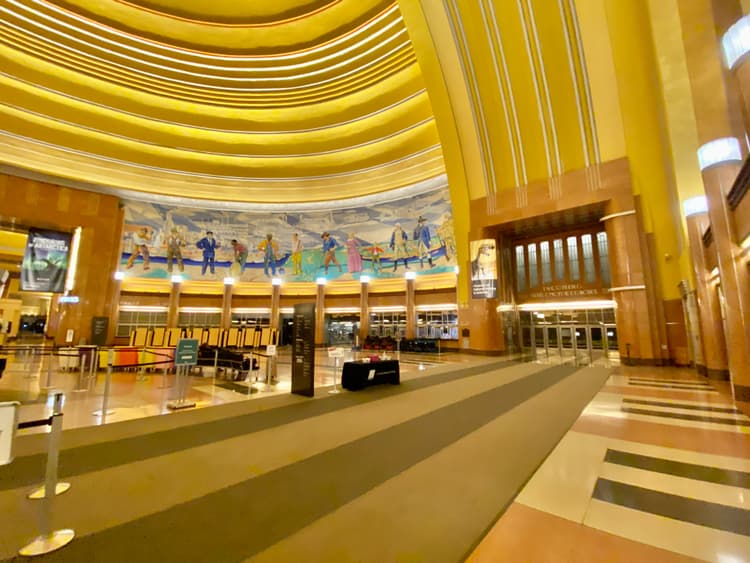
Cincinnati Union Terminal opened in emergency operation on 19 March 1933, when an Ohio River flood forced the city's railroads to abandon their old riverfront depots early; the formal dedication followed on 31 March 1933 in front of an estimated 50,000 people. The building was designed by the New York firm Fellheimer & Wagner, with Roland A. Wank as lead designer and the Philadelphia architect Paul Philippe Cret acting as design consultant between 1930 and 1932. The final project cost reached 41.5 million dollars. Its purpose was consolidation: seven railroads — the Baltimore and Ohio, the Chesapeake and Ohio, the Cleveland, Cincinnati, Chicago and St. Louis (the Big Four), the Louisville and Nashville, the Norfolk and Western, the Pennsylvania and the Southern — gave up five separate stations for one terminal laid out for 216 trains a day, 108 in and 108 out, and 17,000 passengers, across 8 platforms and 16 tracks. The architecture is the reason the building outlived the traffic. Behind the fountain and the ramped forecourt, the half-dome rotunda spans 180 feet (55 m) and rises 106 feet (32 m), and is generally described as the largest half-dome in the Western Hemisphere; the room itself measures roughly 176 by 125 feet (54 by 38 m). Set into the pilasters above the entrance arch is a clock face 18 feet (5.5 m) across, built for the terminal in the early 1930s by Cincinnati's own Verdin Company — its hour hand weighs about 150 pounds (68 kg) and its minute hand about 175 pounds (79 kg), counterweights included. Two limestone bas-reliefs carved by Maxfield Keck in 1932, representing transportation and commerce, flank the rotunda outside. Inside, the German-born artist Winold Reiss produced 23 glass mosaic murals; the terminal's art programme totals roughly 18,150 square feet (1,686 m2), of which Reiss accounts for about 11,908 square feet (1,106 m2). The two rotunda murals, each about 105 by 22 feet (32 by 6.7 m), run two parallel timelines — one of the United States, one of Cincinnati — assembled from nickel-sized glass tesserae, with real people worked into the crowd, among them a local engineer, a Union Terminal construction worker, Reiss's own brother and three Blackfoot men. The French artist Pierre Bourdelle contributed about 5,496 square feet (511 m2) of hand-carved linoleum and painted work — mermaids in the Newsreel Theater, jungle foliage in the dining-room alcove, a reversed map of Cincinnati in the Formal Dining Room — and the Rookwood Tea Room, now the Rookwood Ice Cream Parlor, was tiled floor to ceiling by Rookwood artist William E. Hentschel in mint green, pale grey and mauve, with dragonflies and flowers. The traffic the building was sized for never came back after the war. Southern Railway demolished most of the train concourse by September 1974; fourteen of Reiss's industrial mosaics were cut out and saved before the wrecking began, paid for by a grassroots campaign that raised 400,000 dollars, and the large map mural on the concourse's west wall was lost. Regular passenger service had already ended on 29 October 1972. The terminal was listed on the National Register of Historic Places on 31 October 1972 and designated a National Historic Landmark on 5 May 1977. Cincinnati Museum Center opened in the building on 10 November 1990, Amtrak returned on 29 July 1991, and a 228-million-dollar structural restoration — 176 million from a Hamilton County sales tax, 39 million in federal historic tax credits, 7.5 million in donations and 5 million in state grants — ran from July 2016 to a reopening on 17 November 2018.